The asphalt on the Tuen Mun Road does not care about your schedule. It does not care that you have a meeting at nine, a mortgage due on the first, or a child waiting in the schoolyard with a mismatched pair of mittens. It is simply a grey ribbon of aggregate and tar, stretching across the humid Hong Kong air, waiting for the ordinary to fracture.
Consider the physics of a fraction of a second. At sixty miles an hour, a vehicle travels eighty-eight feet every single second. A momentary lapse, a micro-sleep, a sudden mechanical stutter—and the distance between normalcy and catastrophe vanishes entirely.
On a quiet stretch of expressway, time collapsed.
A Tesla, sleek and silent, sliced through the evening traffic. Electric vehicles possess a deceptive personality. They move without the visceral roar of internal combustion, gliding like ghosts over the pavement. To the driver behind the wheel, the sensation can be one of detached ease. The machine whispers. The screen glows with intuitive maps and diagnostics. But speed remains an unforgiving master, indifferent to whether the power source is an explosion of gasoline or the rapid discharge of lithium-ion cells.
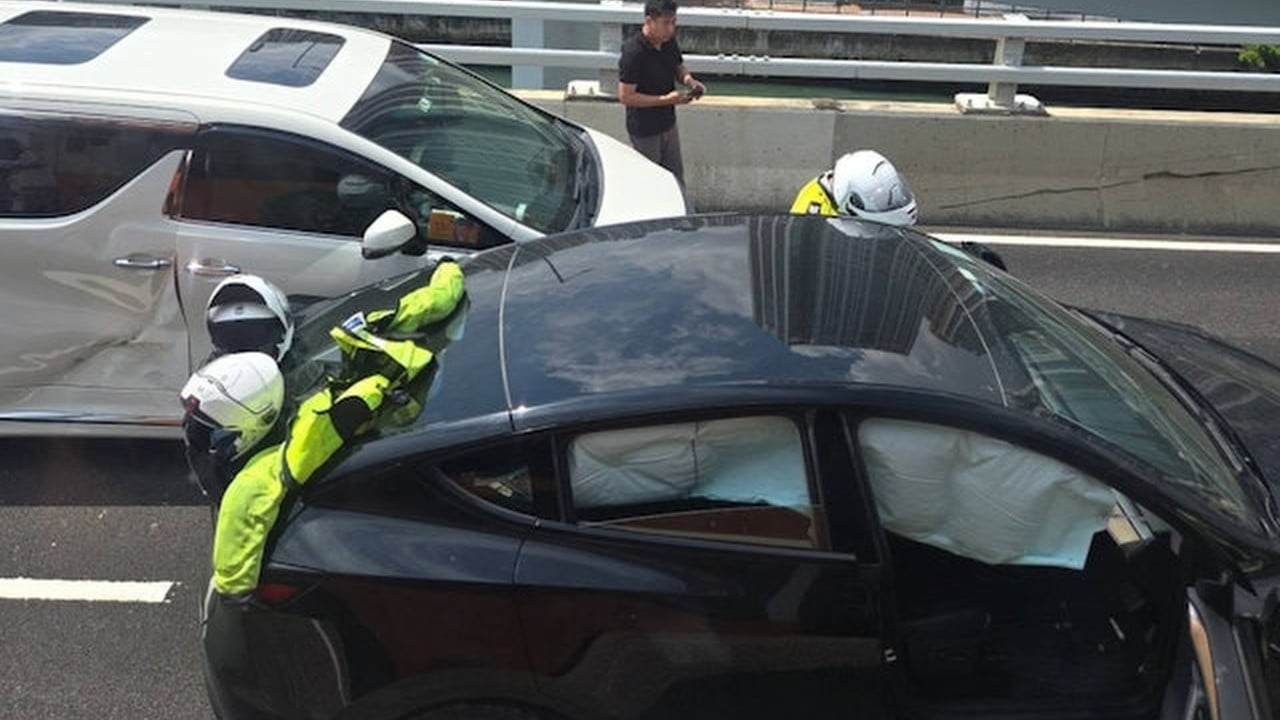
Details from the asphalt tell a brutal story. The car did not simply stop; it collided with two separate vehicles in a chaotic sequence of kinetic violence. Metal screamed against metal. Glass exploded into glittering dust that caught the headlights before settling on the road. And when the motion finally ceased, the silence that followed was heavier than the crash itself.
The driver was gone.
We read these headlines with a morbid, protective curiosity. We scan the text for age, for model numbers, for a hint of fault, desperate to draw an invisible line between the victim and ourselves. They were speeding. Their car was on autopilot. They made a mistake. We crave these distinctions because they allow us to slide behind our own steering wheels with a false sense of immunity.
(Note: While autonomous features and driver-assist technologies are frequently scrutinized in modern transit incidents, the exact operational state of the vehicle's software during this specific Hong Kong collision remains part of ongoing official investigations.)
Yet, the deeper narrative is not about a specific brand of electric car or the dense geography of a crowded Asian metropolis. It is about the profound vulnerability of human flesh inside rolling cages of steel and glass. We have engineered machines capable of accelerating with the force of a roller coaster, controlled by interfaces that mimic our smartphones, yet our nervous systems remain fundamentally unchanged since the Pleistocene epoch. Our reaction times are still anchored to biological impulses that take a quarter of a second just to travel from the retina to the brain.
Drive this route yourself at midnight, and you will understand the hypnosis of the modern commute. The city sprawls outward in a constellation of neon—emerald greens, hot magentas, and sodium yellows bleeding into the smog. The highway becomes a tunnel of light. It is easy to feel untouchable when surrounded by digital dashboards and adaptive cruise control. The car manages the spacing. The car monitors the lane. You are lulled into the dangerous belief that you are a passenger in your own life.
Then reality intrudes with the violence of a hammer blow.
Two cars. One electric sedan. A sudden loss of control on an expressway that has swallowed thousands of hurried stories over the decades.
We must confront the uncomfortable truth of our technological ambition. Every upgrade in vehicle safety, every leap in battery density, and every algorithm designed to make driving effortless creates a psychological trade-off. We trade active vigilance for passive comfort. We lean back. We trust the machine. And when the machine encounters a variable it cannot solve, or when human biology fails to override the system in time, the cost is absolute.
There is no neat moral to wrap around a tragedy like this. No clever concluding thought can resurrect a life snuffed out between two cars on a concrete corridor. The expressway was cleared within hours. The glass was swept away. The traffic resumed its relentless, pulsing rhythm, as if the earth itself were eager to heal over the wound.
Far down the road, another vehicle accelerates into the dark, its screen glowing softly in the driver's face, casting a pale blue light against the windshield while the world rushes past unseen.