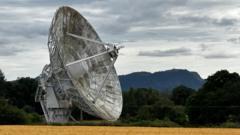
Every time a legacy radio telescope faces the chopping block, the same tired script plays out. Academics wring their hands. Headlines warn of a "dark age" for science. Activists launch petitions to save thousands of tons of aging steel and concrete.
It is an emotional, knee-jerk reaction to a non-problem.
The lazy consensus in scientific journalism laments budget cuts as the death of discovery. They treat every instrument built in the 20th century as a sacred monument that must be funded in perpetuity.
They are wrong. Keeping geriatric telescopes on life support does not save science. It suffocates it.
The brutal reality of astrophysics is that capital is finite. Every dollar spent maintaining a rusted dish with a paint job from the 1980s is a dollar stolen from next-generation arrays, space-based observatories, and advanced computational pipelines. We need to stop romanticizing old iron and start clearing the deck for the future.
The Sentimentality Trap in Big Science
I have spent years watching institutions sink millions into facilities that have outlived their primary scientific utility. The argument for preservation always relies on nostalgia disguised as necessity. "But this dish discovered the first pulsar!" or "This facility mapped the galactic center!"
Great. Put a plaque on it. Then cut the power.
Science is not a museum curation project. It is an aggressive, iterative pursuit of high-fidelity data. When an instrument reaches the flat part of its utility curve, maintaining it is no longer an investment in research—it is a jobs program for a hyper-specialized zip code.
Consider the operational overhead. A legacy single-dish radio telescope requires massive mechanical upkeep: azimuth tracks warp, surface panels degrade, and cryogenic receivers break down. The cost per gigabyte of unique data plummets every year a machine ages past its prime. Meanwhile, modern interferometers—networks of smaller, smarter dishes linked by software—deliver angular resolutions that single-dishes cannot touch, even if you gold-plated their surfaces.
By fighting to keep every old facility open, the scientific community creates a bottleneck. We tie up young researchers in maintaining legacy hardware instead of training them on the software-driven architectures that dominate modern data collection.
The Flawed Premise of "Lost Data"
The loudest objection to decommissioning an observatory is the claim that we will miss critical cosmic events. "What if a supernova goes off and our telescope isn't looking?"
This argument misunderstands how modern astronomy actually works.
First, the sky is not under-sampled; it is under-processed. The bottleneck in astrophysics today is not a lack of photons. It is a lack of data pipelines and engineers capable of sorting through the petabytes of information we already capture. The Square Kilometre Array (SKA) and the Next Generation Very Large Array (ngVLA) are designed to generate more raw data in a few weeks than older observatories produced in decades.
Imagine a scenario where a university spends $5 million a year to keep a single 70-meter dish operational. That dish might observe one target at a time, providing incremental improvements on a well-studied radio source. Now imagine redirecting that same $5 million into cloud computing infrastructure or custom silicon for real-time signal processing on an active interferometer array. The return on investment is not even close.
We are trading massive, field-wide leaps in capability for local, sentimental comfort.
The Downside of Moving On
To be fair, shuttering a legacy facility does carry a real cost. The transition is never completely painless, and honesty demands acknowledging what we actually lose.
- Loss of dedicated monitoring: Some old telescopes excel at long-term, low-priority monitoring of variable sources. New arrays are highly competitive; getting time on them is a cutthroat process. When an old dish dies, those niche, decades-long monitoring projects often die with it.
- Geographic dead zones: Astronomy relies on baseline distance. If you remove a telescope from a specific latitude or longitude, you subtly alter the geometry of global Very Long Baseline Interferometry (VLBI) networks.
- Human disruption: Teams of engineers who know the quirks of a specific 40-year-old gear system cannot just be copied and pasted into a software-defined radio lab. Talent gets displaced.
But these downsides are the price of progress. Minimizing them through endless funding extensions only delays the inevitable and drives up the ultimate cost of modernization.
Stop Asking if We Should Save It
The public, and many scientists, ask the wrong question. They look at a threatened observatory and ask, "Is this telescope still useful?"
Of course it is useful. Any instrument capable of detecting radio waves can find something to do.
The correct question is: "Is this telescope the most efficient use of this capital to answer our highest-priority cosmological questions?"
More often than not, the answer is a definitive no.
If we want to understand dark energy, map the cosmic dawn, or find signatures of life on exoplanets, we cannot get there by clinging to the tools of our parents. The institutions that survive and drive the next century of discovery will be the ones that learn to kill their darlings.
Unplug the dishes. Melt down the steel. Build what comes next.