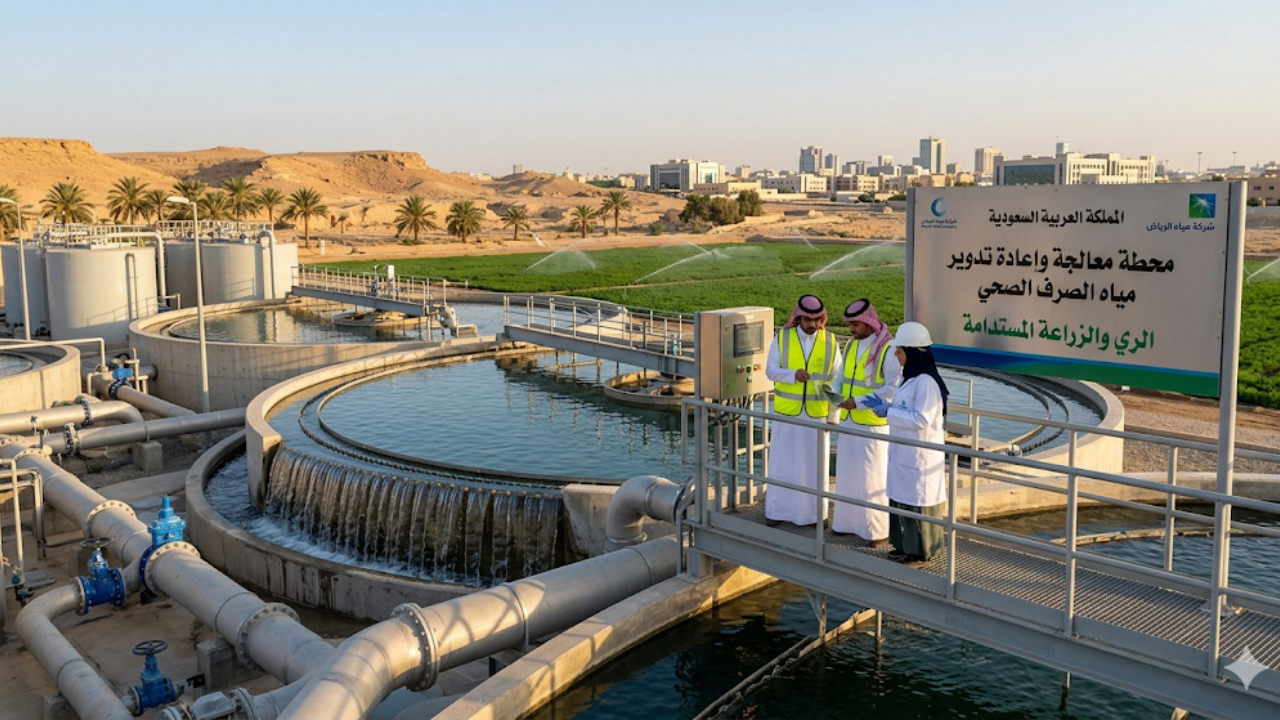
The PR machine loves a "green desert" narrative. It is easy to sell, looks great on Instagram, and feels like a victory over nature. The standard story regarding Saudi Arabia’s wastewater initiatives—specifically the North Riyadh project and the massive afforestation efforts under the Saudi Green Initiative—is that the Kingdom is "recycling" its way to a lush paradise.
That story is a distraction.
If you think the primary goal of piping treated sewage effluent (TSE) into the desert is to make things look pretty or to "save the planet" through carbon sequestration, you have been sold a superficial bill of goods. This isn’t about aesthetics. It isn't even primarily about the environment.
This is an aggressive, multi-billion dollar play in resource arbitrage and infrastructure resilience.
The conventional wisdom says Saudi Arabia is "using waste to create life." The harsh reality is that they are using life (trees) to store and manage an increasingly volatile commodity: water. In a region where every drop is manufactured via energy-intensive desalination, letting water flow into the sea or evaporate is a fiscal crime.
The Thermodynamics of the Desert Mirage
To understand why the "green corridor" narrative is flawed, we have to look at the energy math. Most people assume that planting millions of trees in a hyper-arid climate is a net positive for the environment. It is actually a massive engineering burden.
Desalination is the heartbeat of the Kingdom. It is a process of turning electricity (or heat) into fresh water. When a citizen in Riyadh flushes a toilet, that water represents a significant investment of Joules. In the old model, that water was treated and then dumped.
[Image of the thermal desalination process]
Dumping treated water is a literal drain on the national treasury. But you can't just stop producing wastewater; as the population grows, the volume of "urban runoff" scales linearly. You have a massive, constant stream of liquid capital that needs a home.
The "Green Corridor" is not a forest. It is a distributed biological sponge.
By creating massive plantations of Prosopis juliflora and Acacia, the Kingdom is creating a sink for its secondary resource. These aren't "wild" forests. They are highly managed industrial systems designed to keep the water table pressurized and to prevent the collapse of urban drainage systems.
The Myth of the Carbon Sink
Let’s dismantle the biggest lie in the competitor’s playbook: the idea that these desert forests are a meaningful solution to global carbon levels.
Trees in the desert require constant irrigation. In a natural forest, the ecosystem is a net carbon sink because the water falls for free. In Riyadh, the water used to keep those trees alive has a carbon footprint. You have to pump the water from treatment plants, maintain the pressurized pipe networks, and manage the filtration.
If the energy used to move and treat that water comes from fossil fuels—which it still largely does—the "green" corridor might actually be carbon-neutral at best, or a net-negative at worst.
I have seen municipalities spend fifty dollars in energy costs to sequester ten dollars worth of carbon. It is a shell game. We call it "Green Theater." If the goal were truly carbon capture, the Kingdom would be better off investing that capital into Carbon Capture and Storage (CCS) at the source of their industrial plants rather than trying to force biology to do the work in a 50°C environment.
Why TSE is the New Crude
The real story isn't the trees. It’s the Total Dissolved Solids (TDS) and the infrastructure of the circular economy.
Saudi Arabia is moving toward a "Quadruple Bottom Line" where Treated Sewage Effluent (TSE) is treated as a strategic reserve. By building these green corridors, they are essentially creating a massive "outdoor laboratory" for water recycling technology.
The "lazy consensus" says this water is "reclaimed." A better term would be "upcycled."
- Industrial Feedstock: High-grade TSE is being diverted to cooling towers for power plants.
- Construction Grade: You don't need drinking water to mix concrete for NEOM.
- Agricultural Buffer: By using TSE for non-edible crops (like the trees in the green corridor), the Kingdom frees up precious groundwater for actual food security.
The "Green Corridor" is just the overflow valve. It’s where the water goes when the industry doesn't need it. It’s the buffer that keeps the entire system from backing up.
The Hidden Risk: The Salt Trap
Here is the nuance the "feel-good" articles miss: The Salt Accumulation Problem.
When you irrigate the desert with treated wastewater, the water evaporates, but the minerals stay behind. Over decades, you aren't just building a forest; you are potentially salinating the soil to the point of toxicity.
I’ve watched projects in the Southwest US and parts of Australia fail because they ignored the long-term chemistry of the soil. If Saudi Arabia doesn't manage the drainage and "flushing" of these green zones, they will end up with a salt crust that kills the very trees they planted.
To combat this, the engineering must be far more complex than just "digging a hole and planting a seed." It requires subsurface drainage systems and constant monitoring of soil salinity. This makes the "Green Corridor" one of the most expensive pieces of landscaping in human history.
The Economic Brutality of Beauty
Why do it then? If it’s energy-expensive, salt-risky, and carbon-dubious?
Urban Heat Island Mitigation.
This is the only "green" argument that holds water. A city like Riyadh is a concrete furnace. By using wastewater to create massive green belts, the government is trying to drop the ambient temperature of the city by several degrees.
$T_{actual} = T_{ambient} - \Delta T_{evapotranspiration}$
A 3°C drop in city-wide temperature results in a massive reduction in air conditioning demand. That is the real ROI. The "Green Corridor" is a giant, biological air conditioner powered by the city's own waste.
Stop Asking if it's "Sustainable"
The "People Also Ask" sections of the internet are obsessed with whether this is "sustainable." That is the wrong question. In the desert, nothing is sustainable in the traditional sense. Everything is a feat of engineering against a hostile environment.
The right question is: Is it efficient?
Currently, the global standard for wastewater reuse is pathetic. Most "developed" nations treat their water and dump it into the ocean. Saudi Arabia is at least attempting to extract every possible cent of value from a liter of water before it evaporates.
They are pivoting from a "linear consumption" model to a "looped resource" model. The trees are simply the most visible part of that loop. They are the marketing department for a very complex plumbing project.
The Verdict on the Green Desert
If you want to understand the future of the Middle East, stop looking at the leaves. Look at the pipes.
The green corridor isn't a sign that the desert is being "tamed." It’s a sign that the Kingdom has realized that in the 21st century, water is more valuable than oil, and "waste" is just a word for a resource you're too lazy to harvest.
The competitor's article wants you to feel warm and fuzzy about a desert forest. I want you to realize you are looking at a massive, biological machine designed for resource survival.
The forest is a byproduct. The water management system is the masterpiece.
If they succeed, they haven't just planted trees; they’ve rewritten the rules of how a civilization survives its own geography. If they fail, they’ve just built the world’s most expensive graveyard for Acacia trees.
Stop romanticizing the greenery. Start respecting the engineering.