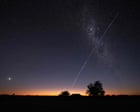
Space startups want to sell you the sun at midnight. It sounds like science fiction, but several companies are currently racing to launch giant orbital mirrors designed to reflect sunlight down to specific spots on Earth after dark. They claim it’s a green energy revolution. They say it’ll make solar farms productive 24 hours a day. I think they’re ignoring a massive, glowing problem. These satellite mirror plans aren't just about clean energy; they’re a direct threat to human health, wildlife, and our basic right to see the stars.
The pitch is simple. A constellation of thin, reflective membranes sits in low Earth orbit. When your city’s solar panels go dark, these mirrors tilt. They catch the sun’s rays from the other side of the planet and beam a "spotlight" down to the ground. Reflect Orbital, one of the main players in this space, recently demonstrated a prototype. It looks impressive on a pitch deck. But if you think about the physics for more than five minutes, the downsides become terrifying. For a closer look into similar topics, we recommend: this related article.
Why orbital mirrors are a biological nightmare
We didn't evolve to live in a world without darkness. Our bodies run on a circadian rhythm that’s hard-coded into our DNA. When blue light—the kind found in sunlight—hits your retinas, it suppresses melatonin. That’s fine at noon. It’s a disaster at 2 a.m.
If these mirrors become a common fixture, "true night" might vanish for millions. We aren't just talking about a little light pollution from a streetlamp. We're talking about a localized artificial day. Scientists at the University of Exeter and other institutions have spent years warning that even dim artificial light at night increases risks of obesity, depression, and sleep disorders. Imagine trying to sleep when a tech startup decides the solar farm three miles from your house needs a "booster shot" of high-intensity light. To get more background on this development, comprehensive analysis can also be found at Gizmodo.
It gets worse for the rest of the planet. Most of the world’s biodiversity is nocturnal. Insects, birds, and sea turtles rely on specific light cues to migrate, hunt, and mate.
- Migratory birds use the stars to navigate. Giant glints of artificial sun will send them off course, leading to exhaustion and death.
- Pollinators like moths, which do a huge chunk of the world’s heavy lifting, are famously disrupted by artificial glow.
- Predator-prey balances shift instantly when the darkness that provides cover suddenly disappears.
The solar energy myth
The marketing for these mirrors leans heavily on the climate crisis. "We need solar power at night to ditch fossil fuels," they argue. It’s a clever shield. Who wants to argue against renewable energy? But the math doesn't quite check out when you look at the scale required.
To actually power a city, you’d need hundreds, maybe thousands, of these mirrors. Space is already crowded. Adding thousands of massive, reflective sheets increases the risk of orbital collisions. If one of these mirrors gets hit by a piece of space junk, it doesn't just stop working. It turns into a cloud of reflective shrapnel. This is the "Kessler Syndrome" scenario—where a single collision starts a chain reaction that makes low Earth orbit unusable for everyone. No GPS. No weather tracking. No internet.
There’s also the efficiency question. We already have better ways to store solar energy. Battery technology is moving at a breakneck pace. Pumped hydro and thermal storage are proven. Launching a mirror into space is expensive, risky, and creates a massive carbon footprint before it even reflects its first photon. It’s a high-tech "solution" searching for a problem that we've already started solving on the ground.
Losing the stars forever
Ask an astronomer about this and you'll see a look of pure dread. We’re already struggling with "mega-constellations" like Starlink. Those satellites are small and only reflect light incidentally. These mirrors are designed to be bright.
If this technology scales, the night sky will no longer belong to humanity. It’ll be a billboard for whoever has the most capital. Every telescope on Earth will have to deal with massive streaks of light ruining data. We’re basically building a cage of light around our planet. It’s a form of environmental colonization. A few companies get to decide that "darkness" is a waste of resources, and the rest of us lose the ability to look up and wonder.
The regulatory vacuum
Right now, space is the Wild West. There aren't many international laws that stop a company from parking a mirror over your head. The Outer Space Treaty says space is for all mankind, but it doesn't say much about light pollution.
National governments are usually slow to react to tech trends. By the time we realize the birds have stopped singing and nobody can sleep, the mirrors will already be up there. We’ve seen this play out with social media and AI. Move fast, break things, and apologize later. But you can't "undo" a ruined ecosystem or a disrupted atmosphere quite as easily as you can delete an app.
What happens next
Don't wait for a giant mirror to appear in your backyard. The conversation is happening now in policy circles and tech forums. We need to demand that "darkness" is recognized as a natural resource worth protecting.
If you care about the environment, stop letting startups frame this as a green initiative. It isn't. Real green energy works with the planet's cycles, not against them. Supporting local dark-sky initiatives and pushing for stricter orbital regulations is the only way to keep the sun where it belongs at night—on the other side of the world. Darkness is essential. It’s time we treated it that way. If we don't, the next generation might grow up thinking the stars are just glitches in a corporate light show.
The push for orbital mirrors is a gamble with our biology and our environment. It’s a shiny distraction from the hard work of building better batteries and smarter grids right here on Earth. Let the sun set. We’ve earned the rest.