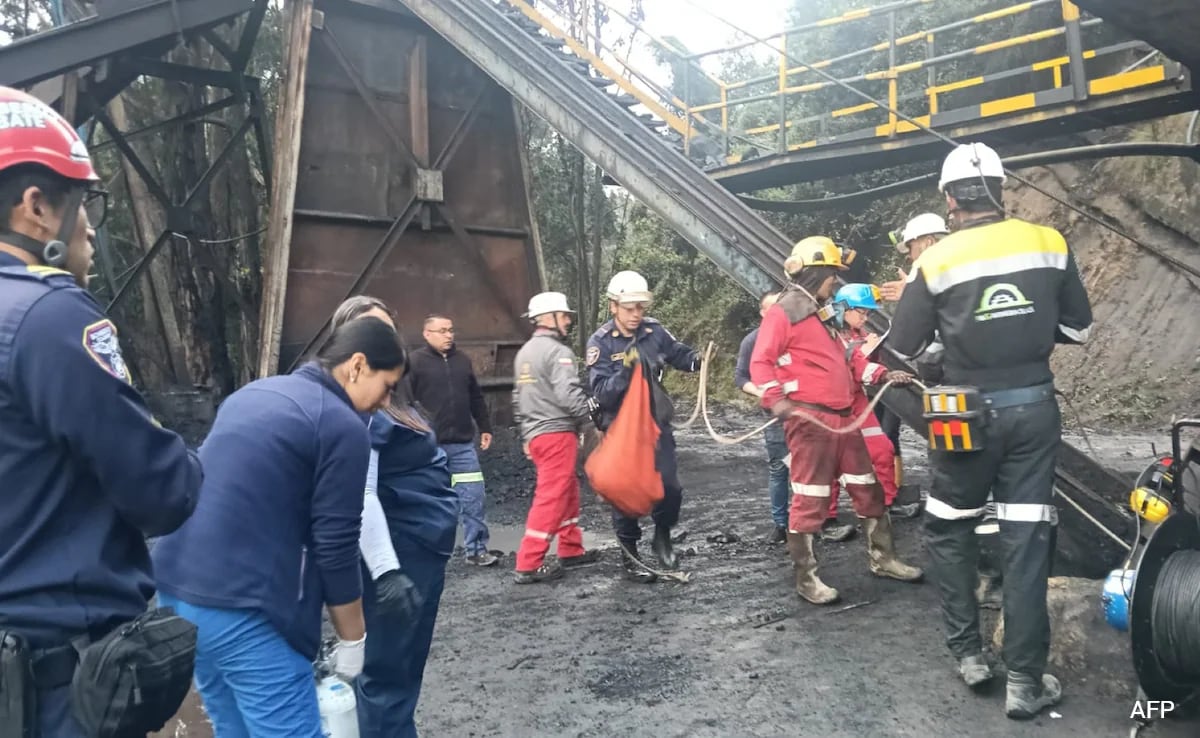
The headlines regarding the latest disaster in Cundinamarca follow a script so tired it’s practically automated. Nine miners dead. A buildup of methane gas. An "unfortunate tragedy." Local authorities express shock, and the industry bows its head in a performative moment of silence.
This isn't a tragedy. It’s a math problem that someone decided was too expensive to solve. If you liked this post, you should read: this related article.
The "lazy consensus" pushed by mainstream reporting and corporate PR departments is that deep-vein mining is inherently volatile and that gas pockets are invisible ghosts that strike without warning. That is a lie. We have the sensor technology, the ventilation physics, and the historical data to ensure that a methane explosion in 2026 is as rare as a steam engine explosion on a modern railway. Yet, men are still being vaporized in the dark.
The False Gospel of "Gas Buildup"
When you read that an explosion was caused by "gas buildup," the subtext is usually "an act of god." The industry wants you to believe that methane is a sentient, malevolent force that sneaks up on unsuspecting crews. For another look on this development, check out the recent coverage from The Guardian.
Methane ($CH_4$) is predictable. It has a specific explosive range—the Lower Explosive Limit (LEL) is 5%, and the Upper Explosive Limit (UEL) is 15%. Anything in between is a bomb waiting for a spark. In a properly managed mine, reaching the LEL should be impossible.
The failure in Colombia, and in dozens of similar operations globally, isn't a failure of geology. It’s a failure of atmospheric management. If the gas reached 5%, the ventilation systems had already failed hours, if not days, prior. To blame the "buildup" is like blaming the water for a person drowning in a pool with no lifeguard and a broken drain.
The Cost of "Acceptable" Risk
I’ve sat in boardrooms where the "Safety First" posters on the wall were paid for by the same budget that slashed maintenance on scrubbers and intake fans. There is a brutal, unspoken calculation in the extraction industry: the cost of a total shutdown to remediate gas levels versus the statistical probability of an ignition event.
Most "accidents" are actually delayed maintenance projects.
- Ventilation Short-circuiting: Air is lazy. It takes the path of least resistance. If your stoppings and seals are leaking, the fresh air never reaches the face where the miners are actually cutting coal.
- Sensor Neglect: Multi-gas detectors are not "set and forget" tools. They require bump testing and calibration. In high-pressure production environments, these checks are the first thing to go.
- The Spark: You can have all the methane in the world, but you need an ignition source. This usually comes from "permissible" equipment that has been modified or poorly maintained, allowing a tiny arc to meet the gas.
If a mine explodes, it means at least three redundant safety layers were bypassed or ignored.
Dismantling the "People Also Ask" Nonsense
Is coal mining getting safer?
The data says yes, but the data is skewed by the closure of smaller, more dangerous mines in developed nations. In regions like Cundinamarca or the Donbas, the risk profile hasn't shifted in thirty years. We are simply exporting the body count to places with lower regulatory overhead.
Can technology stop methane explosions?
We have methane drainage systems that can vacuum the gas out of the coal seam before a single pickaxe touches the wall. We have automated, fiber-optic sensor arrays that can shut down all power to a mine the millisecond a 1% concentration is detected. The question isn't "can we?" It’s "who is going to pay for it?"
The Industry’s Dirty Secret: The Methane Drainage Gap
The gap between a "legal" mine and a safe mine is wide enough to bury nine men.
In many jurisdictions, the law requires "adequate ventilation." That is a subjective, toothless phrase. High-producing mines generate methane at a rate that standard ventilation cannot dilute fast enough. The only solution is pre-drainage—drilling boreholes from the surface or from adjacent galleries to bleed the seam dry.
This process is slow. It’s expensive. It yields no immediate coal. Therefore, it is often skipped in favor of "ventilation-only" strategies that work—right up until they don't.
Stop Calling Them Accidents
An accident is a tree falling on a car during a freak storm. An explosion in a coal mine is a systemic mechanical failure.
When a plane crashes, the NTSB doesn't say "well, gravity is dangerous." They find the specific bolt that sheared or the specific sensor that drifted. They find the human who signed off on the faulty part. In mining, we allow "gas buildup" to be the beginning and the end of the conversation.
We treat these men like martyrs for the global energy supply. They aren't martyrs. They are victims of a spreadsheet that decided their lives were a variable expense.
The Actionable Reality
If you are an investor, a regulator, or a tech provider in this space, stop looking at "Safety Culture" and start looking at "Safety Infrastructure."
- Mandatory Automated Power-Off: Remove the human element. If a sensor hits 1.5%, the mine goes dark. Period. No "checking the reading," no "re-calibrating."
- Publicly Verifiable Gas Logs: Atmospheric data should be streamed to a third-party, immutable ledger. If the gas was rising for six hours before the blast, the world should know in real-time, not six months later during a sanitized inquiry.
- Criminal Liability for Ventilation Engineers: If a bridge collapses, the engineer is held to account. If a mine explodes, the "company" pays a fine that represents 0.01% of its quarterly revenue.
The status quo remains because the consequences of failure are cheaper than the cost of prevention.
Every time you hear about a "gas buildup," remember: someone knew the gas was there. Someone saw the needle move. Someone decided that the next ton of coal was worth the gamble.
Stop mourning the "unforeseeable" and start prosecuting the predictable.