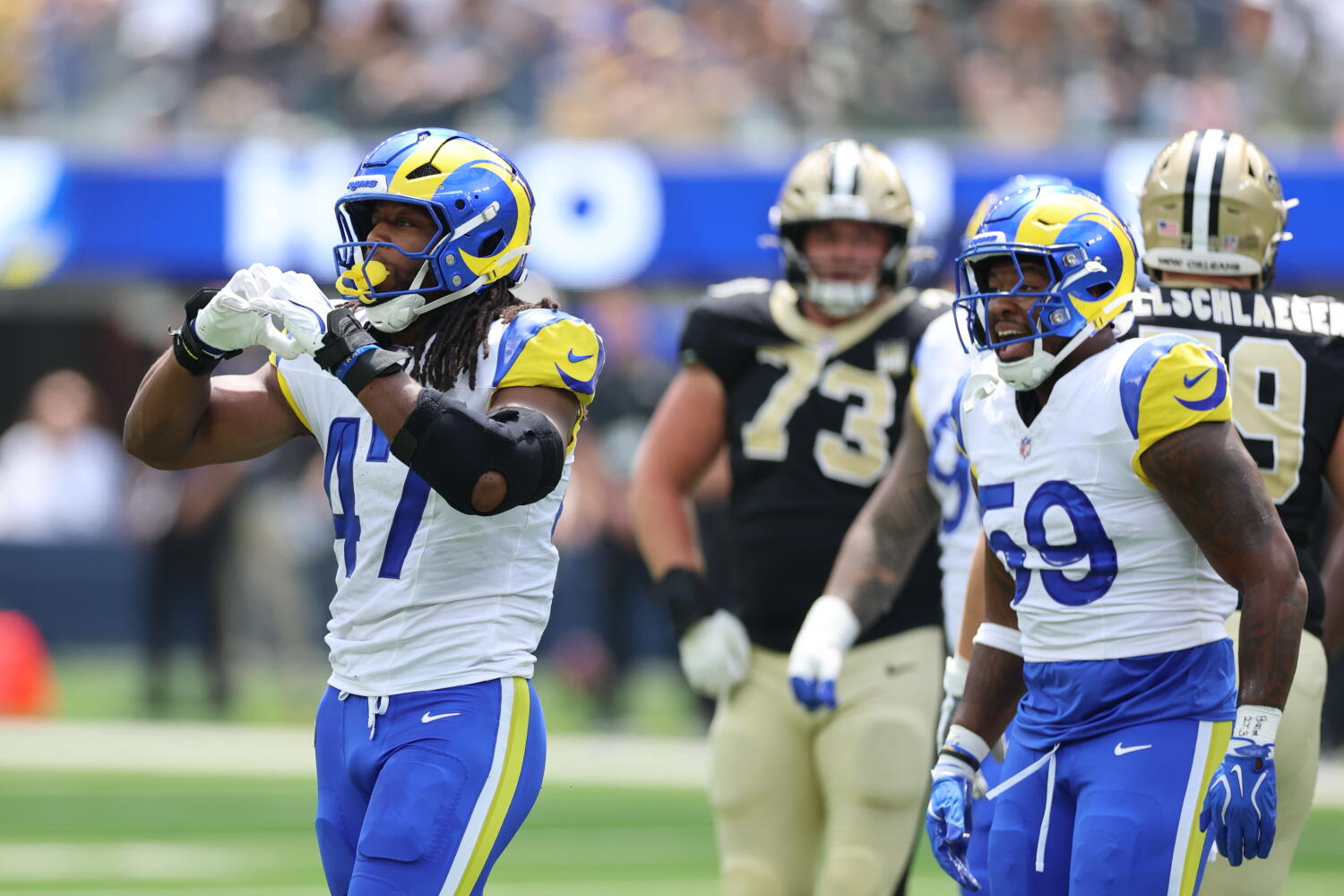
National Football League roster construction is a zero-sum exercise dictated by strict salary caps, positional value curves, and developmental cost functions. When the Los Angeles Rams finalized their initial fifty-three-man roster, the inclusion of undrafted rookie edge defender Wesley Bailey offered a case study in how front offices exploit structural inefficiencies to acquire cheap, high-ceiling assets. Standard media narratives attribute such achievements entirely to grit or training camp overperformance, ignoring the mathematical constraints and economic levers that actually govern modern personnel decisions.
Evaluating how an undrafted player beats the statistical probability curve requires moving past surface-level observations and examining the underlying variables of positional scarcity, financial arbitrage, and athletic profile matching. Also making news lately: Aaron Donald and the Desperate Calculus Behind an NFL Return.
The Cost Function of Edge Roster Spots
Front offices allocate roster real estate based on a sliding scale of financial cost versus performance output. Premium positions such as quarterback, offensive tackle, and edge rusher consume disproportionate amounts of salary cap space in the veteran market. Consequently, finding low-cost contributors at these positions is vital to maintaining overall roster balance.
Total Roster Value = (Elite Veterans * Market Rate) + (Rookie Contracts * Draft Capital Discount) + (UDFA Assets * Minimum Cost Basis)
An undrafted free agent signed to a standard rookie minimum contract occupies the lowest possible tier on the financial cost function. To justify displacing a drafted player or a veteran with guaranteed money, that undrafted prospect must clear a specific threshold of expected marginal value. Additional insights into this topic are detailed by Sky Sports.
- Cap Space Efficiency: The financial delta between a third-day draft pick and an undrafted free agent is marginal in year one, but the absence of signing bonus guarantees provides absolute roster flexibility. Cutting an undrafted player incurs zero dead cap penalty.
- The Replacement Threshold: Teams evaluate whether a back-end edge rusher provides higher value as a situational pass rusher or as a core special teams contributor. Bailey secured his spot by demonstrating traits along the physical dimension that cannot be easily coached, forcing the front office to prioritize his upside over safer, more limited veteran profiles.
Athletic Parameters and Morphological Fit
Draft evaluators heavily weigh pre-draft measurables because physical traits translate more reliably from the collegiate level than specific scheme execution. Standing at roughly six-foot-five and weighing 265 pounds with an expansive wingspan, Bailey presented an athletic baseline that matched the physical profile teams desire on the edge.
The transition from college football to the professional level exposes deficiencies in leverage and hand technique, but raw functional length allows a defender to compensate during the initial adjustment period. Front offices look for specific athletic indicators during pro days and private workouts:
- Burst Metrics: The ten-yard split dictates whether a player can cross the face of an offensive tackle before the blocker sets an anchor.
- Center of Gravity Management: Taller edge defenders must prove they can dip beneath the offensive tackle's hands to turn the corner.
- Functional Density: The ratio of lean mass to total weight determines durability through a seventeen-game regular season.
When an undrafted player exhibits verified metrics in these categories, coaching staffs calculate that technical deficiencies can be corrected through professional development regimens. The physical traits serve as the floor of the evaluation; scheme comprehension serves as the ceiling.
Positional Depth Charts and Variance Management
Roster decisions at the conclusion of the preseason are rarely made in a vacuum. They are deeply influenced by the health status of the broader position group and the need to hedge against variance.
The Rams entered the roster cutdown period managing a dynamic edge group that included high-cost anchors and developing prospects. When constructing the back end of a position room, front offices optimize for skill-set diversity rather than duplication. If the top-tier edge defenders rely primarily on speed-to-power rushes, the final spot often goes to a player who offers a different tactical angle, such as bend or length-based extension.
Furthermore, teams evaluate the waiver wire liquidity. If a coaching staff attempts to expose an undrafted rookie to waivers to stash him on the practice squad, the probability of another franchise claiming him depends on how many other teams scouted those same traits during the pre-draft process. Bailey's strong performances in preseason games eliminated the possibility of safely navigating waivers. Retaining him on the active roster was the only mechanism to prevent loss of the asset to a competitor.
Strategic Execution for Roster Optimization
The mechanics of retaining an undrafted rookie on an initial roster reflect a broader organizational philosophy regarding asset accumulation. Teams that consistently outperform their draft capital rely on a continuous churn of the bottom quartile of their roster, seeking high-variance profiles that can outproduce their acquisition cost.
The primary constraint on any front office is time—both developmental time for the player and evaluation time for the coaching staff. By committing a fifty-three-man roster spot to an undrafted edge defender, the organization signals a belief in the player's developmental trajectory past the initial September threshold. Future performance will depend entirely on whether that foundational athletic profile can be converted into consistent pass-rush productivity when snap counts matter.