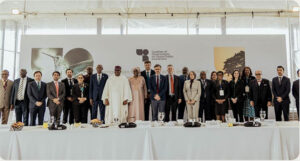
The air conditioning in the ministerial suite of the Jakarta convention center had failed, leaving a heavy, tropical humidity to settle over the mahogany table. It was three in the afternoon. For hours, a senior diplomat from a prominent Western capital had been lecturing a room of Southeast Asian and African trade officials about compliance, structural adjustments, and the rigid architecture of global finance.
He spoke with the casual confidence of someone who believed the rules of the world were written in stone.
Across the table sat a woman we will call Amina. She is a real person, a veteran trade negotiator from a resource-rich African nation, though her name has been changed here to protect her ongoing diplomatic work. Amina did not interrupt. She simply adjusted her glasses, waited for the diplomat to finish his presentation, and then closed her folder with a soft, deliberate click.
"We understand how your banks work," Amina said, her voice quiet but carrying clearly across the humid room. "We have spent fifty years borrowing from them on your terms. But you seem to forget. You need our lithium to power your green transition. We no longer need your permission to sell it."
The silence that followed was absolute.
In that single, unscripted moment, the illusion of the old world order cracked. For decades, international cooperation looked like a lecture. The Global North wrote the rules, managed the institutions, and handed down the templates for development. The Global South listened, signed on the dotted line, and managed the fallout.
That era is over. A profound, quiet revolution is unfolding across Latin America, Africa, Asia, and the Middle East. It is not an armed rebellion, nor is it a loud, ideological crusade. It is something far more formidable: a calculated, pragmatic redesign of how nations talk, trade, and survive together.
The Ghost in the Financial Machine
To understand why this shift is happening now, we have to look at the invisible plumbing of international life. Consider the simple act of a country trying to build a bridge or protect a coastline from rising sea levels.
For half a century, the playbook was identical. A government in the Global South would approach Washington or Brussels. They would apply for a loan from institutions established in the wake of World War II. Then came the strings. To qualify for the money, these nations were frequently forced to slash public spending, privatize state industries, and open their markets to foreign corporations.
It was a system built on a fundamental asymmetry. If you were poor, you traded your sovereignty for capital.
The human cost of this system was rarely recorded in the pristine ledgers of global banking. It was felt instead by the mother in Lusaka who saw her local clinic lose its funding because of a macroeconomic stabilization target. It was felt by the smallholder farmer in Peru whose traditional crops were undercut by heavily subsidized agricultural imports from wealthier nations.
For generations, these costs were accepted as the price of entry into the global modern age. There was, as the old political consensus insisted, no alternative.
But the world changed while the legacy institutions remained frozen in time. Today, the economic output of the BRICS nations surpasses that of the G7. The countries once patronizingly labeled as the "developing world" now hold the keys to the future. They possess the critical minerals required for the technology sector, the youthful demographics that aging northern societies lack, and the geographic choke points of global trade.
They are no longer begging for a seat at the table. They are building their own room.
The New Architecture of Autonomy
This redesign is not about isolation. No one is pulling down the shutters or retreating into autarky. Instead, leaders across the Global South are practicing a sophisticated form of diplomatic calculus.
Think of it as geopolitical diversification.
When a modern African or Latin American state needs infrastructure funding, it no longer makes a single, desperate pilgrimage to the International Monetary Fund. It compares options. It looks at the New Development Bank based in Shanghai. It considers bilateral agreements with Middle Eastern sovereign wealth funds. It evaluates regional development banks that operate without the lecturing tone of traditional Western lenders.
This is not a matter of swapping one master for another, as some anxious commentators in Washington suggest. It is about creating competition where a monopoly once existed.
Consider what happens when a country can choose its partners. The terms change. The strings unravel. Suddenly, international cooperation becomes a true negotiation between peers.
We see this vivid transformation in the rapid expansion of local currency trade. For decades, the US dollar was the undisputed oxygen of global commerce. If Kenya wanted to buy fertilizer from Indonesia, both nations had to convert their currencies into greenbacks first, paying transaction fees to Western intermediary banks and leaving themselves vulnerable to the monetary policy decisions of the Federal Reserve.
Today, that financial dependency is being systematically dismantled. Nations are signing direct currency swap agreements, trading in rupees, yuan, reals, and dirhams. It is a technical adjustment with radical implications. It means a factory owner in Jakarta or a farmer in Mombasa is no longer entirely at the mercy of inflation trends in a country thousands of miles away.
When the Script No Longer Works
The traditional arbiters of global politics are watching this transformation with a mixture of confusion and alarm. For years, the standard response to dissatisfaction from the Global South was to promise reform. There would be speeches about updating voting shares at the World Bank, or vague pledges to include more diverse voices in global forums.
But these promises began to feel like an endless series of committees designed to delay actual change. The old powers wanted to reform the system just enough to keep it the same.
The turning point arrived when the rhetoric of global solidarity clashed with reality during recent global crises. When life-saving medical supplies and technologies were hoarded by wealthy nations during the pandemic, the lesson was carved deep into the consciousness of leaders across the Global South. When climate change negotiations repeatedly yielded grand promises of financial aid that failed to materialize, the message became unmistakable.
You are on your own.
This realization brought an end to the era of romantic third-worldism. The new leadership of the Global South is clear-eyed, unsentimental, and fiercely transactional. They are not joined by a shared ideology, but by a shared geography of exclusion and a mutual desire for self-determination.
They are redefining what it means to be a global power. It is no longer about who has the largest blue-water navy or the most dominant cultural exports. It is about who can build the most resilient networks of survival.
The True Stakes of the Re-Ordering
It is tempting to view these shifts purely through the lens of statistics, trade volumes, and diplomatic communiqués. But that misses the point entirely. The real story is measured in human dignity and the return of agency to places that were denied it for centuries.
It is found in the confidence of a new generation of diplomats who grew up in independent, economically vibrant capitals rather than colonial dependencies. They speak the language of international law with absolute fluency, and they are using that language to dismantle the double standards that have long compromised global governance.
When these leaders look at international cooperation now, they see a landscape that must be negotiated on equal terms. They are forcing a recognition that there is no single, universal path to development, and that a system cannot be truly stable if it serves only a fraction of the world's population.
The old world was simple, hierarchical, and deeply unequal. The world being built by the leaders of the Global South is complex, fragmented, and unpredictable. It is a world where power is distributed rather than concentrated, where alliances are fluid rather than fixed, and where no single capital can dictate the destiny of the human race.
Back in that humid conference room in Jakarta, after Amina had spoken, the Western diplomat looked down at his papers. He did not argue. He did not counter with a policy directive or a warning about credit ratings. He couldn't. The old scripts had run out of lines, and the new story of the world was already being written right in front of him.