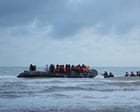
The salt spray off Dover does not care about manifestos. It hits the bow of a rigid inflatable boat with the force of a cold fist, soaking through cheap nylon jackets and freezing the marrow of fingers that have clutched nothing more secure than a cell phone screen for weeks.
To a person standing on the cliffs of Kent, watching the grey chop heave beneath a sullen sky, the English Channel is a watery boundary. To the men and women crammed thirty deep into rubber hulls designed for eight, it is a narrow, terrifying bridge between a life that has already ended and a future that refuses to begin.
Lately, however, the water has become something else entirely. It has turned into a chalkboard for political arithmetic.
A debate erupted in Westminster that stripped away whatever thin veneer of diplomatic caution remained in the immigration conversation. It began with Robert Jenrick, a prominent voice on the British political right, staking out a position that pushed past the usual vocabulary of deterrence. He argued for an escalation so stark it jolted even seasoned parliamentary watchers: the theoretical introduction of lethal force in extreme scenarios to stop migrant boats from reaching British shores.
The assertion hung in the air like gunpowder. It forced a reaction from Nigel Farage, the leader of Reform UK, who found himself walking a narrow ridge. Farage denied that his party would advocate for troops to shoot at small boats, seeking to distance his movement from the blood-chilling literalism of Jenrick’s premise while still projecting an image of unyielding iron at the frontier.
Politics loves a spectacle. But behind the podiums and the dueling television interviews lies a chilling reality: when the discourse descends into discussions of bullets and blockades, we have stopped talking about human beings. We are talking about targets.
Consider what happens on a typical night three miles off the coast of Dungeness.
The wind drops, just for an hour. The water flattens into a greasy sheet. In the dark, an outboard motor coughs into life. It is an old Yamaha, bolted to a transom that is already splintering. The fuel tank is half-full of a dirty mix of petrol and seawater.
In the bow sits a twenty-two-year-old former accountant from Damascus who has forgotten what it feels like to sleep without the sound of artillery shaking his teeth. Behind him is a teenager from Sudan who lost his entire family in an afternoon of smoke and screams. They do not know what the word deterrence means. They do not read the Daily Mail. They do not watch the BBC political shows where men in well-tailored suits debate whether their vessel constitutes a national security threat or a humanitarian crisis.
They know only one metric: the white cliffs of Dover, glowing faintly under the light pollution of the southeast coast.
When politicians invoke military language—when they toss around phrases like "lethal force," "rules of engagement," and "border defense"—they are performing a dangerous psychological trick. They are transforming a chaotic, desperate maritime rescue operation into an active combat zone.
Language creates reality. If you call a refugee a combatant, soon enough you start talking about how to neutralize them. If you frame a leaky rubber dinghy as an invading armada, the public stops picturing shivering children wrapped in foil blankets and starts picturing hostile combatants storming a beachhead.
This is the rhetorical architecture that allowed Jenrick’s claim to find oxygen. It is the same architecture that forces leaders like Farage to dance on the head of a pin, denying the extreme outcome while capitalizing on the anger that birthed it.
The public is angry. That is not a secret. Towns along the southeast coast have borne the immediate, visible weight of an asylum system that feels perpetually on the verge of structural collapse. Local hotels are booked out for months. Public services are stretched thin. Residents feel ignored by a distant capital that seems entirely disconnected from the realities of their daily lives.
Politicians tap into that raw, legitimate frustration. But instead of offering functional administrative solutions—faster processing, streamlined legal pathways, effective international cooperation—they reach for the theatrical hammer. They offer the fantasy of the iron fist.
Shoot them. Turn them back. Stop them by any means necessary.
It plays well on a thirty-second clip for social media. It cuts through the white noise of parliamentary procedure. But it collapses the moment it encounters the cold salt water of reality.
No British soldier, standing on the deck of a Border Force cutter in the freezing dark, is going to open fire on a boat full of unarmed civilians. No commander in their right mind would issue that order, and no legal framework under British or international law would survive its execution. It is a rhetorical ghost—a phantom conjured to signal toughness to an electorate that is tired of feeling helpless.
Yet ghosts leave footprints. By even introducing the concept of lethal force into the conversation about small boats, the debate crosses a moral Rubicon. It normalizes the unthinkable. It suggests that human life has a sliding scale of value, dependent entirely on which side of an arbitrary line of latitude one happens to be born on.
We have been down this road before. History is littered with the wreckage of societies that allowed their fear of the outsider to erode their commitment to basic humanity. It always starts with the language. First, they are illegal. Then, they are a flood. Then, they are a security threat. And finally, in the fevered imaginations of political shock-jocks, they are legitimate targets for the military.
Step back from the microphones in Westminster. Look at the water.
The small boat is drifting now. The engine has died, choked by salt and poor maintenance. The passengers are bailing water out with their bare hands, using empty plastic water bottles cut in half. Their fingers are blue. Their teeth are chattering so hard they can barely speak.
A Royal National Lifeboat Institution vessel cuts through the dark, its powerful searchlight slicing across the waves, catching the terrified faces in the bow. The crew on that lifeboat do not care about political debates. They do not care about poll numbers or party manifestos or the rhetorical posturing of leadership contenders.
They throw a line.
That is the true frontline of this crisis. Not the television studios, not the parliamentary committee rooms, but the dark water where men and women risk everything for a second chance at breathing.
Until our leaders find the courage to speak about these human beings with honesty rather than theater, the shadow of the trigger will hang over the Channel. And the water will remain what it has always been: deep, cold, and indifferent to our politics.