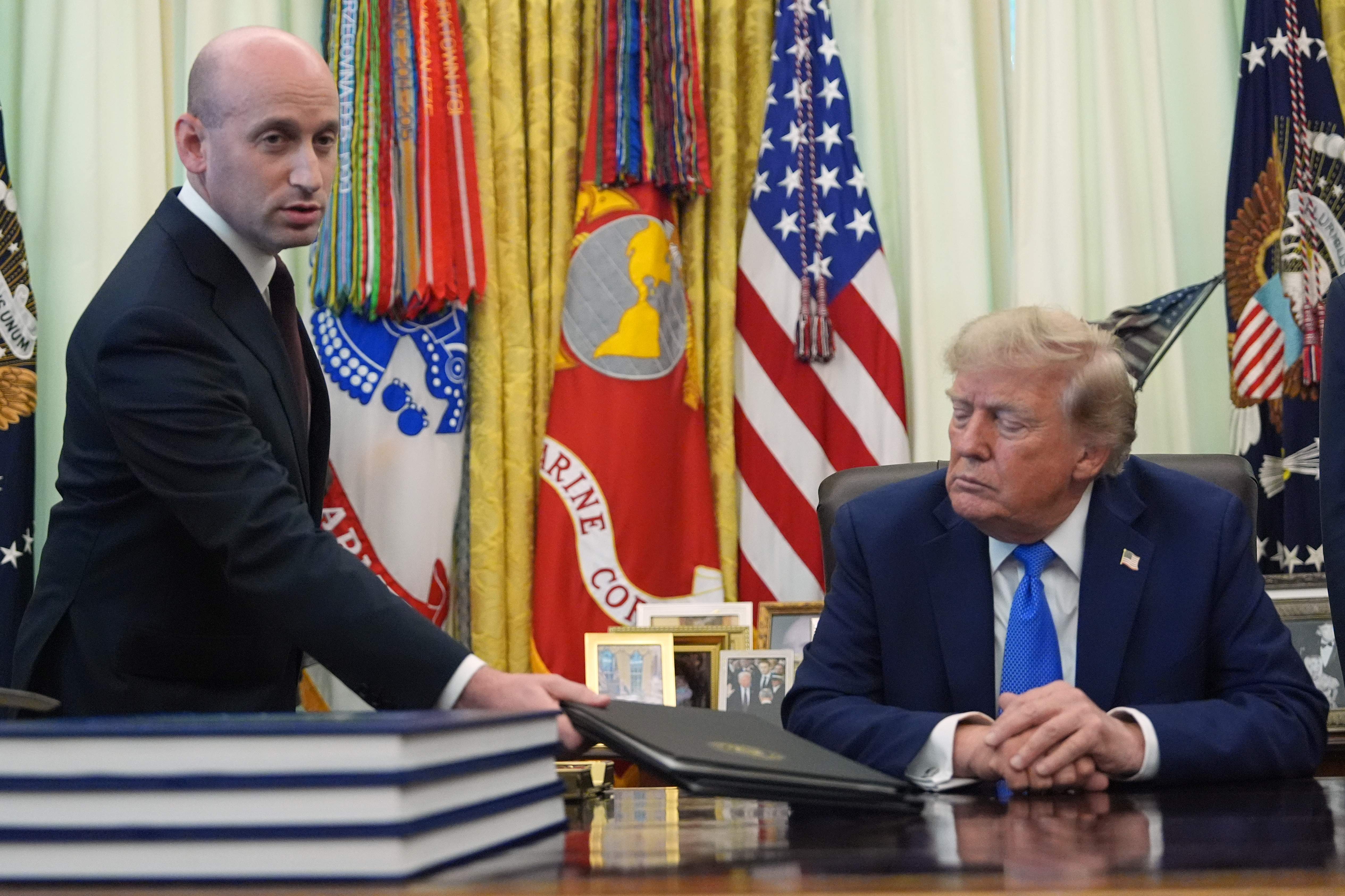
Washington pundits are hyperventilating. Again.
The standard beltway take on Donald Trump replacing Susie Wiles with Stephen Miller as White House Chief of Staff reads like a predictable soap opera script: the adult leaves the room, the ideological firebrand takes the wheel, and the West Wing descends into chaos. Don't miss our previous article on this related article.
That consensus is not just lazy. It is fundamentally wrong about how modern executive power actually functions.
Legacy media analysts evaluate White House Chiefs of Staff using a 1990s corporate playbook. They obsess over "process," "gatekeeping," and "bipartisan smoothing." They treat the West Wing like a Fortune 500 boardroom where the primary goal is minimizing friction. When you apply that metric to a populist administration built entirely on disrupting institutional inertia, you misread every single move. To read more about the history of this, Associated Press provides an excellent summary.
I have spent two decades watching political operations and high-stakes executive teams implode. They rarely fail because a leader is too ideological. They fail because the person running the machinery mistakes motion for progress. They spend four years managing consensus instead of forcing outcomes.
Replacing Wiles with Miller is not a breakdown of discipline. It is a deliberate shift from a maintenance model to an execution model.
The Myth of the "Honest Broker" Chief of Staff
To understand why the mainstream commentary misses the mark, you have to dismantle the sacred cow of Washington management theory: the "honest broker."
Traditional political science—dating back to Richard Neustadt’s Presidential Power and codified by figures like James Baker—argues that a Chief of Staff must act as a neutral traffic cop. The job, according to textbook orthodoxy, is to ensure the President hears every side of an argument, to protect the principal from their own worst impulses, and to keep the trains running on time.
Here is the problem with that theory when applied to Donald Trump: Trump does not want a traffic cop. He wants a battering ram.
Susie Wiles is an elite political operative. Her superpower is organization, loyalty, and campaign mechanics. In a campaign environment, where the single binary metric is winning an election, that skill set is unmatched. She kept a notoriously fractious operation pointed at a single target and delivered a historic victory.
Governing, however, is a completely different sport.
In the White House, the permanent bureaucracy—the sprawling network of federal agencies, civil service protections, and administrative procedures—is designed to outlast any four-year term. A traditional Chief of Staff views their role as managing that bureaucracy. They schedule interagency meetings. They draft consensus memos. They negotiate with committee chairs on Capitol Hill.
Every hour spent managing the system is an hour the system uses to dilute the President’s agenda.
Stephen Miller understands something that traditional operational chiefs refuse to accept: in Washington, process is the enemy of policy.
Ideological Alignment Over Operational Friction
When an outsider enters the Oval Office, the biggest threat to their agenda is not the opposition party. It is translation loss.
Think about how a standard White House operates. The President states a bold, uncompromising goal at 9:00 AM. By 11:00 AM, the Chief of Staff routes it through the Domestic Policy Council. By 2:00 PM, the Office of Legal Counsel raises procedural objections. By 5:00 PM, congressional liaisons warn that three moderate senators are nervous. By the next morning, the bold directive has been watered down into a toothless executive order that changes nothing on the ground.
I have seen executives blow millions of dollars and years of political capital on this exact dynamic. When your chief operator prioritizes institutional harmony over ideological purity, your original vision dies by a thousand paper cuts.
Miller eliminates translation loss.
Having worked beside Trump since the 2016 campaign, Miller does not need to guess what the principal wants. He does not need to convene a working group to figure out the messaging angle or the policy parameters. He is the ideological architect of the movement’s core platform—specifically on immigration, trade, and dismantling the administrative state.
Putting the chief ideologue in the Chief of Staff chair fuses policy generation with executive enforcement.
Instead of a Chief of Staff asking, "Can we get this through the standard review process?" Miller asks, "Which statutory authority allows us to sign this before lunch?"
The Difference Between a Manager and an Enforcer
To see the structural shift clearly, look at how these two archetypes handle the daily mechanics of the West Wing:
- Paper Flow: A traditional Chief of Staff filters information to prevent radical surprises. An ideological Chief of Staff weaponizes paper flow, ensuring only action-forcing documents hit the Resolute Desk.
- Cabinet Management: Traditionalists empower Cabinet secretaries to run their own fiefdoms. Miller treats Cabinet secretaries as direct-report implementers whose sole job is executing White House directives, not building independent power bases.
- Crisis Response: Operational chiefs try to lower the temperature and appease critics. Enforcers lean into the fight, using political friction to force opponents into defensive postures.
What Everyone Gets Wrong About West Wing "Chaos"
Search any news aggregator today and you will see the same recycled anxieties: Will Stephen Miller alienate Capitol Hill? Will his aggressive style trigger a staff exodus? Does he lack the managerial experience to run a massive federal apparatus?
These questions are flawed because they assume stability is the goal.
In corporate turnaround scenarios—and make no mistake, Trump views the federal government as a distressed asset requiring radical restructuring—stability is fatal. If a company is hemorrhaging cash because its middle management refuses to adapt, hiring a polite, consensus-driven Chief Operating Officer guarantees bankruptcy. You bring in a restructuring specialist who breaks glass, cuts dead weight, and forces rapid compliance.
Let us look at the real-world mechanics of how Miller operates inside a government agency.
During the first Trump administration, Miller did not hold the Chief of Staff title, yet he routinely outmaneuvered Cabinet secretaries and senior advisors. Why? Because he understood the granular mechanics of federal rulemaking better than the people running the departments. While others were debating broad political optics on cable news, Miller was reading obscure subsections of the Immigration and Nationality Act and drafting precise regulatory language.
That is the nuance the pundits miss. They paint Miller as a fire-breathing speechwriter who only cares about rhetoric. In reality, he is an obsessive administrative technician. He knows how the Administrative Procedure Act works. He knows where the statutory loopholes are buried. He understands that personnel is policy, and that controlling the scheduling and paper flow of the Oval Office gives you leverage over every single agency head in Washington.
The Strategic Reality of a Second Term
You cannot evaluate this move in a vacuum. You have to look at the clock.
A second-term president is immediately fighting the calendar. You have roughly 18 to 24 months of peak political capital before the midterm election cycle paralyzes Congress and every ambitious politician starts positioning for the next presidential race.
If you spend the first year building coalitions, vetting safe nominees, and respecting Senate traditions, your window closes before you pass a single structural reform.
Consider a simple scenario. Imagine a president wants to fundamentally overhaul federal trade policy and execute a massive deregulation sweep across three major departments.
- Under a traditional Chief of Staff: You spend six months conducting economic impact studies, consulting industry trade groups, and holding listening sessions with swing-district lawmakers. By month eight, special interests have mobilized, lobbyists have bought off key committee members, and the package stalls.
- Under an ideological Chief of Staff: You drop twenty executive orders in the first ten days, force the agencies to defend the new baseline in court, and dare Congress to stop you. You accept the lawsuits and the bad press as the cost of doing business, knowing that even if half your actions get tied up in litigation, the other half permanently alters the baseline reality before your opponents can organize.
Trump already tried the traditional route in 2017 when he tapped Reince Priebus, the former head of the Republican National Committee. That experiment failed miserably because Priebus tried to merge a populist insurgency with the establishment Republican apparatus. The result was constant leaking, internal sabotage, and a stalled legislative agenda.
Wiles provided the discipline Priebus lacked, but she is fundamentally a campaign general. By elevating Miller, Trump is signaling that the campaign is over and the ideological trench warfare has begun.
The Undeniable Risks of the Miller Model
A sharp analysis does not ignore blind spots. Elevating Stephen Miller comes with severe, predictable vulnerabilities that could easily backfire if left unchecked.
First, tunnel vision. When the Chief of Staff is also the primary ideological driver, the President loses an internal devil's advocate. If a policy initiative is politically toxic or legally DOA, there is no senior gatekeeper in the room to pump the brakes and say, "This will cost us the House in two years." Echo chambers destroy administrations just as fast as internal leaks do.
Second, Congressional friction. Miller does not suffer fools, and Washington is full of fools who happen to hold committee gavels. Legislation requires votes. You cannot govern entirely by executive fiat, and alienating key Senate appropriators or House moderates over ideological purity tests can grind judicial confirmations and budget bills to a halt. Without a skilled legislative liaison operating as a counterweight, Miller’s aggressive posture could turn routine procedural votes into bloodbaths.
Third, burnout and bottlenecks. Miller is notorious for micromanaging details—down to editing individual lines of press releases and regulatory drafts. A Chief of Staff who tries to write every memo and control every micro-decision quickly becomes a single point of failure. The federal government is simply too vast for one person to micromanage without creating massive administrative logjams.
How to Read the West Wing Going Forward
Stop listening to anonymous sources complaining about West Wing morale. Morale is a metric for HR departments, not historical movements.
If you want to know whether the Trump-Miller partnership is actually working over the next twelve months, ignore the palace intrigue stories and track three hard metrics:
- The Velocity of Rulemaking: Watch the Federal Register, not cable news panels. Measure how quickly agencies issue final rules rescinding previous regulations and implementing new statutory interpretations. If the paperwork is moving at record speed, Miller is succeeding.
- Cabinet Turnover: Watch how fast agency heads get replaced. A strong ideological Chief of Staff does not tolerate slow-walking from Cabinet secretaries. If a department head drags their feet on a White House directive and gets fired within six months, the enforcement model is working.
- The Litigation Ratio: Track how many executive actions survive preliminary injunctions. Aggressive execution always triggers immediate lawsuits from state attorneys general and advocacy groups. If Miller’s team is drafting orders tight enough to survive appellate review, they are permanently reshaping the legal landscape.
Susie Wiles did her job. She built the machine that won the war.
Now, Donald Trump has handed the controls to the guy who drew the battle plans. You do not have to like Stephen Miller’s politics to recognize the cold logic of the move. When a leader decides they are done negotiating with the status quo, they do not hire a diplomat to run the front office.
They hire a closer.