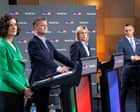
Up until mid-November 2022, the Victorian state election felt like it was being fought in slow motion. Voters were tired. After two years of brutal lockdowns, endless press conferences, and political fatigue that hung over Melbourne like winter fog, nobody seemed particularly thrilled about heading back to the ballot box. Then came the sole leaders' debate, and suddenly the entire campaign caught fire.
If you tuned into Sky News' People's Forum on November 22, 2022, expecting polite policy talk about tram timetables and hospital funding, you got something wildly different. You got pop culture insults, heated interruptions, and an unexpected third shadow looming over the stage. Victorian Premier Daniel Andrews and Opposition Leader Matthew Guy finally stood feet apart in front of undecided voters, and the resulting clash gave a sluggish election the jolt of life it desperately needed.
Why This Single Debate Mattered So Much
Most state elections feature at least two or three televised debates. Not this one. Andrews and Guy agreed to just one major face-to-face showdown, hosted by Sky News and The Herald Sun in Melbourne's outer suburbs, just days before the November 26 election day.
That scarcity raised the stakes enormously. Early voting was already underway, with hundreds of thousands of Victorians having cast their ballots before a single question was asked on that stage. For the remaining undecided voters in marginal seats across Melbourne's sandbelt and outer growth corridors, this was their last real chance to see both men under genuine pressure without a phalanx of media advisers filtering every word.
I've watched plenty of Australian political debates over the years, and most of them are painfully scripted. Leaders memorize three-point talking points and repeat them regardless of what a voter actually asks. What made this night stand out wasn't the policy detail—it was how quickly the veneer cracked when everyday Victorians started pressing them on trust, integrity, and the state's eye-watering debt.
The Voldemort Jibe That Stole the Headlines
You can't talk about this debate without talking about Harry Potter. Seriously.
During an exchange over integrity and political associations, Matthew Guy went after Andrews' record and his relationships with controversial figures. Andrews, never one to let a punch go unreturned, fired back by comparing Guy to Lord Voldemort—the villain from J.K. Rowling's Harry Potter series whose name people are too afraid to say out loud.
It was a sharp, theatrical line designed specifically for the evening news cycle, and it worked. Within minutes, "Voldemort" was trending across Australian social media. The point Andrews was trying to make wasn't subtle. He was suggesting that Guy was trying to distance himself from his own past controversies—including the infamous 2017 "Lobster with a Mobster" dinner at the Lobster Cave restaurant in Beaumaris—by acting as though voters shouldn't mention them.
Did it answer the underlying questions about Labor's own integrity issues, including multiple IBAC (Independent Broad-based Anti-corruption Commission) investigations? Not really. Politicians use pop culture metaphors to deflect when they're cornered, and Andrews is a master of changing the temperature in a room. Still, in pure debate theatre, the line landed hard.
Gotham City and the Battle Over Crime and Debt
If Andrews brought Hogwarts to the stage, Guy brought DC Comics.
While attacking the state of Melbourne under eight years of Labor government, Guy painted a grim picture of rising debt, stalled infrastructure, and law-and-order concerns. At one point, he compared Melbourne's trajectory to Gotham City—the crime-ridden, decaying metropolis guarded by Batman.
Let's be honest about what Guy was doing here. He was tapping into a very real anxiety felt by many suburban Victorians who looked at the state's ballooning net debt—projected at the time to climb past $165 billion—and wondered what they were actually getting for it. Between the cancelled East West Link, the massive cost blowouts on the West Gate Tunnel, and the looming price tag of the Suburban Rail Loop, Guy had plenty of ammunition.
Calling Melbourne "Gotham City," however, was a gamble. Melburnians are fiercely protective of their city, even when they're frustrated with the government running it. Calling the place they live a fictional dystopia can easily backfire if voters hear it as an insult to their home rather than an attack on the Premier. You could almost see the split reaction in the room: some nodding along about crime and living costs, others wincing at the hyperbole.
The Elephant Not in the Room The Greens
Here's the fascinating part about a two-man debate in modern Australian politics: sometimes the most important player isn't even invited.
Throughout the night, the spectre of the Australian Greens hung over almost every exchange between Andrews and Guy. Neither man wanted to talk about them, yet neither could avoid them.
Guy repeatedly pressed Andrews on whether Labor would do deals with the Greens to form a minority government if Labor lost its majority. It was a classic Coalition wedge strategy. In outer suburban seats, voters who were angry with Andrews over lockdowns still worried that a Labor-Greens coalition would push policies they hated, from tougher restrictions on gas appliances to major changes in forestry and taxation.
Andrews flatly denied he would do any deals with the Greens, insisting he was running to form a majority Labor government. That's standard political survival 101. Admitting you might need minor party support before election day signals weakness and hands your opponent an easy scare campaign.
Yet the Greens' shadow wasn't just an ideological threat for Labor—it was an electoral one in inner-city seats like Richmond, Northcote, and Albert Park. Andrews had to walk a tightrope all night, sounding progressive enough not to bleed inner-Melbourne votes to Adam Bandt's party while sounding grounded enough to hold onto tradies and families in places like Cranbourne and Werribee.
How the Audience Actually Reacted
What makes the Sky News People's Forum format genuinely useful is that the studio audience consists of genuinely undecided voters who cast a verdict at the end of the broadcast. No pundit spin. Just a simple show of hands or electronic vote on who won.
The questions from the floor were blunt and personal. Small business owners asked why they had been left carrying the financial burden of the world's longest cumulative lockdown. Healthcare workers and patients raised the state's ambulance ramping crisis and overloaded emergency departments—a problem that had become impossible for the government to brush aside after tragic stories of delayed triple-zero responses dominated the news throughout 2022.
Andrews leaned heavily on his record of building things—level crossing removals, new hospitals, free kinder, and bringing back the State Electricity Commission (SEC). His pitch was simple: you might not always like me, and we've been through hell together, but we deliver big projects and we don't cut services.
Guy pitched himself as a fresh start who would pause the Suburban Rail Loop, funnel billions directly into fixing the health system, and rule out any new taxes. His biggest hurdle wasn't his policy document; it was convincing voters that the Victorian Liberal Party—plagued by internal factional brawls and multiple leadership spills since 2018—was stable enough to govern.
When the 100 undecided voters in the room cast their verdict at the end of the hour, Daniel Andrews came out ahead, winning the room despite the intense grilling over health and integrity.
What Most Coverage Missed About That Night
Looking back at the media coverage from November 2022, most outlets focused entirely on the zingers—Voldemort, Gotham City, and the snappy one-liners. That's what gets clicks. What got overlooked was how clearly the debate exposed the structural reality of Victorian politics.
First, it showed that lockdown anger alone wasn't enough to automatically hand the opposition victory. Plenty of people in that room were furious about how 2020 and 2021 were handled. Anger, though, isn't a governing plan. When voters pressed Guy on exactly how his health funding promises added up without cutting other programs, the answers felt thinner than the critique.
Second, it proved how powerful incumbency remains when an opposition hasn't spent four years building an alternative identity. Andrews knew every button to push because he'd been standing at a podium answering hostile questions almost daily for two years. Whether you loved him or loathed him, his command of government machinery was obvious on stage.
Third, the constant invocation of the Greens revealed that the two-party system in Victoria was fraying in real time. Both major party leaders spent valuable minutes debating a third party that wasn't even allowed through the studio doors. In a modern democracy, excluding a party polling above 11 percent statewide from the sole leaders' debate looked increasingly outdated, even if it suited both Labor and the Coalition to keep the stage to themselves.
Lessons for Watching Any Election Debate
If you want to cut through the noise the next time political leaders face off before an election, pay less attention to the viral insults and watch for three specific things instead:
- Watch what a leader refuses to answer directly. When Andrews sidestepped IBAC questions with a Harry Potter joke, or when Guy pivoted away from internal Liberal Party unity, those deflections told you exactly where their internal polling showed weakness.
- Listen to the questions from regular voters, not the moderator. Journalists ask questions designed to produce headlines; everyday voters ask questions about ambulance wait times, mortgage stress, and school funding. The gap between what politicians want to talk about and what citizens actually care about shows up immediately.
- Ignore the post-debate spin room. Within thirty seconds of the broadcast ending, party strategists flood the media area to declare their boss won in a landslide. Trust the unscripted moments on stage—the hesitations, the body language, and the reactions of undecided voters in the room—over anything said after the cameras turn off.
Four days after that fiery night, Victorians went to the polls and returned Daniel Andrews' Labor government with an increased majority, picking up seats even in areas analysts thought were gone. The Voldemort and Gotham City lines didn't win the election on their own, of course, but that single debate crystallized the exact choice voters faced: stick with a polarizing builder they knew, or take a leap on an opposition that hadn't quite convinced them it was ready.