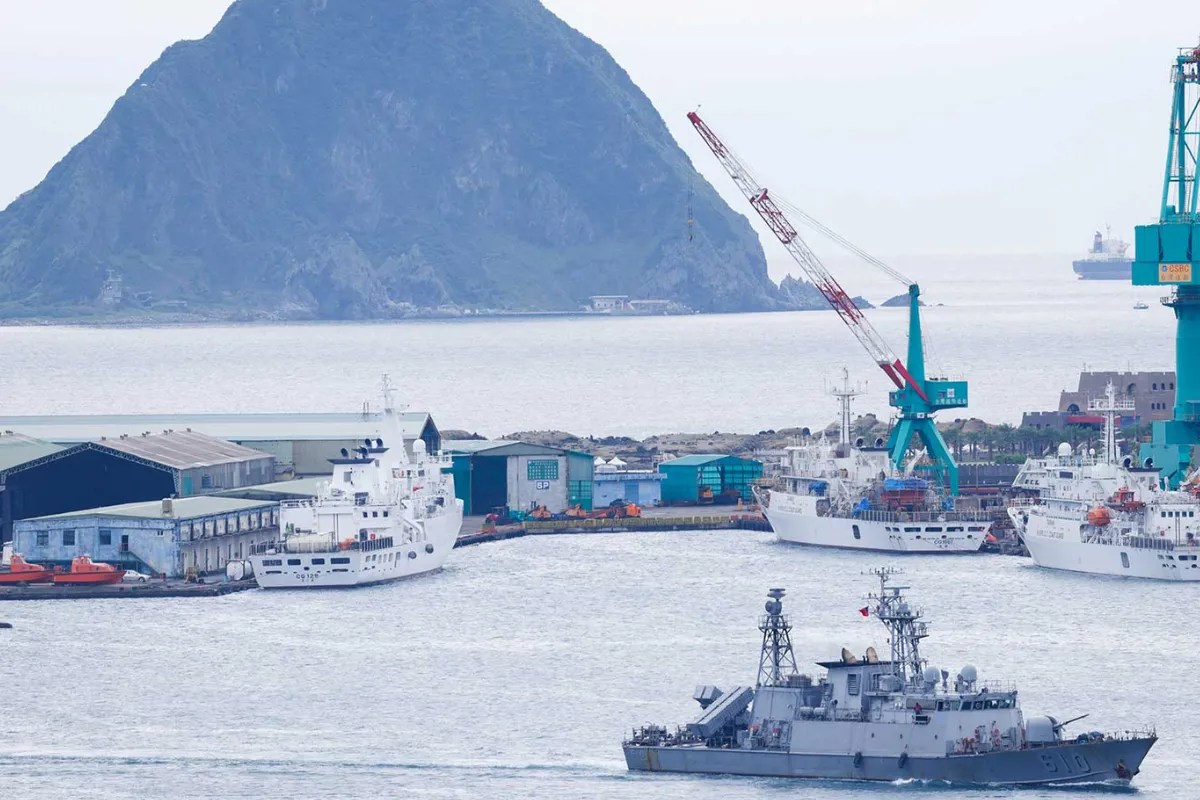
The regular appearance of Chinese warships and military aircraft around Taiwan has become a staple of global news feeds. When the Taiwanese Ministry of National Defense reports another dozen vessels or a sudden influx of fighter jets crossing the median line, media outlets churn out predictable updates about rising tensions. These reports treat each surge as an isolated flashpoint or a sudden fit of anger from Beijing.
That interpretation misses the mark entirely. This is not a series of hot-headed provocations. It is a systematic, calculated campaign of attrition designed to wear down Taiwan without firing a single shot. By focusing only on the daily ship counts, standard reporting overlooks how Beijing uses these deployments to reshape reality in the Taiwan Strait, test Western monitoring capabilities, and exhaust the crew and equipment of an island state.
The Gray Zone Strategy of Infinite Attrition
Beijing relies on gray zone warfare. This approach operates in the murky space between peace and open conflict, utilizing military pressure to achieve political goals without triggering a full-scale war.
When a Chinese missile frigate cruises just outside Taiwan’s contiguous zone, it forces a reaction. Taiwan must scramble its own naval vessels, spin up radar tracking systems, and put pilots on standby. This constant state of alert strains personnel and rapidly burns through maintenance budgets. Ships require overhauls after a set number of operational hours, and airframes degrade with every sudden scramble. China possesses a massive hull advantage; its shipyards build vessels at a rate that outpaces any other nation. Taiwan cannot match this output, and Beijing knows it.
The primary objective is psychological. By maintaining a constant, unpredictable presence, the Chinese military normalizes its proximity to Taiwanese territory. What once caused national alarm now registers as a routine Tuesday. This gradual erosion of defensive boundaries ensures that if an actual invasion or blockade begins, the initial movements will look exactly like the exercises Taiwan has watched for years, stripping the defenders of precious reaction time.
Shifting From Political Theater to Operational Muscle
Historically, China surged its forces around Taiwan in response to specific political triggers, such as a high-profile visit from a US official or an arms sale announcement. Now, the patterns have shifted. The deployments happen regardless of the diplomatic calendar.
Redefining the Median Line
For decades, an unspoken agreement kept both sides from crossing the median line of the Taiwan Strait. That boundary is effectively gone. Chinese aircraft now routinely cross this marker, treating the entire strait as domestic airspace. This is a deliberate effort to alter the legal and physical status quo. By erasing the median line, China reduces the physical buffer zone that protects Taiwan from a sudden strike, moving the starting line of a potential conflict miles closer to the island’s coast.
Joint Operational Rehearsals
Recent naval movements show a level of coordination that goes far beyond simple posturing. We are seeing integrated exercises that involve:
- Type 052D Guided-Missile Destroyers acting as command hubs for regional air defense.
- Electronic Warfare Vessels mapping Taiwanese radar frequencies and tracking how Western satellites monitor the region.
- Civilian Roll-On/Roll-Off (Ro-Ro) Ferries training alongside the military, practicing loading operations that would be necessary to transport heavy armor during a beach landing.
These are not demonstrations. They are live-fire rehearsals for a multi-domain blockade. The People's Liberation Army (PLA) uses these sorties to iron out communication kinks between its navy, air force, and rocket command, treating the waters around Taiwan as a giant training ground.
The Overlooked Financial Toll on Taipei
The material cost of defending against these constant incursions is staggering. Every time a Chinese fleet approaches, Taiwan responds with a proportional deployment to shadow the intruders.
| Metric | Impact of Constant Scrambles |
|---|---|
| Fuel Consumption | Soars as aging vessels run at high speeds to intercept modern PLA hulls. |
| Maintenance Cycles | Compressed drastically, leaving fewer ships available for long-term defense. |
| Personnel Fatigue | High burnout rates among radar operators, pilots, and naval engineers. |
The financial burden forces difficult choices. Taiwan operates on a limited defense budget. Money spent on fuel, immediate repairs, and crew overtime is money that cannot be invested in asymmetric capabilities like sea mines, mobile anti-ship missile batteries, or drone swarms. China is effectively dictating Taiwan's defense spending, forcing them to waste resources on mirroring presence missions rather than building a resilient defense system.
Washington and the Intelligence War
Behind the visible movement of steel on water lies an invisible battle for data. During every surge, US and allied reconnaissance aircraft fly just outside the zone to harvest signals intelligence. They track how Chinese ships communicate, how their radars lock onto targets, and how efficiently their command structure operates.
Conversely, China uses these surges to bait Taiwan and its allies into activating their primary defensive systems. When a Taiwanese missile battery locks its radar onto a Chinese fighter jet, Chinese electronic intelligence planes capture that signature. They log the frequency, the location, and the response time. In a real conflict, that data would be used to jam those exact systems or target them with anti-radiation missiles. It is a continuous loop of intelligence collection where every reaction betrays a secret.
The Illusion of a Defined Timeline
Western analysts often attempt to pin down a specific year for a potential invasion, pointing to internal Chinese military goals or political anniversaries. This focus on a single catastrophic date obscures the reality of what is happening right now.
An invasion is only one tool in Beijing's kit, and it is the most risky. A failed amphibious assault would jeopardize the political survival of the ruling party. A prolonged, suffocating blockade disguised as a series of constant military exercises achieves the same goal with a fraction of the risk. By slowly choking Taiwan's maritime access, discouraging foreign investment, and demonstrating that the US cannot easily break a perimeter of modern warships, China aims to make capitulation feel inevitable.
The warships lingering off the coast of Taiwan are not a warning of a future war. They are the execution of a current strategy, unfolding slowly, methodically, one deployment at a time. The pressure will not decrease; it will adapt, test new boundaries, and wait for the structural fatigue to finally show.