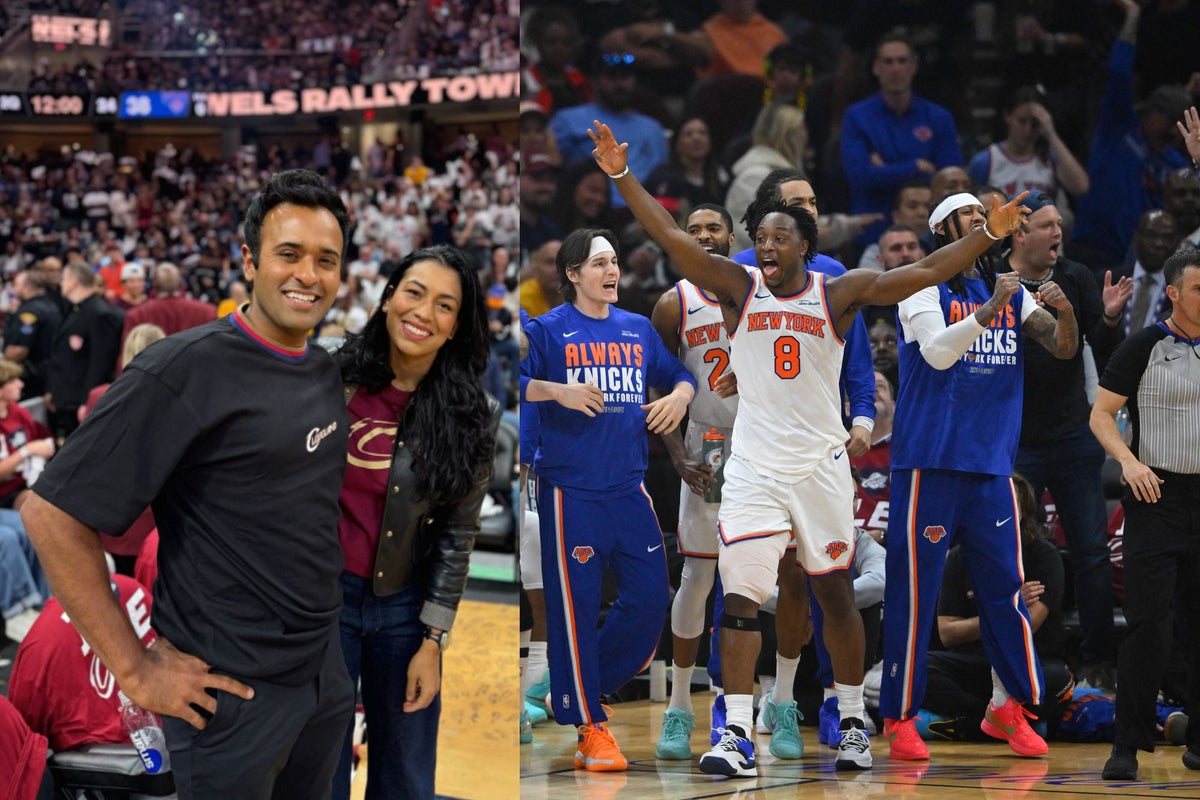
The corporate suite at a major sporting event is supposed to be the ultimate safe space for the modern political operative. Safely insulated by soundproof glass, premium catering, and a curated list of donors, a candidate can comfortably pretend to be a person of the people while remaining entirely detached from them. But when a campaign attempt spills out into the public bowl during an absolute postseason disaster, the illusion shatters.
Vivek Ramaswamy discovered this reality during the New York Knicks clinical demolition of the Cleveland Cavaliers to secure their trip to the NBA Finals. Standing in Rocket Arena as the home team trailed by as much as 45 points in a 130-93 blowout loss, the billionaire pharmaceutical executive and Ohio Republican gubernatorial nominee attempted to transform a sports tragedy into a personal public relations victory. The home crowd, suffering through a historic 37-point playoff elimination loss, was entirely uninterested in the pitch. Ramaswamy was roundly rejected by fans who viewed the appearance as a cynical, tone-deaf insertion of ambition into an arena of genuine civic grief.
The incident reflects a deeper, systemic miscalculation plaguing modern political strategy. Consultants continuously operate under the flawed premise that any crowd is an opportunity, failing to see that a stadium full of furious sports fans is a volatile ecosystem with its own rigid rules of engagement.
The Myth of the Neutral Sports Backdrop
For decades, political campaigns have utilized athletic venues as shortcut mechanisms to signal authenticity. It is an established playbook. A candidate puts on a crisp, unwashed team jersey, awkwardly holds a local beer, and smiles for a photographer while pretending to understand the nuances of a pick-and-roll.
But sports franchises are not passive backdrops. They are deep repositories of regional identity, generational trauma, and intense emotional investment. When the Cavaliers are dismantled by a ruthless New York squad executing a 18-0 run, the emotional temperature of the arena drops into a toxic mixture of apathy and rage.
Inserting a partisan political narrative into that specific vacuum is a fundamental misunderstanding of the audience. Fans do not look at the court and see a demographic breakdown of potential primary voters. They see a catastrophic defensive failure. Ramaswamy attempting to shake hands, flash cameras, and distribute campaign energy while Jalen Brunson and Karl-Anthony Towns pick apart the home defense is viewed not as leadership, but as a bizarre form of narcissism.
Inside the Anatomy of a Postseason Eviction
The sporting public possesses a highly refined radar for opportunistic behavior. When a wealthy candidate arrives via private jet, sits in premium seating, and attempts to engage with a crowd that just watched their season evaporate, the friction is immediate.
Consider the operational reality of that night in Cleveland. The Cavaliers offense ground to a halt, shooting a dismal 27.5% from beyond the arc and committing 22 turnovers. James Harden was trapped in a 2-for-8 shooting nightmare while Evan Mobley finished a team-low minus-30. The stadium was a pressure cooker of resentment.
Political operatives often fail to grasp that team loyalty operates on an entirely different plane than political affiliation. A stadium contains a diverse coalition of voters who, for two and a half hours, have agreed to put aside structural disagreements to rally behind a unified color scheme. Bringing a divisive gubernatorial campaign into that space violates the unspoken contract of the arena. It forces a fractured partisan reality back onto a crowd that paid premium ticket prices to escape it.
The Regional Backlash of Political Tourism
The immediate political fallout for Ramaswamy demonstrates how quickly these managed optics can backfire. Rather than projecting the image of a committed local leader supporting his home state team, the spectacle handed an easy victory to his opposition.
Democratic strategists immediately seized on the moment, labeling the appearance an ill-timed photo op and pointing out that Ramaswamy had previously relocated business interests out of the state. The contrast was stark. While everyday fans sat in the upper decks processing a brutal sports defeat, a billionaire candidate used the backdrop of their loss to fuel a national media profile.
Cavaliers vs. Knicks Game 4 Team Stats
+-----------------------+------------+------------+
| Statistic             | NY Knicks  | CLE Cavs   |
+-----------------------+------------+------------+
| Final Score           | 130        | 93         |
| Field Goal %          | 49.0%      | 41.6%      |
| Rebounds              | 60         | 33         |
| Turnovers             | 13         | 22         |
| Maximum Lead          | 45         | 6          |
+-----------------------+------------+------------+
This dynamic is not unique to Ohio. Political history is littered with the carcasses of campaigns that treated sporting events as generic gathering halls. When a politician enters an arena during a loss, they become a lightning rod for the collective frustration of the room. They are an easy, targetable manifestation of the broader irritation felt by thousands of captive spectators.
Why the Arena Always Wins
The ultimate lesson of the blowout rejection is that sports fans cannot be engineered into a compliant focus group. They are active participants in a collective narrative, and they protect that narrative fiercely against outside manipulation.
When a team is losing by double digits in an elimination game, the arena enters a state of hyper-awareness. Every corporate intervention, every artificial jumbotron prompt, and every political intrusion is magnified and resented. The crowd knows when it is being used.
Politicians who continue to treat the playoff landscape as a series of convenient, high-density campaign stops will inevitably find themselves facing the same wall of resistance. The stadium bowl is a meritocracy of passion. If you are not there to suffer through the turnover streaks and the defensive lapses alongside the people in the rows behind you, your presence will be rejected. No amount of money, name recognition, or political momentum can survive the raw, unscripted anger of a sports fan watching their team fail.

.png/revision/latest?cb=20211008004133)