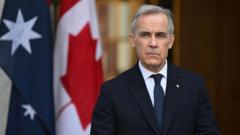
Mark Carney is currently performing a high-wire act over a chasm of shifting geopolitical alliances, and the safety net of the old world order has already been shredded. While headlines focus on his "regretful" support for U.S.-Israeli strikes on Iran, the reality is far more transactional. Canada’s Prime Minister is not just weighing the ethics of a middle-eastern war; he is desperately trying to trade security compliance for economic survival in an era where Donald Trump treats allies like vassals.
By endorsing the destruction of Iran’s nuclear infrastructure while simultaneously questioning the legality of the strikes, Carney is attempting a "studied ambiguity" that satisfies no one. He is caught between a base that demands adherence to international law and a White House that views "international law" as a quaint relic of a bygone century.
The Davos Doctrine Meets High Explosives
In January 2026, at the World Economic Forum in Davos, Carney introduced what he called the "rupture." He argued that the rules-based order was dead and that middle powers like Canada must prepare for a world defined by raw power and "weaponized interdependence."
Fast forward to February 28, 2026. As U.S. and Israeli missiles rained down on Iranian leadership and nuclear sites in Operation Epic Fury, Carney was in Mumbai. His first instinct was not to call for a ceasefire or consult the United Nations. Instead, he issued a statement of support, framing the strikes as a necessary evil to stop a nuclear-armed Tehran.
This was a pivot from the traditional Canadian "honest broker" persona. For decades, Ottawa has positioned itself as the adult in the room, insisting on multilateralism and the sanctity of the UN Charter. Carney’s quick endorsement signaled that under his leadership, Canada is moving toward a harder, more cynical realism. He knows that with the United States-Mexico-Canada Agreement (USMCA) under review, any daylight between Ottawa and Washington on security issues could lead to devastating tariffs on Canadian steel, aluminum, or automotive parts.
Sovereignty as a Sunk Cost
The contradiction in Carney's stance became glaringly obvious during his subsequent trip to Australia. Standing in Canberra alongside Prime Minister Anthony Albanese, Carney’s tone shifted. He admitted Canada was not consulted or informed of the strikes in advance. He then went a step further, stating that "prima facie, it appears that these actions are inconsistent with international law."
This is the central tension of the Carney administration. He is backing a war he suspects is illegal because he believes he has no choice. In his view, the "world as it is" demands that Canada stay in the good graces of its largest trading partner, even if that partner is bypassing every international norm Canada helped build.
Critics from both sides are pouncing. Conservative defense critic James Bezan accused him of making foreign policy "on the fly," while former Liberal Foreign Minister Lloyd Axworthy slammed him for failing to defend the very international law he claims to value. Carney is essentially telling the world that Canada’s principles are for sale if the price is economic stability.
The Military Participation Trap
Perhaps most concerning for the Canadian public is Carney’s refusal to rule out direct military involvement. While he initially claimed Canada was not part of the "planning" and thus not part of the conflict, he recently softened that line. "One can never categorically rule out participation," he told reporters in Australia.
This isn't just rhetoric. As the conflict spreads, the stakes are rising:
- The Strait of Hormuz: With the IRGC declaring the Strait closed, 20% of the world's oil is at risk. A global energy shock would hit the Canadian economy—already struggling with inflation—like a sledgehammer.
- The Indian Ocean Front: The sinking of an Iranian vessel by a U.S. submarine off the coast of Sri Lanka marks a dangerous escalation into maritime warfare that could demand a NATO or allied naval response.
- The Domestic Backlash: Carney’s "regretful support" is already fracturing his own party. Foreign Affairs Minister Anita Anand has had to play "cleanup," emphasizing human rights and regime change, while Carney remains focused on the cold math of the U.S. relationship.
Trading Blood for Trade Routes
The strategy here is transparently transactional. Carney is gambling that by giving Trump a "win" on Iran, he buys himself leverage in the upcoming trade negotiations. It is a high-stakes play that assumes the White House values loyalty. However, history suggests that for the current U.S. administration, loyalty is a one-way street.
Canada is essentially offering its diplomatic cover for a military campaign it doesn't control, in the hopes of avoiding an economic war it can't win. If the war in Iran drags on and casualties mount, Carney’s "studied ambiguity" will look less like sophisticated diplomacy and more like a lack of moral courage.
He is betting that Canadians care more about their mortgages and the price of gas than about the finer points of international law in a distant desert. It is a cynical bet, but in the "ruptured" world Carney described in Davos, it might be the only one he has left.
The irony is that by trying to strike a balance, Carney may have already tipped over. He has alienated the internationalist wing of his party, signaled to the U.S. that Canada’s support can be taken for granted, and left the Canadian military in a state of "fundamental hypothetical" readiness for a war they were never supposed to fight.
Mark Carney wanted to lead Canada into a new era of "pragmatic and principled" foreign policy. Instead, he has found himself trapped in a grey zone of his own making, where the only thing certain is that the old rules no longer apply.
If you want to understand the true cost of this alignment, look at the trade balance sheets next quarter, not the diplomatic cables.


