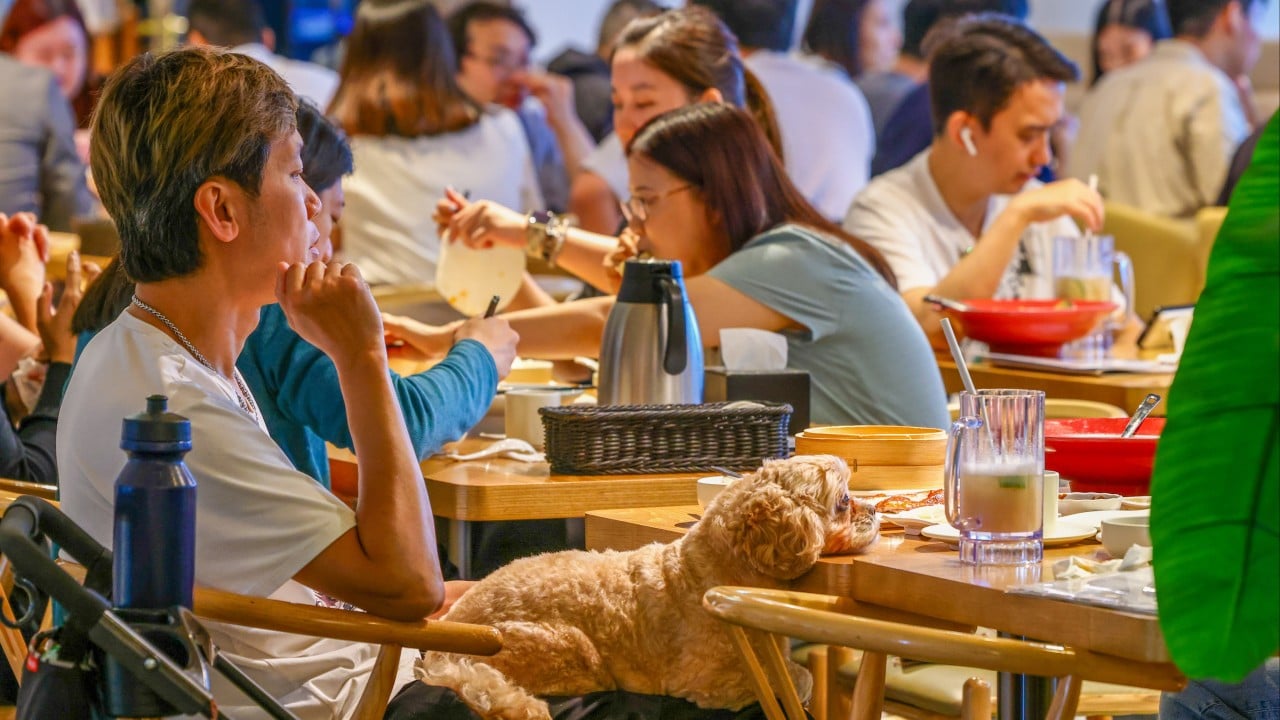
Hong Kong is overturning a three-decade ban on dogs in restaurants, desperate to revive an ailing food and beverage sector through a government-sponsored pet economy.
The Food and Environmental Hygiene Department opened electronic applications for its new dog-admission permit scheme, capping the first phase at 1,000 licensed general and light refreshment eateries. Within hours, the deluge of applicant data proved what desperate operators already knew: local dining is in freefall, and four-legged companions are the latest liferaft.
Yet underneath the optimism lies a minefield of hyper-regulation. Establishments specializing in hotpot or barbecue are barred. Premises under 20 square meters are disqualified. Dogs must remain on leashes under 1.5 meters, staying clear of food prep areas, buffets, and salad bars. Staff face instant penalties if they handle food after petting an animal, and three minor compliance missteps inside a year will permanently strip an operator of their endorsement.
This isn't a leisure-led cultural shift. It is an economic triage strategy disguised as progress.
High Stakes and Heavy Leashes
For thirty-two years, Cap. 132X of the Food Business Regulation maintained a hard wall between livestock and public dining tables. Breaking that wall required an executive pivot from Chief Executive John Lee, who explicitly framed the policy change around capturing a booming pet market.
Local restaurateurs are dealing with an unprecedented capital flight of diners. Every weekend, hundreds of thousands of residents cross the northern border into Shenzhen, where retail spaces are vast and dining is significantly cheaper. The domestic customer base is shrinking, but the city’s pet population is expanding.
Young professionals and couples are delaying families, replacing children with standard poodles, shiba inus, and French bulldogs. This demographic is willing to spend cash on high-margin artisanal lifestyle experiences, making them a lucrative target for businesses.
The state-engineered lottery system for the initial 1,000 slots reveals deep administrative anxiety. The government wants the economic bump, but it is deeply afraid of a public health backlash or a high-profile dog fight in a cramped Mong Kok dining room.
The Operational Reality of Hong Kong Real Estate
The mechanics of Hong Kong dining rooms do not naturally accommodate animals. Space is premium real estate.
A standard local restaurant utilizes a tight layout designed to maximize seat turnover per square foot. Introducing a 25-kilogram golden retriever into a narrow corridor between tightly packed tables creates an immediate operational bottleneck. If two territorial dogs sit tail-to-tail in a high-density environment, chaos is inevitable.
Consider a hypothetical mid-tier cha chaan teng in Causeway Bay trying to monetize this policy.
To comply, the venue must pay a license amendment fee and undergo a rigorous layout review. They must mount highly visible regulatory signage at the main entrance, alerting pet-allergic or fearful diners that animals are inside. They have to train frontline staff to police customer behavior, monitor leash lengths, check that fighting breeds are excluded, and enforce the rule prohibiting dogs from sitting on chairs or tables.
+--------------------------------------------------------+
|       FEHD DOG-FRIENDLY COMPLIANCE CHECKLIST         |
+--------------------------------------------------------+
| [✓] Minimum Floor Plan Space > 20 Square Meters        |
| [✓] Exclusion of Tabletop Heating (No Hotpot/BBQ)       |
| [✓] Fixed Leash/Tether Points Restricted to < 1.5m     |
| [✓] Buffer Zone Maintained 1.5m From Salad Bars/Buffets|
| [✓] Frontline Staff Sanitation Training Logs Updated   |
+--------------------------------------------------------+
Then comes the real financial friction: liability insurance. Under government rules, if an animal inflicts an injury on-site, the licensee must file a police report and notify the department within 48 hours. Insurance providers are already adjusting premiums upward to account for the heightened risk of dog bites and slip-and-fall claims resulting from liquid accidents on restaurant floors.
For an industry working on single-digit profit margins, these compliance costs quickly chip away at the financial benefits of attracting dog owners.
The Hidden Threat to Corporate Cleanliness
Public hygiene remains the most significant variable in this grand experiment.
The government plans to run a one-month adaptation phase from the July launch, sending public health inspectors into permitted venues daily to monitor compliance. This level of oversight puts intense pressure on understaffed kitchens.
If an animal sheds heavily, dander enters the air conditioning system. In a humid climate, managing pet hair and dander requires a major upgrade to a restaurant's filtration infrastructure.
Furthermore, the code prohibits the cooking or heating of dog food on-site. If a premium brand wants to offer a high-margin pet menu, everything must be served cold or pre-packaged. The moment a waiter serves an unauthorized warm dish to a dog, the venue risks receiving one of the three warning letters that can shut down the program.
Tapping a Polarized Consumer Base
The policy assumes that everyday diners will easily accept sharing spaces with animals. But Hong Kong is a crowded town with diverse opinions on public etiquette.
A significant portion of the local demographic remains highly sensitive to hygiene and noise. For every millennial diner eager to eat pasta next to a maltipoo, there is an older patron or young family who will refuse to enter an establishment where dogs are present.
By opting in, a business owner isn’t just adding a customer segment; they are actively alienating another.
The biggest risk is that the program could spark friction between patrons. When a non-pet owner objects to an animal barking in an enclosed dining room, the serving staff—who are already managing high-stress service windows—will have to step in as mediators.
If a restaurant handles these interactions poorly, the resulting negative reviews on platforms like OpenRice can quickly wipe out any revenue gains from pet-owning customers.
Survival Metrics for a New Era
Success under this new regulatory framework requires more than just hanging a sign on the door. Operators need to approach the change with strict operational discipline rather than viewing it as a quick marketing trick.
Smart venues are mapping their floors down to the millimeter. They are setting up designated pet zones near entrances to keep animals away from the main kitchen traffic.
They are investing in advanced air purification systems to eliminate odors and dander before customers can complain.
Most importantly, they are updating their booking systems to separate diners who have pets from those who don't, using digital tools to prevent seat friction before anyone even sits down.
The rush of initial applications proves the local food scene is desperate for cash. But as the July launch approaches, the venues that survive won't just be the ones that welcomed dogs; they will be the ones that managed the administrative weight of the state's tight regulatory leash.