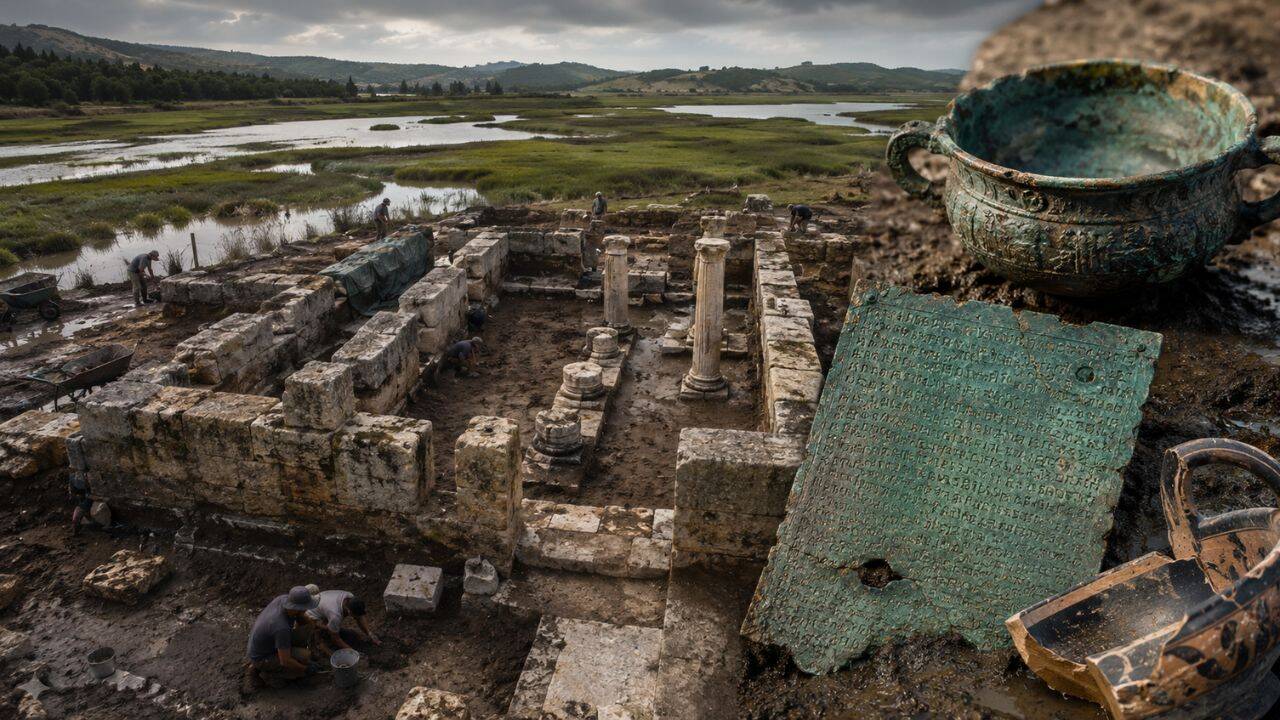
Archaeologists in the Peloponnese have finally unearthed the lost sanctuary of Poseidon of Samikon, a legendary religious center buried for two millennia beneath layers of Greek marshland. While initial reports focused on the simple romance of a long-lost ruin, the true significance of this discovery lies in how it upends our understanding of ancient geopolitics, maritime trade, and climate adaptation. This was not just a temple. It was a heavily fortified financial hub and diplomatic safe zone that controlled one of the most lucrative maritime routes in the ancient world.
The Myth of the Isolated Temple
For centuries, historians relied on the account of Strabo, the ancient Greek geographer who described a celebrated grove of wild olives dedicated to Poseidon near the Peloponnesian coast. Many assumed the site was a quiet place of worship.
The physical reality on the ground tells a radically different story.
The joint excavation by the Austrian Archaeological Institute and the Ephorate of Antiquities of Elis has revealed a massive, double-nave temple structure dating back to the sixth century BCE. Measuring over 28 meters in length and nearly 10 meters wide, the building features thick stone foundations designed to withstand both tectonic activity and rising water levels. This was a monumental infrastructure project. The scale of the construction proves that the regional powers poured immense capital into this specific geographic chokepoint.
Geopolitics of the Marshlands
To understand why the Triphylian cities built such a massive structure in a swamp, you have to look at the ancient coastline. The landscape was not a scenic beach. It was a treacherous network of lagoons, sandbars, and coastal marshes that forced ships to navigate close to the shore.
The sanctuary sat at the nexus of these waterways. It served as a landmark for sailors, but more importantly, it operated as an amphictyony—a league of neighboring cities that used the neutral sacred ground to form alliances, trade goods, and set maritime laws.
- Economic Control: The temple collected tithes and taxes from passing merchant vessels.
- Security: The massive walls offered protection against coastal pirates.
- Resource Management: The priesthood controlled access to freshwater springs in an otherwise brackish environment.
By placing the sanctuary under the protection of Poseidon, the god of the sea and earthquakes, the local tribes created a divine insurance policy for their wealth. Harming the temple meant risking total ruin from the elements.
The Inscriptions That Change Everything
The most explosive evidence recovered from the site comes in the form of inscribed bronze plaques and stone fragments found buried within the temple floor. These are not religious hymns or prayers. They are legal documents.
One recently cleaned inscription details a complex property dispute between two local factions, arbitrated by the temple priests. Another fragment records a multi-city treaty that regulated the movement of troops and goods through the coastal pass.
These artifacts prove the sanctuary functioned as a supreme court for the region. In a world fragmented by constant warfare, the temple provided a centralized, bureaucratic framework that kept trade moving. The priests were bureaucrats disguised as holy men, leveraging spiritual authority to enforce economic stability.
Engineering Against the Elements
The discovery also forces a reassessment of ancient engineering capabilities. The marshlands of Elis are notoriously unstable, prone to flooding and silting.
The builders of the Samikon sanctuary solved this through a sophisticated foundation technique. They utilized alternating layers of packed clay, gravel, and large limestone blocks to create a floating foundation effect. This design absorbed the shifting of the wet soil and mitigated the impact of seismic tremors.
The Real Reason It Disappeared
The ultimate demise of the sanctuary was not caused by war or religious conversion. It was a slow, environmental strangulation.
As the centuries progressed, tectonic shifts and heavy siltation from nearby rivers gradually pushed the coastline outward. The bustling maritime lagoon transformed into a landlocked marsh. The temple lost its direct access to the sea, and with it, its economic relevance. By the time the Roman Empire solidified its grip on Greece, the grand sanctuary of Samikon was already sinking into the mud, forgotten by the merchants who once financed its glory.
The ongoing excavations at Samikon are stripping away the romantic veneer of classical antiquity to reveal a gritty, highly organized corporate state operating under the guise of religious devotion. The true value of the find is the blueprint it provides of how ancient civilizations weaponized geography, infrastructure, and belief to dominate their world.