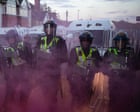
Hampshire Police have charged six more individuals with violent disorder following the explosive riots in Southampton. This brings the total number of prosecutions to 11 as authorities scramble to suppress the fallout from the murder of 18-year-old student Henry Nowak. While the state focuses on the street-level chaos, the escalating unrest is not merely a reaction to a brutal crime. It is a direct explosion of public fury over institutional failure. The civil disorder ignited when recently released police bodycam footage exposed a terrifying reality. Responding officers handcuffed a bleeding, dying teenager who was gasping for air, choosing to believe the absolute lies of his killer, Vickrum Digwa, because they were terrified of a racial grievance.
The newly charged individuals include Kevin Reeves, Andrew Riddett, Harry Varney, Taylor Grundy, Dillon Crawford, and Andrew Summerhayes. They represent a growing list of citizens sweeping into clashes outside the Southampton Central Police Station and the Portswood area. Eleven police officers have been injured, and bricks, bottles, and wheelie bins have transformed local streets into a combat zone. Politicians have rushed to condemn the riots, claiming that far-right agitators are weaponizing a tragedy. However, reducing this crisis to mere political agitation misses the rot at the center of the story. The core issue is the weaponization of identity politics within British law enforcement.
Anatomy of an Institutional Deception
On December 3, 2025, Henry Nowak was walking home alone after a night out with his university football teammates. He crossed paths with 23-year-old Vickrum Digwa, who was openly carrying an eight-inch dagger. When Nowak asked Digwa if he was a "bad man"—likely startled by the visible blade—Digwa seized the student's phone and attacked him. He stabbed the unarmed teenager five times, piercing his chest, catching a lung, and severing a major vein.
As Nowak lay bleeding on a driveway, Digwa and his brother began a calculated deception. The brother called emergency services, claiming they were the targets of a racially motivated assault by Nowak. When the Hampshire and Isle of Wight Constabulary arrived, Digwa doubled down on the lie, claiming Nowak had insulted his religion and knocked off his turban.
What happened next is captured in the brutal clarity of police body-worn video.
Nowak, visibly suffering from catastrophic chest wounds, told the responding officers that he had been stabbed and could not breathe. An officer openly dismissed him, saying, "I don't think you have, mate." Instead of receiving immediate medical triage, Nowak was pinned, arrested, and forced into handcuffs. It took a full three minutes of agonizing suffocation before the officers realized the boy was dying.
Digwa, meanwhile, sat comfortably in the back of a police cruiser. Unaware that a hidden camera was rolling, he conversed in Punjabi with his brother, mapping out a self-defense narrative.
The criminal justice system worked fast enough to convict Digwa of murder, securing a life sentence with a minimum of 21 years. His mother, Kiran Kaur, was also convicted for hiding the murder weapon. Yet, the conviction did nothing to answer the damning question haunting the British public. Why did trained police officers instinctively treat a dying white student as a dangerous racist perpetrator and a armed killer as an unquestioned victim?
The Ideological Paralysis of Modern Law Enforcement
This was not a standard operational oversight or a lack of training. The catastrophic failure in Southampton is the logical consequence of an institutional culture that has spent years prioritizing political correctness over basic investigative observation.
Over the past decade, British police forces have been subjected to intense institutional re-engineering. Documents like the National Police Chiefs’ Council anti-racism commitment have institutionalized a system where officers are constantly told that systemic bias governs their every interaction. In practice, this has created a deep-seated fear among frontline staff. Officers are terrified of being branded racist, losing their jobs, or sparking a public relations disaster for their constabulary.
When Hampshire officers arrived at the scene in Portswood, they faced a choice. They could look at the physical evidence—an unarmed teenager suffering from critical puncture wounds—or they could react to a verbal allegation of racial abuse. The ideological conditioning kicked in. The accusation of racism was treated as an absolute truth that overrode physical reality. The immediate instinct was to appease the alleged victim of a hate crime, even if that meant handcuffing a boy who was drowning in his own blood.
The tragic irony is that this modern approach to policing, ostensibly designed to foster fairness, mirrored the exact institutional failures identified decades ago. In 1993, the racist murder of black teenager Stephen Lawrence shook Britain. The subsequent Macpherson Report concluded that the Metropolitan Police suffered from institutional racism because officers failed to properly investigate the crime, ignored crucial evidence, and treated the victim’s family with suspicion.
Thirty-three years later, the ideological pendulum has swung completely, yet it has produced the exact same result. The police failed to observe the physical reality of a dying human being because they were blinded by preconceived notions.
The Internationalization of a Domestic Crisis
The fallout of the Nowak case has rapidly moved beyond the borders of Hampshire, sparking a bitter international political row that reaches all the way to Washington.
High-profile international figures, including US Vice President JD Vance and tech billionaire Elon Musk, have openly criticized the British state, pointing to the case as evidence of two-tier policing. This term refers to the growing public perception that British authorities police certain demographic groups and political demonstrations with a soft touch, while cracking down with maximum severity on others.
Downing Street has responded with predictable hostility. Prime Minister Keir Starmer accused foreign political figures of attempting to interfere in British democracy and stoking division on the streets. Home Secretary Shabana Mahmood condemned the riots, stating that the tragedy was being hijacked to incite disorder.
The state's defense relies on a simple tactic. By labeling all critics as far-right agitators or foreign disruptors, the government avoids addressing the core failure of its own institutions. This is a deflection strategy that cannot hold. When ordinary citizens see video footage of a dying teenager being handcuffed while his killer films him on a smartphone, their anger does not require a prompt from social media or foreign politicians. It is a natural human reaction to profound injustice.
The Failure of the State's Counter-Narrative
Government officials and police chiefs keep insisting that the system works because Digwa was ultimately convicted. This argument completely misses the mark.
The issue isn't whether the courts can eventually sort out a murder trial after months of forensic investigation. The issue is that the immediate, state-sanctioned response on the street was fundamentally broken. If a citizen cannot rely on a first responder to recognize a life-threatening stab wound because that officer is mentally navigating a minefield of identity politics, then the basic social contract between the public and law enforcement is severed.
Mark Nowak, the victim's father, has handled the loss of his son with incredible dignity. He explicitly stated that he holds Digwa completely responsible and does not want his son's death used to fuel racial hatred or street violence. He called on the government to treat knife crime as a national emergency.
The state is using the father's plea for peace as a shield to deflect from accountability. There is a vast difference between inciting racial hatred and demanding a thorough, uncompromising investigation into institutional rot. The Independent Office for Police Conduct has launched an investigation into the officers' actions, with a report expected in three months. However, a bureaucratic review will do little to restore public faith if it treats the incident as an isolated error by a few bad apples.
The riots in Southampton are dangerous, destructive, and legally indefensible. Burning wheelie bins and injuring police dogs does not honor the memory of an accountancy student who loved football. But these riots are a symptom, not the disease. The disease is an elite political and administrative class that has spent years transforming law enforcement into an engine for social engineering. Until the British state admits that its ideological framework paralyzed those officers on the night of December 3, the tension on the streets will continue to rise. Police forces cannot protect the public when they are too terrified of vocabulary to see a weapon.