Cold tea leaves a bitter film on the tongue when a meeting drags past midnight. You can smell the dry wool of heavy winter coats, the faint lemon scent of furniture polish, and the quiet exhaustion of men who know that every syllable spoken across polished oak might echo months later in the whine of incoming artillery.
Silence. Then a sentence that drops the temperature in the room by ten degrees.
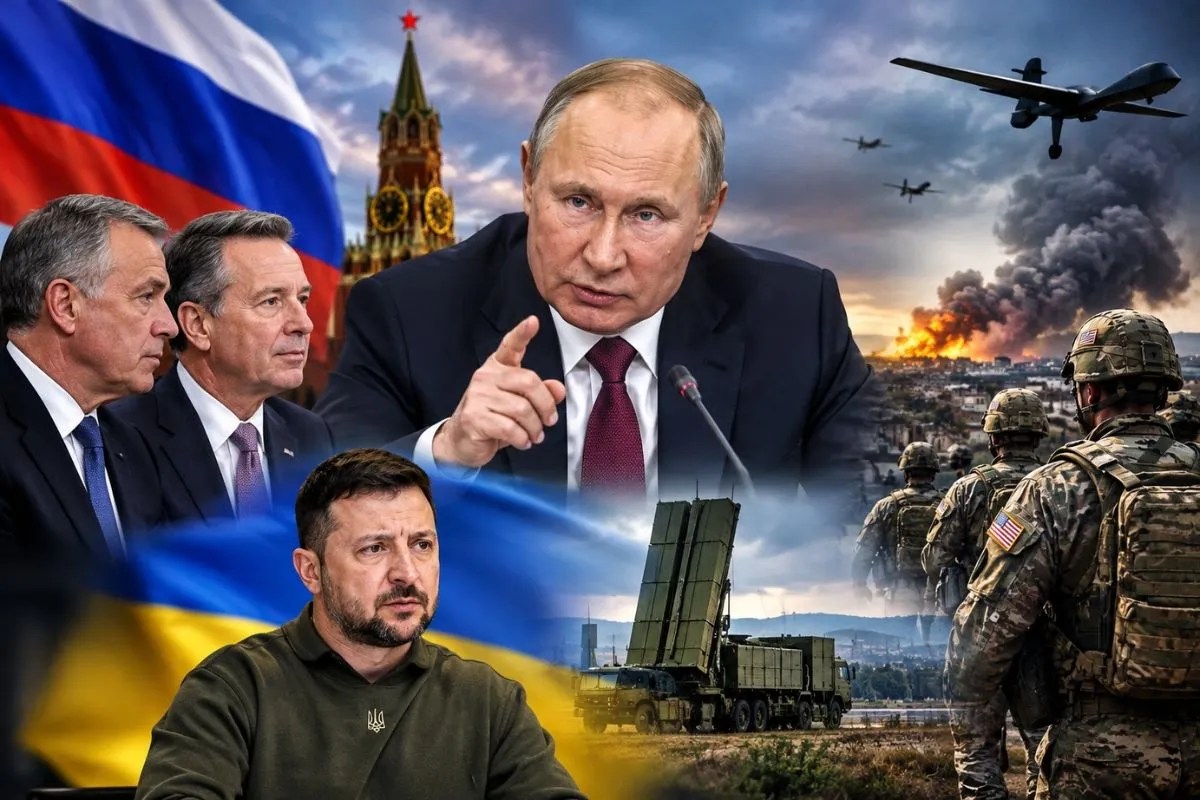
When a leader sits across from American envoys in Moscow—figures like Steve Witkoff and Jared Kushner, men accustomed to the language of real estate deeds, sovereign wealth funds, and high-stakes backchannel deals—and declares that foreign troops deployed on the ground will be treated as legitimate targets, the air changes. Diplomacy stops sounding like a negotiation over borders and begins to sound like a warning about funeral arrangements.
I have spent years watching how distant geopolitical announcements bleed into ordinary lives. You do not see a "legitimate target" on a television map. You see it in the trembling hands of a twenty-two-year-old corporal checking his rifle strap in a damp trench three hundred miles from home, wondering whether the politician who promised "peacekeeping" or "stabilization" ever bothered to ask what happens when the shooting starts anyway.
Why does a warning delivered inside a Kremlin chamber carry so much weight, even when it arrives wrapped in diplomatic polish? Because war rarely begins with a surprise attack alone. Often, it begins with a redefinition.
The Architecture of a Threat
To understand what happens when Moscow draws a line around foreign soldiers, you first have to strip away the polite vocabulary of international statecraft. Diplomats love euphemisms. They speak of "reassurance forces," "training missions," "technical advisors," and "security guarantees." On paper, those phrases sound protective, almost domestic, like neighborhood watch volunteers wearing high-visibility vests.
On the battlefield, labels do not stop shrapnel.
Consider what happens next: once a side in an active or frozen conflict declares that foreign personnel are valid military objectives, the entire calculus of deterrence shifts. A soldier wearing a foreign patch is no longer an untouchable symbol of alliance or a tripwire meant to make an adversary blink. In the eyes of the opposing command, that soldier becomes an asset to be degraded, a political cost to be inflicted on a rival capital, or a lever to fracture a coalition before it fully forms.
Let me use a metaphor here to make the mechanics plain. Imagine two neighbors arguing over a shared boundary line where a tree has fallen across the fence. One neighbor invites a cousin who owns a chainsaw to stand near the trunk just to keep the argument civil. The other neighbor looks out the window, sees the chainsaw, and says, "If that blade touches my side, or even looks like it might, I am treating your cousin as part of the dispute." Suddenly, the presence meant to calm the yard becomes the very reason both men lock their doors at night.
That is the trap embedded in foreign troop deployments during a high-stakes standoff. What one capital views as a stabilizing shield, another views as an armed foothold.
Hypothetical Scenario: Picture a young logistics officer—let us call him Tomas, a hypothetical specialist from a European NATO member state—assigned to a base well behind the active front lines. His job is not pulling a trigger. He tracks spare parts for generators, coordinates medical supplies, and helps local crews repair damaged rail lines. His family back home sleeps a little easier because his unit was promised it would stay out of combat zones. Yet the moment a belligerent power announces that foreign troops on the ground are legitimate targets, Tomas's spreadsheet suddenly sits inside a target envelope. A drone operator sitting in a bunker hundreds of miles away does not see a supply clerk. The operator sees a signature, a coordinate, a foreign presence to be punished.
That is the invisible stake behind every headline about Moscow issuing direct warnings to American emissaries. It is not merely a rhetorical flex for domestic audiences or a test of Western resolve. It is a declaration that there is no safe corner for outsiders once they step onto contested soil.
Why Envoys Like Witkoff and Kushner Matter in This Moment
When American representatives such as Steve Witkoff and Jared Kushner engage in high-level discussions involving Moscow, observers often ask a sharp, skeptical question: what is the point of sending dealmakers and political insiders into rooms thick with historical grievance and military calculation?
Fair question. And honestly, it is a point where even seasoned analysts disagree, sometimes sharply.
On one side stands the traditional diplomatic school. Its adherents argue that wars end through painstaking treaties, clear security architectures, and verifiable commitments backed by military credibility. To them, sending non-career negotiators or business-minded intermediaries into a confrontation where survival and sovereignty are on the line risks trading away hard-won leverage for vague promises that crumble under pressure.
On the other side sits a more transactional view. Proponents argue that entrenched bureaucracies sometimes get trapped in circular scripts, repeating the same red lines year after year without finding a way out. An envoy who thinks in terms of incentives, face-saving exits, and backchannel arrangements might spot a hidden door where career diplomats only see a brick wall.
Yet there is a catch, and it is a big one. Threats issued in Moscow do not bend easily to real estate logic. Property can be bought, leased, or restructured when both parties agree on valuation. Sovereignty and battlefield red lines operate differently. When a leader warns that foreign troops will be hunted as legitimate targets, they are stating a hard operational rule: we will not step aside because a respected outsider asks nicely.
We have seen this pattern across history, long before modern drones or satellite links. During the Cold War, superpowers repeatedly tested one another's nerve through proxies, advisors, and carefully calibrated warnings. Sometimes restraint held because neither side wanted a direct collision between nuclear-armed states. Other times, miscalculation crept in through the back door—a downed aircraft, a misread signal, a local commander acting under ambiguous orders.
I have to admit something here, because pretending otherwise would insult your intelligence: nobody outside those closed rooms knows with complete certainty whether a Kremlin warning is meant as an absolute ceiling or a bargaining chip pushed to its extreme. Uncertainty is the native weather of crisis diplomacy. You can read every leaked cable and parse every translated quote, and still be left with a knot in your stomach because human pride and misjudgment are variables no algorithm can price.
The Anatomy of a "Legitimate Target"
People often ask what "legitimate target" actually means in real-world conflict, as if there were a neat legal switch flipped the moment a politician speaks to a camera.
In reality, the phrase sits at the intersection of military doctrine, propaganda, and raw power.
From a military standpoint, any armed combatant participating in hostilities—or providing direct tactical support within a war zone—is generally viewed under the laws of armed conflict as a lawful target for the opposing force. That is the cold, clinical reality of warfare. If foreign soldiers arrive with weapons, direct artillery, or integrate into combat operations, calling them "peacekeepers" does not change their status on the battlefield.
Where things turn volatile—and dangerous—is in the gray zone.
What if the foreign troops are trainers stationed far from the front? What if they are air-defense crews protecting cities from missile barrages? What if they are engineers clearing mines or rebuilding power grids? A warning from Moscow that foreign troops will be treated as legitimate targets is deliberately broad. Ambiguity is a weapon in its own right. When the exact boundary of what counts as a target is left fuzzy, governments sending personnel have to ask themselves uncomfortable questions every single day:
- Will our soldiers be struck only near the front, or anywhere inside the country?
- If a barracks is hit and foreign nationals are killed, will our public demand immediate retaliation—and what happens if we retaliate?
- Are we prepared to defend our troops directly, turning a proxy or regional war into a direct clash with Russia?
Consider what happens next in the minds of leaders back in Washington, London, Paris, or Berlin. Every threat carries a hidden tax. Even if a government refuses to back down publicly, planners have to harden bases, disperse personnel, tighten rules of engagement, and weigh the political shock of body bags coming home from a mission that voters thought was purely supportive.
In behavioral terms, it is a classic game of chicken played with heavy machinery. Each side wants the other to swerve first, while insisting it holds the steering wheel steady.
What the Noise Misses on the Ground
Turn on cable news or scroll through social feeds when a story like this breaks, and you will see two predictable reactions. One crowd treats every harsh word from Moscow as proof of imminent global catastrophe. Another dismisses it as bluster, insisting that threats made to American envoys are just theater designed to extract concessions.
Both reactions miss the texture of what is actually happening.
Bluster is real in politics. Leaders exaggerate, posture, and test boundaries to see who flinches. At the same time, dismissing a threat entirely because it sounds dramatic is how smart people get caught off guard. When a state has already committed massive industrial, human, and economic resources to a conflict, its warnings are rarely empty air. They reflect real doctrine, real stockpiles, and real willingness to absorb costs.
Let me trace how this ripples outward through three very different lives—one real-world dynamic, and two hypothetical sketches meant to show the human geometry of the crisis.
First, a hypothetical diplomatic aide sitting in a windowless briefing room in a European capital. Before the Moscow warning, her team was drafting memos on post-war reconstruction and long-term security guarantees. After the warning, her inbox fills with urgent notes on force protection, evacuation contingencies, and legal review. Her job has shifted overnight from imagining peace to pricing risk.
Second, a hypothetical civilian family living in an eastern city already scarred by air raids and blackouts. To them, debates over whether foreign troops should deploy—and whether Moscow will target them—are not abstract chess moves. If foreign forces arrive and draw heavier strikes, their neighborhood might become a higher-priority target. If foreign forces stay away, they wonder whether their city will ever get the shield it desperately needs. Either way, they live inside someone else's strategy.
Third, there is the American side of the table. When envoys like Witkoff and Kushner meet with Russian leadership, they step into a room where memory runs deep and trust is scarce. In Moscow, officials view American power through decades of suspicion, rivalry, and contested influence. In Washington, policymakers view Russian coercion as a direct challenge to international order and allied security. When those two worldviews collide across a conference table, even a single phrase about foreign troops becoming legitimate targets acts like a spark near dry timber.
The Cost of Misreading the Signal
History is unkind to leaders who treat their adversary's warnings as mere background noise—and equally unkind to those who panic at every shadow.
Think back to the months before major escalations in the twentieth century. Rarely did statesmen say, "Tomorrow we shall lose control of events." Instead, they moved piece by piece. They issued firm statements. They stationed forces "defensively." They warned of consequences if lines were crossed. Each step felt rational from the inside, yet each step narrowed the room for retreat.
If foreign troops enter a conflict zone despite an explicit warning that they will be treated as legitimate targets, the margin for error shrinks to almost nothing. A single stray missile, a misidentified patrol, or a localized strike could trigger a chain reaction nobody planned to start. Conversely, if allies pull back solely out of fear whenever a threat is issued, they hand the initiative over entirely to whoever shouts the loudest.
That is the tightrope walk defining this moment. Firmness without recklessness. Realism without fatalism.
You do not need a degree in grand strategy to feel the weight of that balance. Anyone who has ever stood between two angry people knows how fragile de-escalation is once pride enters the room. One sharp word invites another. Soon nobody is arguing about the original problem anymore; everyone is fighting over who refuses to blink.
Behind the Closed Doors
Meetings in Moscow involving American emissaries do not happen by accident, nor are they casual chats over coffee. They happen because someone believes—rightly or wrongly—that direct contact might shift an immovable object, or at least map out where the real boundaries lie.
When a warning is delivered straight to the face of an American envoy rather than merely shouted through state media, it carries a particular edge. There is no ambiguity about who heard it. The message is meant to travel fast, straight back to decision-makers who hold real levers of military and economic power.
And yet, words spoken in a room are still only the opening act. What happens next depends on choices made far from the cameras: how intelligence is read, how forces are positioned, how allies coordinate, and whether any channel remains open that does not rely on humiliation to prove strength.
Outside the Kremlin walls, winter settles over the streets, sharp and unforgiving, while thousands of miles away families watch the news with a quiet, heavy dread they can barely put into words. A single line spoken across a table—that foreign soldiers who step onto the field will be treated as targets—hangs in the cold air like frost on glass, clear enough to see right through, sharp enough to cut if anyone presses too hard.