The bathroom is supposed to be the safest room in the house. You lock the door, turn the brass handle of the faucet, and let the steam build against the mirror until the outside world disappears behind a curtain of condensation. For most of us, washing our hands or stepping under a warm shower is an act of pure, thoughtless muscle memory.
Now, imagine a different reality. Picture a hypothetical child—let’s call him Leo—standing at that exact same porcelain sink. To Leo, who navigates the world with sensory processing sensitivities, the bathroom isn't a sanctuary. It is an ambush. The fluorescent bulb above the vanity hums at a frequency that feels like a dental drill against his molars. The sudden rush of cold water hits his skin like tiny needles. And then comes the soap.
A single pump of standard, store-bought hand wash unleashes a chemical storm. Synthetic lavender, engineered in a laboratory to mimic a flower it has never met, slams into his olfactory nerves. The lather feels slimy, clinging to his fingers long after he tries to rinse it away, leaving behind a tight, squeaky residue that makes his skin crawl for an hour. For Leo, a thirty-second hygiene routine ends in a full-body meltdown on the bathmat, tears mixing with tap water while an exhausted parent wonders why something so simple has to be so agonizingly hard.
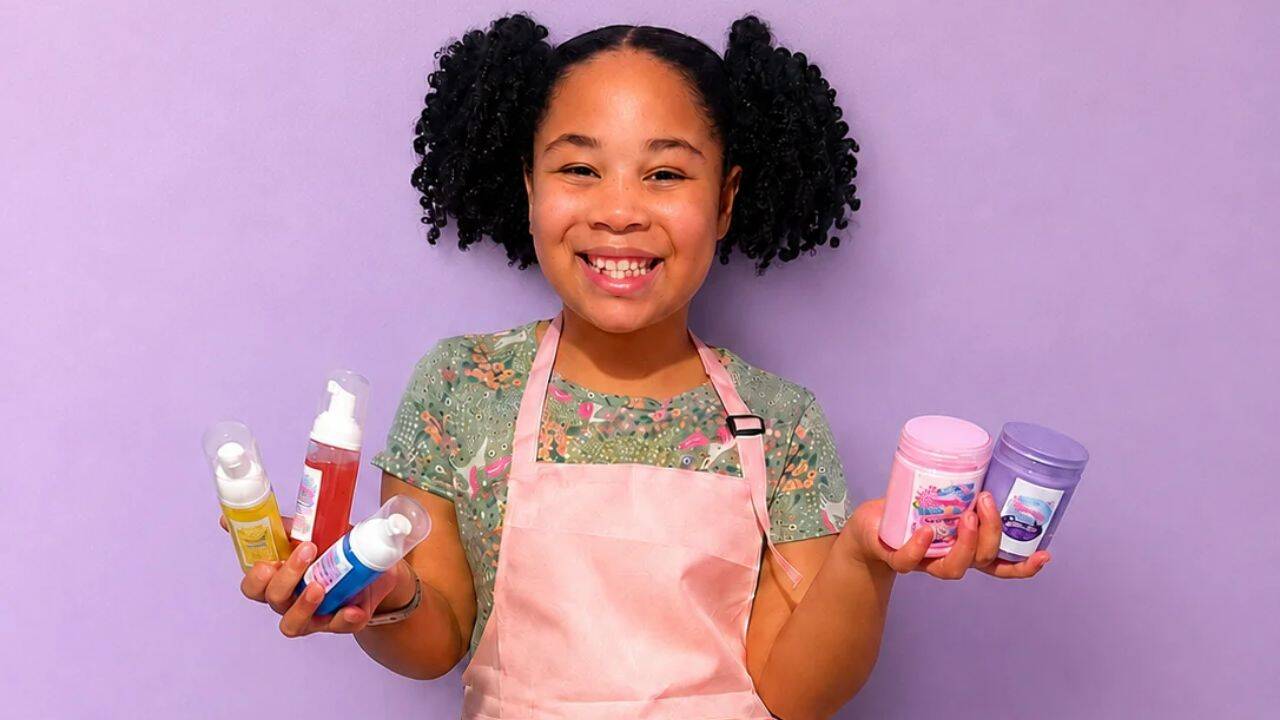
This is the invisible friction millions of families navigate every single day. It is a quiet, exhausting battle fought over toothbrushes, shirt tags, loud blenders, and bars of soap. And it is the exact battleground where a nine-year-old girl from Ohio decided to build an empire.
When news broke recently that a fourth-grader from the Buckeye State had walked away with a $10,000 grand prize in a youth entrepreneurship competition for her sensory-friendly soap business, the headlines treated it like a cute human-interest filler piece. A feel-good puff piece tucked between stock market tickers and local weather forecasts.
They missed the point entirely.
That $10,000 check wasn't a participation trophy handed out to a precocious kid with a lemonade stand. It was venture capital validating a massive, glaring blind spot in modern consumer goods. It was proof that when giant multinational corporations design products for the statistical average, they accidentally engineer daily torture devices for everyone on the margins—and that sometimes, it takes a nine-year-old with a mixing bowl and deep empathy to fix what billion-dollar R&D departments can't even see.
The Architecture of Overwhelm
To understand why a kid-made bar of soap is worth ten thousand dollars, you first have to understand how the human nervous system processes the physical world. Think of your brain as an airport air-traffic controller. Every second, millions of data points—the pressure of socks against your ankles, the smell of coffee brewing down the hall, the flicker of a computer screen—fly toward the control tower. A neurotypical brain effortlessly sorts these signals, waving the harmless ones past and flagging only the genuine threats, like a hot stove or an approaching car.
For roughly one in six children—and millions of adults, particularly those on the autism spectrum or living with ADHD and sensory processing disorder—that air-traffic controller is overwhelmed. Every single plane is treated like an emergency landing. There is no filter. The tag inside a cotton t-shirt doesn't just itch; it screams for attention. And the heavy, artificial perfumes pumped into commercial soaps, shampoos, and lotions aren't merely unpleasant. They are neurological static.
I remember the first time I truly understood this, watching a close friend’s daughter refuse to wash her hands after finger-painting. She wasn't being defiant. She was terrified. To her, the slick, heavily scented liquid in the dispenser was a sensory assault. Her mother had spent hundreds of dollars buying "gentle," "natural," and "baby-safe" washes from big-box pharmacies, only to realize that marketing labels mean very little when you flip the bottle over and read the fine print. "Fragrance" or "parfum"—a single word allowed by federal regulators to hide dozens of undisclosed synthetic chemicals—lurked in nearly all of them.
The personal care industry has spent decades conditioning consumers to equate cleanliness with smell. If your hands don't smell like "Ocean Breeze" or "Warm Vanilla Sugar," did you even wash them? Manufacturers load their formulas with harsh sulfates to create towering mountains of foam, artificial dyes to make the liquid look pretty on a store shelf, and lingering chemical scents designed to cling to your epidermis all day long.
They built a multi-billion-dollar industry around sensory overload. And in doing so, they locked millions of people out of basic comfort.
Kitchen Table Chemistry
Enter our young Ohio entrepreneur. While the rest of the world was busy buying scented foaming hand soaps in bulk, she noticed a problem right in front of her. Whether driven by her own sensory needs, those of a sibling, or a close friend—the universal spark behind almost every great invention—she realized that the simple act of getting clean was causing real distress.
She didn't have a chemistry degree. She didn't have a focus group. What she had was proximity to the problem and the stubborn curiosity that only a nine-year-old possesses.
Start small. Melt the base. Test the texture. Fail. Try again.
Making soap that genuinely respects a sensitive nervous system requires unlearning almost everything commercial manufacturing relies on. When you strip away synthetic fragrances, harsh detergents like sodium lauryl sulfate, and artificial colorants, you are left with the raw physics of fats, oils, and lye. The texture has to be predictable. It cannot leave a waxy film, nor can it strip the skin's natural lipid barrier to the point where hands feel dry and tight. The visual appearance matters, too; swirling neon colors can be visually overstimulating, whereas muted, earthy tones—or pure, unbleached simplicity—invite calm.
Working out of a kitchen in Ohio, testing batches with the rigor of a seasoned formulator, she engineered a line of soaps designed specifically to quiet the noise. No hidden perfumes. No aggressive lather that refuses to rinse away. Just clean, gentle, predictable tactile experiences.
When she stepped onto the stage to pitch her business to a panel of adult judges, she wasn't selling novelty. She was selling relief. Judges at youth entrepreneurship competitions see dozens of pitches every year—dog-walking apps, custom slime kits, T-shirt printing schemes. Most of them are charming exercises in basic math. Buy supplies for two dollars, sell the product for five, pocket the difference.
This pitch was different. She stood before business veterans and explained not just her profit margins, but the lived reality of sensory overwhelm. She articulated a clear market gap, demonstrated a working, tested product, and proved that customers were already buying it because nothing else on the grocery store aisle worked for their families.
The judges didn't just clap. They wrote a check for $10,000.
Why Big Brands Miss the Obvious
It is worth pausing to ask a slightly uncomfortable question: How does a fourth-grader outmaneuver companies with entire skyscrapers full of scientists and marketers?
The answer lies in the economics of mass production. Legacy consumer brands operate on scale. To keep costs down and shelf-life indefinite, they rely on standardized chemical inputs. Developing a truly hypoallergenic, sensory-neutral product line requires sourcing higher-grade, unrefined ingredients, eliminating cheap synthetic fillers, and accepting smaller initial batch runs. For a massive conglomerate, chasing a "niche" demographic looks like a rounding error on a quarterly spreadsheet.
Until you look at the actual numbers.
According to data from the Centers for Disease Control and Prevention, roughly 1 in 36 children in the United States is diagnosed with autism spectrum disorder, a figure that has steadily climbed as diagnostic tools have improved. Expand that circle to include children and adults with ADHD, eczema, severe allergies, migraine disorders triggered by synthetic scents, and sensory processing challenges, and suddenly your "niche" market comprises tens of millions of households.
These are not casual shoppers browsing an aisle for a fun new scent. These are fiercely loyal, desperate buyers who, once they find a product that doesn't trigger a meltdown or a rash, will buy it by the case for the rest of their lives.
Historical precedent backs this up. Consider OXO Good Grips. In the late 1980s, founder Sam Farber watched his wife, Betsey, struggle to hold a standard metal vegetable peeler because of severe arthritis in her hands. He didn't set out to build a medical device; he set out to make a peeler that didn't hurt to hold. He engineered a chunky, oval-shaped handle made of pressure-absorbing rubber. The kitchenware industry told him nobody would pay a premium for an "accessible" peeler. They were wrong. It turned out that a tool designed for arthritic hands was vastly more comfortable for everyone's hands. Universal design—building for the people with the greatest barriers—inevitably creates a superior product for the entire population.
This young Ohio founder stumbled onto the exact same truth in her soap molds. A bar of soap gentle enough for a child with severe sensory sensitivities isn't just good for neurodivergent kids. It is better for a nurse washing her hands forty times a shift, better for a newborn with delicate skin, and better for anyone tired of smelling like an artificial fruit salad.
The Anatomy of a Ten-Thousand-Dollar Pitch
Winning a five-figure grant before you hit double digits requires more than a good recipe; it requires translating empathy into cold, hard business sense. Consider what happens next when a kid actually receives that kind of capital.
For an adult startup, $10,000 barely covers a month of legal fees and a decent website. For a nine-year-old’s kitchen-table operation, it is rocket fuel.
Suddenly, buying carrier oils, shea butter, and packaging in wholesale bulk slashes the cost of goods sold in half. It pays for professional safety testing, proper labeling compliance, and an e-commerce storefront capable of shipping orders beyond Ohio state lines. Most importantly, it buys legitimacy. When a parent searching late at night for "soap for kids who hate washing hands" lands on her website, they aren't just doing a charitable deed by supporting a kid entrepreneur. They are buying a specialized solution from a funded, validated brand.
Yet, running a real business at nine years old comes with genuine, unvarnished challenges. Let's not romanticize the hustle to the point of absurdity. Childhood is short, and turning a passion into an obligation carries real weight. There are orders to pack after math homework is finished, inventory to count when friends are riding bikes down the street, and the sudden pressure of expectations from strangers on the internet.
That is where the adult scaffolding around young founders becomes critical. The goal of youth entrepreneurship isn't to turn fourth-graders into burned-out mini-CEOs obsessed with hustle culture. The goal is agency. It is showing a young person that when they see something broken in their community, they do not have to wait around for a grown-up to fix it. They have the power to mix the ingredients, test the formula, stand in front of a room full of strangers, and build the solution themselves.
The Ripple Effect in the Bathroom
Think back to Leo, standing at that bathroom sink, dreading the turn of the faucet.
Now, swap out the brightly colored, heavily perfumed liquid dispenser on the edge of the counter. Place a simple, unadorned bar of sensory-friendly soap in its spot.
Leo turns the water to lukewarm. He picks up the bar. It doesn't feel greasy, and it doesn't smell like a department store perfume counter. It produces a quiet, creamy wash that rinses clean in three seconds flat, leaving his hands feeling like his own skin—just clean. No tears. No shouting. No lingering chemical ghost haunting his fingertips for the rest of the afternoon. He dries his hands on a soft towel, turns off the light, and walks out into the hallway to start his day.
It is a tiny victory. Nobody writes a press release when a kid washes his hands without crying. There are no trophies handed out in suburban bathrooms on Tuesday mornings.
Yet, those tiny, invisible victories are the exact currency that changes lives. Somewhere in Ohio, a nine-year-old girl looked at a problem the rest of the world ignored, took ten thousand dollars of hard-won prize money, and proved that good business doesn't require shouting the loudest. Sometimes, the most powerful thing you can build is something quiet enough to let everyone else finally breathe.