At 5:45 in the morning, before the South Texas sun turns the asphalt into a shimmering mirage, the diesel engines start rumbling along Highway 83.
This is the hour of the roughneck, the border patrol agent, the nurse pulling a double shift in McAllen, and the third-generation citrus grower checking his irrigation lines. If you want to understand what is actually happening in American politics right now, skip the cable news panels in Manhattan. Drive down to the Rio Grande Valley at dawn, roll down your window, and smell the dust, the diesel, and the damp earth coming off the river.
For decades, political strategists in Washington treated this stretch of borderland like a reliable ATM for the Democratic Party. They assumed that a shared surname meant a shared ballot. They looked at census spreadsheets, saw a booming Hispanic population across Texas, and declared that demographics were destiny. Texas, they promised, was turning blue. It was only a matter of time.
Time ran out on that theory.
Instead of handing Texas to the left, Latino voters along the border and inside the sprawling suburbs of Houston, Dallas, and San Antonio executed one of the most dramatic political realignments in modern American history. They swung toward Donald Trump in 2020, pushed that momentum even further in 2024, and now sit squarely at the center of a high-stakes tug-of-war that will decide the fate of the Republican congressional majority—and the second half of Trump’s presidency—in the 2026 midterm elections.
Washington calls it "the Texas test." Down here, it just feels like kitchen-table survival.
The Myth of the Monolith
To see why the political establishment got this so wrong, consider a hypothetical composite of the modern South Texas voter. Let us call him Mateo.
Mateo is thirty-eight years old. He lives in Hidalgo County, owns a small air-conditioning repair business, coaches his son’s Little League team on Saturdays, and attends Mass most Sundays. His grandparents crossed the river legally in the 1950s to pick cotton, working until their knuckles bled so his parents could open a hardware store. Mateo is fiercely proud of his Mexican heritage. He speaks Spanish with his grandmother and English with his crew.
For years, national pundits assumed Mateo’s top political priority was immigration reform—specifically, softening border enforcement. They couldn't have been further from the truth.
When Mateo looks at the border, he does not see an abstract humanitarian debate playing out on a television screen. He sees his cousin, a U.S. Customs and Border Protection officer, working sixty-hour weeks under relentless stress. He sees local hospital emergency rooms overwhelmed, ranch fences cut, and high-speed chases tearing past his kids' elementary school. More than anything, Mateo looks at his ledger at the end of the month. He sees the price of refrigerant, copper tubing, diesel fuel, and groceries, and he measures every politician by one ruthless metric: Is my family better off than we were four years ago?
Mateo is not a unicorn. He is a statistical reality.
According to U.S. Census data, Hispanics now make up roughly 40 percent of the Texas population, numbering more than 12 million people and effectively tying non-Hispanic whites as the state’s largest demographic group. Yet the term "Latino voter" is a linguistic trap. Treating 12 million Texans as a single political bloc makes about as much sense as assuming a dairy farmer in Wisconsin and a tech billionaire in San Francisco vote the same way because they both speak English.
A fourth-generation Tejano family in Laredo whose ancestors lived on that land before Texas was even a republic holds vastly different cultural and economic instincts than a recent immigrant in El Paso or a young software engineer in Austin. When political consultants ignore those fault lines, they end up blind to the earthquake happening beneath their feet.
How the Map Fractured
If you want proof of how fast the ground shifted, look at Starr County.
Sitting right on the Mexican border, Starr County is roughly 97 percent Hispanic. For more than a century—since 1892, before the invention of the airplane—Starr County voted reliably Democratic in presidential elections. It was as close to an unbreakable political streak as America possessed.
Then came the 2020s. First, Trump slashed the Democratic margin there from sixty points down to five. Four years later, he won Starr County outright, flipping a stronghold that had held firm through the Great Depression, World War II, and the Civil Rights era. Similar shockwaves tore through Zapata, Maverick, and Cameron counties.
I remember standing outside a polling place in Cameron County during the last cycle, watching a retired schoolteacher in a faded blue windbreaker argue gently with her twenty-something nephew wearing a red cap. She talked about Lyndon B. Johnson, Medicare, and the dignity of organized labor—the pillars that built her loyalty to the Democratic Party. He talked about oil field jobs in the Permian Basin, the cost of his pickup truck payment, and a frustration that national Democrats seemed more interested in policing language than protecting paychecks.
Neither of them was angry. Both of them were dead serious. That single conversation captured the generational and economic split running right through the heart of Texas families.
The Midterms Have Different Rules
Here is the catch that keeps Republican strategists awake at night.
Presidential elections are loud, theatrical spectacles fueled by massive turnout and marquee personalities. Midterm elections are quiet, grinding wars of attrition. Historically, the party holding the White House loses seats in the midterms—an almost gravitational law of American politics driven by voter complacency on the winning side and white-hot anger on the losing side.
Trump’s name will not be on the ballot in November 2026. Without him at the top of the ticket, the big question in Texas is simple: Will the working-class Latino voters who showed up for Trump show up for standard-issue congressional Republicans?
Consider what happens next if they stay home.
Across Texas, several battleground congressional districts—particularly along the border in districts like Texas’s 15th, 28th, and 34th, as well as fast-diversifying suburban seats around Houston and Dallas—hang on razor-thin margins. In 2022 and 2024, Republicans poured millions of dollars into Spanish-language radio, opened community centers in predominantly Hispanic neighborhoods, and recruited charismatic Latino candidates who looked and sounded like the districts they wanted to represent.
It worked. Now comes the hard part: governing.
The Pendulum of Promise and Delivery
Winning a voter’s trust is like earning credit at a local hardware store; keeping it requires paying the bill on time.
Many Hispanic voters gave Republicans a chance because they were frustrated by inflation, anxious about border chaos, and alienated by social policies that clashed with their traditional, faith-centered values. In the oil patches of West Texas and the logistics hubs of Laredo, voters wanted deregulation, cheap energy, and an economy that rewarded grit.
Yet political loyalty in South Texas is conditional, not permanent.
If tariffs raise the price of imported goods in border towns whose entire economies depend on cross-border trade with Mexico, voters in McAllen and El Paso will feel it immediately at the cash register. If aggressive deportation sweeps sweep up longtime, law-abiding neighbors alongside violent offenders, families with mixed immigration statuses will recoil. If healthcare costs climb or local schools struggle without federal support, that retired schoolteacher in Cameron County will have plenty of ammunition the next time she talks to her nephew.
Democrats, meanwhile, are licking their wounds and attempting a course correction of their own. Gone are the days when national operatives could parachute into San Antonio two weeks before Election Day, pass out tamales, play a mariachi track, and expect automatic loyalty. Smart Texas Democrats have realized they have to rebuild from the dirt up—talking less about ideological abstractions and more about wages, healthcare access, water infrastructure, and small-business loans.
They know they do not need to win 80 percent of the Hispanic vote anymore to make Texas competitive. Because of the sheer population growth among young Latinos turning eighteen every single day in Texas—hundreds of thousands of new eligible voters each cycle—even a modest five- or six-point swing back toward the Democrats in key districts could flip seats in the U.S. House and hand Speaker’s gavel control back to the opposition.
Why the Whole Country Is Watching
It is tempting for someone living in Ohio, Pennsylvania, or Georgia to look at Texas and think it is just another regional skirmish. That would be a mistake.
Texas is the laboratory where America’s political future is being mixed in real time. The demographic shifts reshaping the Lone Star State—a massive, youthful, economically ambitious Hispanic population moving rapidly into the middle class—are the exact same forces reshaping Arizona, Nevada, Florida, and even parts of the Midwest.
What happens in the Rio Grande Valley and the Houston suburbs during the 2026 midterms will answer two fundamental questions about the American electorate:
First, was the Latino shift toward the GOP a durable realignment—the birth of a permanent, multiracial, working-class conservative coalition—or was it merely a temporary protest vote against high prices?
Second, can either political party actually listen to working people without talking down to them?
People are tired of being treated like demographic data points on a consultant’s PowerPoint slide. They are tired of being told how they should vote based on their last name, their accent, or their zip code. I have talked to too many voters in Texas who feel caught between two parties that only remember their names when November rolls around. They aren't looking for saviors in Washington. They just want leaders who respect their intelligence, protect their neighborhoods, and leave enough money in their bank accounts to fix the transmission when it blows.
Dusk on the Border
Drive back along Highway 83 just as the sun drops below the brush country.
The heat finally breaks, cooling the hood of your truck. Outside a strip mall in Edinburg, the neon lights flicker on above a taqueria, a tax-preparation office, and a campaign storefront with fresh vinyl lettering on the glass. Inside, volunteers are stacking yard signs and taping precinct maps to the drywall.
Down the road, the floodlights along the border wall hum to life, casting long shadows across the mesquite trees and the slow, muddy current of the river.
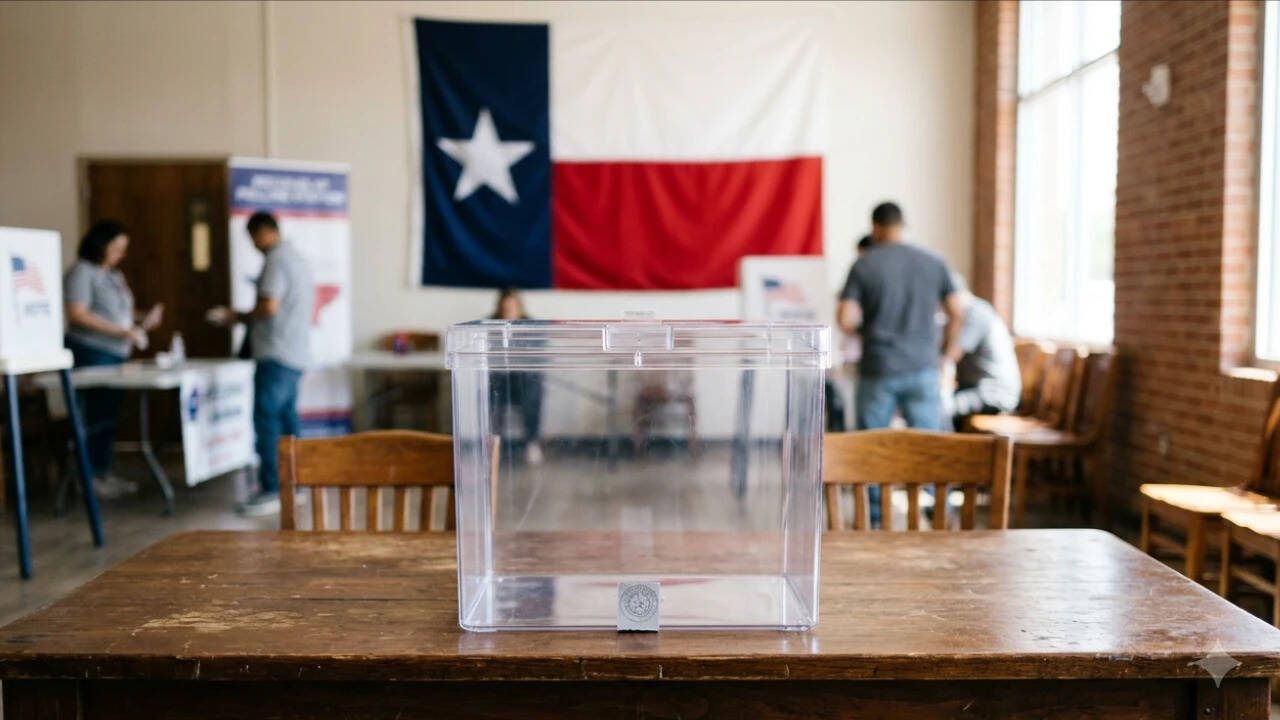
In a few months, millions of Texans will walk into elementary school gyms, church basements, and county courthouses to cast their ballots. Some will vote to double down on the disruption they chose two years ago. Others will vote to pump the brakes. None of them will be thinking about how their choice looks on a national electoral map. They will be thinking about the truck payment, the Sunday sermon, the price of eggs, and the future waiting for their kids on the far side of high school graduation.
And when the polls close and the networks start projecting the winners, the verdict on Washington’s grandest political experiment will be written in ink across South Texas.