Dust.
It is the first thing you notice when you step into the back rooms of a county archive. Not the romanticized, cinematic dust that dances in a single shaft of sunlight, but a sterile, institutional particulate. It is the microscopic debris of decaying leather, crumbling wax, and human skin. It is the smell of forgotten time.
Let us construct a man to sit in this dust. We will call him Arthur. Arthur is a hypothetical construct—a composite stand-in for the very real, very quiet army of unpaid volunteers who spend their Tuesdays in the fluorescent-lit basements of the United Kingdom’s records offices. He is a retired civil servant, perhaps, a man who finds comfort in order, in the slow, methodical categorization of the past.
On a rainy morning, Arthur is given a box.
It is an unremarkable cardboard box, acid-free, numbered with a stark black marker. Inside rests the correspondence of an 18th-century aristocrat—a minor political figure whose name has been completely swallowed by history. Arthur’s job is simple but punishingly tedious. He must pull out a document, read enough of the faded, looping cursive to understand what it is, log a brief description into a digital database, and place it in a fresh, protective sleeve.
Most of it is excruciatingly mundane. A dispute over a property line in Sussex. A bill for a carriage repair. A letter complaining about the damp weather and a nagging case of gout.
Then, Arthur unfolds a larger sheet of paper.
He notices the texture first. It does not feel like the cheap wood-pulp paper of the modern era, which turns yellow and brittle in a matter of decades. This is rag paper, made from woven linen and cotton fibers. It is thick, substantial, and surprisingly soft. It has survived more than two centuries in a damp English manor without dissolving.
He adjusts his reading glasses. The ink is a rusty, faded brown—iron gall ink that has slowly oxidized into the fibers. The handwriting is aggressive, hurried, but clear.
He begins to read.
When in the Course of human events...
Arthur stops. He blinks. The hum of the climate control system suddenly seems very loud. He reads the next line.
...it becomes necessary for one people to dissolve the political bands which have connected them with another...
He is holding a contemporary, handwritten copy of the United States Declaration of Independence.
To understand the sheer, heart-stopping gravity of this discovery, you have to understand the physical reality of 1776. We are accustomed to information moving at the speed of light. A thought is typed in Washington and read in London a millisecond later. But in the late 18th century, information was tethered to the physical world. It moved at the speed of a wooden ship fighting the currents of the North Atlantic.
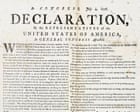
When the Continental Congress agreed to the text of the Declaration on July 4, they immediately sent it to a printer named John Dunlap. He worked through the night, setting the type by hand, locking it into a press, and printing an estimated two hundred broadsides. These were posters, meant to be slapped onto tavern walls and read aloud to nervous crowds in village squares.
Today, only twenty-six of those original Dunlap broadsides are known to exist.
But printing was only one part of the equation. To truly spread the rebellion, the words had to be copied by hand. Clerks, politicians, and ordinary citizens sat down with quill and ink, copying the text from the printed broadsides onto personal sheets of paper. They folded these copies, sealed them with wax, and handed them to riders.
Some of those copies were bound for England.
Consider what it meant to carry this document across the ocean in the late summer of 1776. If you were a British spy operating in Philadelphia, you copied it to send an intelligence report back to your superiors in Whitehall. Look at what these madmen have done. If you were an American loyalist, you sent it to relatives in London as proof of the colonies' descent into treasonous anarchy.
This piece of paper was not just a philosophical treatise. It was a live grenade. It was a physical manifestation of high treason against the Crown. If an English naval vessel stopped your ship and found this document in your trunk, you would hang.
Yet, someone wrote it out. Someone folded it. Someone risked the crossing.
The ship would have fought the heavy swells of the Atlantic for four to six weeks. The paper would have been subjected to the pervasive, salty dampness of a wooden hull. Finally arriving in a British port, it would have been loaded onto a carriage, bumping along rutted dirt roads until it reached its destination—perhaps the very aristocrat whose correspondence Arthur the volunteer is now cataloging.
How did the aristocrat react when he read it? Did he laugh at the audacity of a bunch of colonial farmers declaring themselves equal to the British Empire? Did he throw it onto his desk in disgust?
Whatever his reaction, he did not destroy it. He folded it back up. He filed it away with the carriage repair bills and the complaints about the gout.
And there it sat.
It sat in the dark while King George III went mad. It sat through the French Revolution. It slept undisturbed while the British Empire conquered the globe and then slowly fractured. It remained tucked away while zeppelins dropped bombs on London in the first World War, and while the Blitz shattered the city in the second. Through all the screaming violence and deafening noise of two and a half centuries of human history, this piece of paper rested in utter silence.
Until a volunteer opened a box on a rainy Tuesday.
There is a profound irony in this survival. The Declaration of Independence is the ultimate anti-British document. It is a litany of grievances against the British King, accusing him of tyranny, cruelty, and destruction. Yet, one of its rarest, most pristine contemporary copies was preserved not in a heavily fortified, argon-filled encasement in Washington D.C., but in the accidental, benign neglect of a British country estate.
We owe an incalculable debt to this neglect.
We tend to view history as a series of deliberate actions. We build grand museums. We carve faces into mountains. We believe that we are carefully curating the story of humanity for future generations. But the truth of historical preservation is far more chaotic.
The survival of our collective memory relies heavily on luck, oversight, and a bizarre human reluctance to throw things away. People keep boxes of paper because sorting through them is too much effort. Decades pass, the owners die, and the boxes are shuffled into attics, then basements, and eventually, if they are incredibly fortunate, into the hands of a county archive.
This brings us back to the volunteers.
It is difficult to overstate the importance of the work being done by the Arthurs of the world. Archival institutions are chronically underfunded. They are stuffed to the rafters with thousands of linear feet of uncatalogued boxes. A professional archivist might spend their entire career managing the intake of these collections, ensuring the climate control is functioning, and fighting for budget scraps just to keep the lights on.
They simply do not have the manpower to read every piece of paper.
Without the retirees, the amateur historians, the people willing to sit in the dust for zero pay just for the quiet thrill of touching the past, the vast majority of our history would remain effectively lost. A document that is sitting unread in an uncatalogued box is no better off than a document that has been burned to ash. It is functionally invisible.
When a volunteer spots an anomaly—when they recognize the rhythm of a sentence that does not belong in a stack of 18th-century tax receipts—they are performing a rescue operation. They are pulling a voice back from the edge of the void.
To hold a document like this is to experience a collapse of time.
The glass barriers of history shatter. You are no longer reading an abstract text printed in a textbook. You are holding the physical output of a human body that lived centuries ago. You can see where their quill paused. You can see the slight variation in the thickness of the letters as the ink began to run dry before they dipped the pen again. You can almost hear the scratch of the nib against the rag paper.
The words themselves, despite their familiarity, suddenly feel dangerous again.
We hold these truths to be self-evident, that all men are created equal...
In a quiet room in the United Kingdom, those words ring out not as an established, unshakeable national creed, but as what they originally were: a terrifying, radical argument made by desperate people facing down the greatest military power on earth.
The discovery of a vanishingly rare copy of the Declaration of Independence is not just a triumph of archival science. It is a reminder of the fragility of truth. We take our history for granted. We assume the great documents, the foundational ideas, will always be there. But ideas do not survive in a vacuum. They survive because they are written down. They survive because the paper does not rot. They survive because someone refused to throw the box away.
And they survive because, eventually, someone takes the time to sit in the quiet, open the box, and read.
Arthur logs the document. He slides it into a protective Mylar sleeve. He will notify the head archivist. There will be verifications, authentication processes, perhaps a press release, and a brief flurry of international news coverage. The piece of paper will become famous. It will be moved to a secure vault. It will never again sit in a cardboard box next to a recipe for treating gout.
But for a few more minutes, it is just Arthur and the paper.
The quiet rebellion resting on a table. The ink oxidized into the linen. A fire set two hundred and fifty years ago, folded up in the dark, still burning.