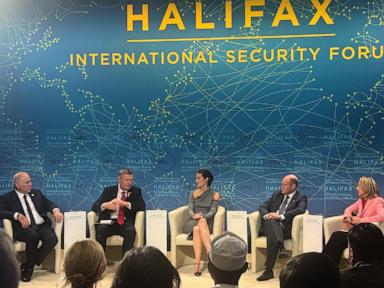
The hotel lobby in Halifax smells like wet wool, roasted espresso, and decades of unspoken agreements. For years, this was the room where the real work happened. Not at the podiums, where defense ministers delivered carefully scrubbed speeches for the cameras, but in the corners by the coat check, where a Canadian colonel and an American planner could stand with lukewarm paper cups and hash out how to keep a radar station running in the high Arctic before the winter ice locked in.
Now, look at the empty chairs. Learn more on a connected topic: this related article.
A U.S. senator recently stepped up to the microphones in Washington to clarify a piece of news that had sent a quiet shudder through Ottawa and the Pentagon alike. Yes, the Pentagon had placed new restrictions on engagement with Canada. No, the senator insisted, this was not a severance of military ties, nor a teardown of the continent's shared defense grid. The new rules, the lawmaker explained, were narrowly targeted. They focused on think tanks and social events.
On paper, that sounds like bureaucracy trimming fat. It sounds like an accountant taking a red pen to an expense report—cutting out the steak dinners, the reception cocktails, and the endless panel discussions in brightly lit conference rooms. If you read the dry wire reports, you might shrug and move on. Who cares if generals and policy analysts have to skip a few hors d'oeuvres? Further reporting by TIME highlights related perspectives on the subject.
Pause. Think about how two nations actually stay married for eighty years.
When you strip away the treaties, the joint command centers, and the billion-dollar procurement contracts, an alliance is just a collection of human beings who trust each other enough to pick up the phone at three in the morning. And that trust is rarely built inside a classified briefing room. It is forged in the margins. It happens at the think tank roundtables where bad ideas are killed quietly before they become official policy, and at the social events where two people from different flags realize they share the same dark humor and the same fear of getting it wrong.
The Architecture of a Whisper
To understand why a restriction on think tanks and social gatherings carries such heavy invisible stakes, you have to understand how Washington and Ottawa actually talk to one another.
I spent years covering defense policy on both sides of the 49th parallel, watching the machinery of North American security grind forward. From the outside, the relationship between the United States and Canada looks like an automated juggernaut—an unbreakable wall of radar domes, fighter jets, and shared intelligence known as NORAD. People assume it runs on autopilot. It does not. It runs on friction, compromise, and thousands of informal conversations that never make it into an official transcript.
Consider a hypothetical scenario, built from a hundred real nights I have witnessed in Washington and Ottawa. Picture a mid-level Pentagon strategist—let's call him Mark—and a Canadian defense analyst named Claire. They are standing near a buffet table at a security forum hosted by a non-partisan think tank. Neither of them is authorized to negotiate a treaty. Neither of them is carrying a briefcase full of classified blueprints.
Over bad white wine, Claire mentions that a new Canadian procurement timeline is slipping because of supply chain bottlenecks in Ontario. Mark mentions that the Pentagon is quietly shifting its logistical priorities in the North Atlantic. Neither statement is a secret, yet neither would ever appear in an official diplomatic cable. By the time they throw their napkins in the trash, both of them know how to adjust their respective plans back at the office so their two militaries do not collide in the dark six months later.
That is what happens at think tanks and social events. They are the shock absorbers of statecraft.
When the Pentagon draws a line and tells its personnel to step back from those spaces when Canada is in the room, it is not dismantling the engine. It is draining the oil. The gears will still turn for a while. The metal will still meet metal. Until one day, under stress, the friction becomes heat, and the heat becomes smoke.
What the Senator Actually Said
Let us look closely at the facts on the ground, without embellishment. When word leaked that the Pentagon was tightening the rules on how Defense Department officials interact with Canadian counterparts, alarms went off across the border. Canada is not just a neighbor; it is the only nation on earth that shares a formal, binational military command with the United States. Since the height of the Cold War in 1957, American and Canadian officers have sat side by side in bunkers, watching the skies over the North Pole together.
So when whispers of restrictions surfaced, the immediate fear in Ottawa was operational. Would joint exercises stall? Would intelligence sharing slow down? Would the daily choreography of continental defense hit a wall?
The U.S. senator's clarification was meant to pour cold water on that panic. The restrictions, the senator emphasized, do not touch core military-to-military operations. They do not halt joint patrols, intelligence pipelines, or command structures. Instead, the directive targets informal venues—specifically policy forums hosted by think tanks and diplomatic or social receptions.
In Washington, policy shifts like this rarely happen in a vacuum. They are usually born out of frustration, budget scrutiny, or political signaling. Sometimes an administration wants to send a message to an ally that is lagging on defense spending targets, or dragging its feet on modernizing aging Arctic infrastructure. Other times, Pentagon leadership decides that too many officials are spending too much time on the "rubber chicken circuit"—attending panels, delivering remarks at private institutes, and mingling at embassy receptions rather than staying focused on core readiness.
Whatever the internal trigger, the message was unmistakable: the official channels remain open, but the side doors are locked.
The Myth of Purely Official Channels
There is a seductive logic to banning social events and think tank panels. To a taxpayer or a hard-nosed budget hawk, those gatherings look like elite pageantry. They picture ambassadors clinking glasses under chandeliers while think tank fellows trade buzzwords that never change the price of bread or the readiness of a rifle platoon.
I used to share some of that cynicism. Early in my career, watching diplomats work a room in Georgetown, it was easy to dismiss the whole affair as theater. Why couldn't two governments just send each other memos? Why did the taxpayer need to fund travel budgets so a colonels' panel could debate maritime sovereignty in front of a hundred policy wonks?
Then I watched a crisis unfold in real time, and my cynicism evaporated.
Think of the relationship between two allied militaries like a suspension bridge. The massive steel cables—the treaties, the joint commands, the formal summits—carry the obvious weight. You can see them from miles away. You can measure their tension. You can write laws about them.
But a suspension bridge does not survive a hurricane because of the main cables alone. It survives because of the thousands of smaller suspender ropes, dampers, and expansion joints that allow the bridge to sway without snapping. Those smaller pieces are the informal networks. They are the personal relationships built over years of seeing the same faces at the same conferences, arguing over the same maps at think tank workshops, and sharing a quiet word in the hallway after the cameras have been turned off.
When you restrict participation in think tanks and social events, you are not cutting the main cables. You are unbolting the expansion joints. On a calm, sunny day, the bridge looks completely unchanged. Traffic moves across it at highway speed. Anyone standing on the shore can point to it and say, truthfully, that the bridge is still standing.
The test does not come on a sunny day. The test comes when the wind picks up.
Why the Timing Hurts
To understand the emotional weight of this moment in Ottawa, you have to look at the broader weather pattern between the two countries.
For decades, Canada operated under an unspoken assumption: geography and shared history guaranteed an automatic seat at Washington's table. Canadians knew they were the junior partner in the relationship—economically, militarily, demographically—but they believed their loyalty bought them permanent, frictionless access. They fought alongside Americans in Normandy, in Korea, in the mountains of Kandahar. They opened their homes to stranded American airline passengers on September 11, 2001.
In return, Canada often underspent on its own military, quietly relying on the American security umbrella while channeling domestic funds into healthcare and social programs. Washington complained about it politely behind closed doors for forty years.
Then the world changed. The Arctic ice began to melt, opening new shipping lanes and exposing vast mineral wealth to Russian and Chinese ambitions. Great power competition returned with a vengeance. Suddenly, the sleepy northern border was no longer a buffer zone; it was a front line. Washington's patience with Ottawa's sluggish defense spending and delayed procurement began to wear thin.
Against that backdrop, a Pentagon restriction on think tanks and social events lands very differently in Ottawa than it does in Washington. In Washington, it is a line item—a targeted administrative adjustment. In Ottawa, it feels like a cold shoulder at a dinner party where you thought you were family.
I spoke recently with a retired Canadian general who spent half his career posted in the United States. He wasn't angry about the Pentagon's rule. He was just tired. He described the slow, subtle shift he has watched over the last decade: how conversations have become slightly more guarded, how agendas have become slightly more rigid, how the effortless warmth that used to define the U.S.-Canada defense relationship has required a little more effort every year.
"When you stop going to each other's receptions," he told me, "you stop knowing who is getting promoted, who is stressed out, and who is actually calling the shots. You start reading each other's press releases instead of reading each other's faces."
The Invisible Cost of Silence
Think tanks, in particular, play a role that the public rarely sees. They are the intellectual sandboxes of foreign policy.
When a government official speaks at an official bilateral meeting, every word is vetted by lawyers, public affairs officers, and political appointees. Nobody takes a risk. Nobody floats an unbaked idea, because an unbaked idea in an official meeting becomes an international incident by sundown.
Think tank workshops—especially those held under rules that forbid attributing quotes to specific speakers—are the exact opposite. They are the one place where an American defense planner and a Canadian strategist can sit across a table and say, What if our current plan for Arctic radar is completely obsolete in five years? How do we fix it without blowing up our budgets?
Those conversations do not produce treaties. They produce understanding. They allow two bureaucracies, each trapped inside its own political constraints, to see the world through the other's eyes.
Cut off that avenue, even partially, and both sides retreat into their silos. The Americans make plans based on what makes sense in Arlington, Virginia. The Canadians make plans based on what survives Parliament Hill in Ottawa. And by the time those two plans meet in an official briefing room months later, both sides have already dug into their positions. Compromise becomes harder. Friction becomes personal.
It is a slow drift, almost invisible to the naked eye. Nobody wakes up one morning and declares the alliance over. Instead, an invitation goes unanswered. A panel seat goes unfilled. A reception room feels a little quieter than it did the year before.
What Happens When the Room Empties
Let us be clear about what is not happening here. The United States and Canada are not becoming adversaries. NORAD is not closing its doors. American and Canadian pilots will still scramble together if an unidentified aircraft approaches North American airspace. The U.S. senator's clarification is grounded in reality: the core machinery of continental defense remains intact.
Yet truth in politics rarely lives in the extremes. The danger for the U.S.-Canada relationship was never a dramatic rupture. The danger has always been neglect—the slow, quiet erosion of habit.
Habit is what makes an alliance feel effortless. When two militaries work together for eighty years, they develop a shared shorthand. They know what a pause on a phone call means. They know which rules can be bent in an emergency and which lines must never be crossed. That shorthand is not taught in military academies. It is absorbed through proximity. It is learned at the conference tables of think tanks, in the hallways of hotels in Halifax, and over lukewarm coffee at receptions where nobody is taking notes.
When you tell people to skip the room, you do not just save travel money or send a political signal. You interrupt the transfer of that shorthand to the next generation of officers and analysts. The young captain from Texas and the young major from Ontario never get the chance to stand by the coat check and realize they are solving the same puzzle.
Back in that Halifax hotel lobby, the espresso machine still hisses behind the counter. The rain still streaks the tall windows looking out over the harbor. Conferences will still be held, speeches will still be given, and press releases will still assure the public that the partnership between neighbors remains as strong as ever.
And maybe, on paper, it is.
But if you want to know the true temperature of an alliance, do not read the treaties. Do not listen to the speeches at the podium. Just look at the corner by the coat check, and see who is still willing to stay after the meeting ends.


