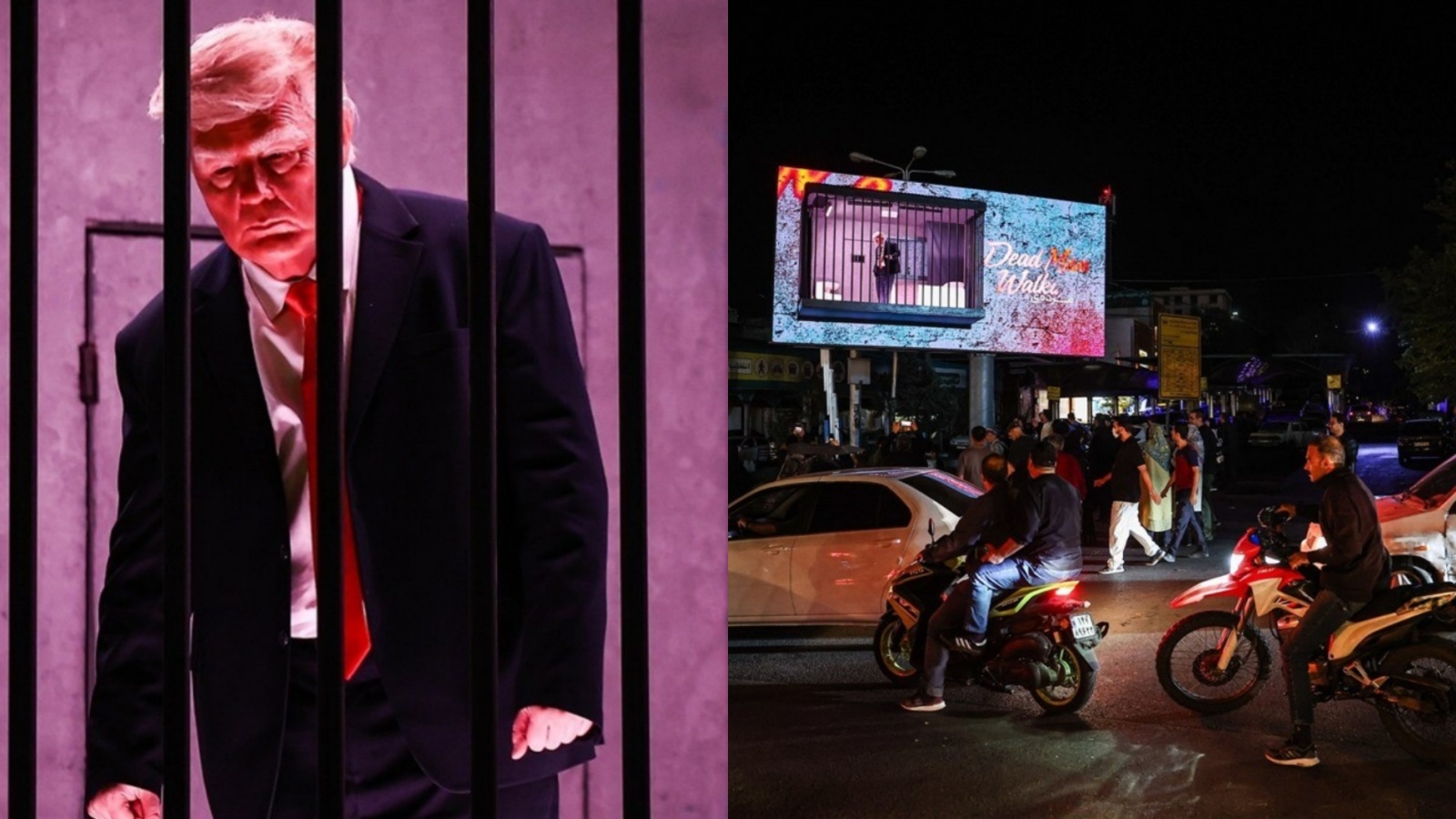
A giant metal cage. A recognizable face. A central square in Tehran.
Every time a stunt like this goes up, the lazy consensus writes the same predictable story. Outrage on one side. Triumphalism on the other. Cable pundits and wire reporters treat a Tehran square installation as a direct punch thrown at Washington, proof of ideological dominance or escalating street-level hostility.
They are reading the wrong ledger.
A public square installation putting a foreign leader behind bars is not a display of power. It is a symptom of leverage deficit. When a state or movement has real, decisive levers over an adversary, it uses them quietly or surgically. It does not need theatrical ironwork on a roundabout to convince its own citizens—or the outside world—that it is in control.
I have spent years studying political messaging, strategic communications, and information warfare across high-friction regions. I have seen governments and campaigns blow fortunes on monumental spectacles that looked ferocious on a camera lens and accomplished next to nothing on the ground. Spectacle is cheap compared to statecraft. Paint, steel, scaffolding, and a photo-op cost pennies relative to real geopolitical influence. Yet media analysts keep mistaking loud staging for structural strength.
What Everyone Gets Wrong About Political Street Theater
The standard takeaway from a Tehran square installation is that it represents pure, unfiltered state conviction. That framing misses how public display actually functions under tight information control and economic strain.
First, let's get the terminology straight. Propaganda is systematic messaging designed to shape attitudes and align behavior toward a political goal. Psychological projection is attributing one's own constraints, frustrations, or vulnerabilities onto an outside figure. When a public installation locks a rival leader inside bars, it blends both—but the projection does the heavy lifting.
Think about the audience. A billboard or sculpture in a capital city speaks to three groups at once:
- Domestic commuters stuck in traffic who care far more about inflation, currency swings, and daily groceries than symbolic cages.
- Foreign journalists looking for a visual hook to turn a complex standoff into a neat headline.
- Political insiders signaling loyalty or settling internal scores through approved cultural channels.
Notice who is missing from that list: the person depicted behind the bars. Donald Trump does not govern from a roundabout in Tehran, and a symbolic cage in Iran changes zero votes in Ohio or Florida. In fact, for political figures built on grievance and defiance, being cast as a captive target by an adversarial capital can easily be flipped into fuel back home.
Imagine a scenario where a municipal communications team has a tight budget after a rough fiscal quarter and zero breakthroughs at the negotiating table. What is the fastest way to look combative without taking a single real-world risk? Build a big visual in a high-traffic square, wait for foreign outlets to run photos of the Tehran square installation, and call the outrage cycle a win.
That is not dominance. That is compensatory theater.
The Mechanics of Symbolic Escalation
Why do commentators fall for this every single time? Because visual contrast is seductive. Bars are immediate. A well-known face is unmistakable. A headline like "Tehran square installation puts 'Trump' behind bars" gives a busy reader an instant mental picture without requiring any background knowledge.
Good political communicators—going back to scholars like Harold Lasswell on propaganda analysis and Jacques Ellul on how modern mass media interacts with state messaging—have long pointed out that modern spectacles rely on emotional shorthand. They bypass slow, analytical thinking. You do not need to explain sanctions regimes, regional proxy dynamics, or diplomatic backchannels when you have a literal cage on a city street.
Yet shorthand has a major flaw: it flattens cause and effect.
When analysts treat street art or public installations as a barometer of real power, they confuse visibility with impact. Visibility measures how many people see an image or click a link. Impact measures whether anyone's actual options, incentives, or behavior changed afterward.
Consider the gap between the two:
| Dimension | Street Installation / Symbolic Stunt | Hard Strategic Leverage |
|---|---|---|
| Primary cost | Low upfront material and staging cost | High economic, diplomatic, or security cost |
| Speed of execution | Fast; days or weeks to fabricate and mount | Slow; requires coalition building, resources, or patience |
| Target's real constraint | Minimal; no direct operational friction | High; alters budgets, trade flows, or options |
| Risk of backfire | Moderate to high; easily mocked or repurposed | Varies; depends on miscalculation and retaliation |
A cage made of steel is static. It sits there in the sun and rain, attracting gawkers, selfie-takers, and skeptics alike. Real leverage moves pieces on the board without needing applause.
Answering the Questions People Actually Search
When a story like this breaks, search behavior follows a very familiar pattern. People type quick questions trying to decode what it means. Most of those questions are framed around the wrong assumption.
Does a public installation like this scare Washington or shift U.S. policy?
No, and asking whether a street display intimidates Washington starts from a faulty premise. Foreign policy decisions in Washington are driven by domestic politics, alliance dynamics, military and intelligence assessments, energy and trade interests, and institutional inertia—not by how angry a piece of street staging looks in a foreign capital. If anything, dramatic anti-American visuals in a rival city often harden hawkish talking points rather than soften them.
Is this proof of massive grassroots enthusiasm in Iran?
Assuming a state-backed or tolerated installation in a tightly managed public space equals organic mass enthusiasm is a classic analytical trap. Public space in authoritarian or semi-authoritarian capitals is curated. What goes up in a major square reflects institutional permission and official priorities far more reliably than it measures private opinion in living rooms or cafes. A crowd taking photos near a weird or provocative structure does not equal ideological devotion; people look at unusual things on their commute all the time.
What do ordinary citizens actually take away from these displays?
Brutally honest answer: usually fatigue or dark humor. When people are dealing with steep living costs, power headaches, or restricted opportunities, grand symbolic gestures can feel detached from everyday reality. Slogans and cages do not lower grocery prices or fix infrastructure. Over time, repeated over-the-top displays tend to breed cynicism rather than awe.
Where My Contrarian Take Can Go Wrong
Being contrarian for its own sake is just another lazy habit. Dismissing every symbolic act as "mere theater" has real blind spots, and I owe you the honest caveats.
First, symbols are not completely weightless. In politics, framing matters over long stretches of time. Repeated visual narratives help set the emotional baseline for a society, defining who "us" and "them" are and what counts as acceptable hostility. Even cynical citizens absorb repetition if it goes unchallenged for decades.
Second, misreading local subtext is easy from thousands of miles away. Sometimes a public display aimed outward is actually a coded message to a domestic faction—hardliners signaling to moderates, or cultural managers proving their ideological orthodoxy to superiors. If you only analyze the foreign target on the billboard, you miss the internal power struggle happening behind it.
Third, underestimating an adversary because they rely on loud messaging is a dangerous mistake. Noise and capability are separate variables. A regime or movement can put up cheesy or theatrical street displays and still possess serious asymmetric tools elsewhere. Treating flashy propaganda as proof of total weakness is just the flip side of treating it as proof of total strength.
What You Should Do Instead When Reading the Next Headline
If you work in media, policy, finance, marketing, or simply care about not getting played by outrage bait, stop reacting to the cage and start auditing the incentives.
- Audit the budget and timing. Ask why this specific installation appeared right now. Did it distract from bad economic news, a diplomatic stall, or an internal dispute? Timing usually reveals the real motive.
- Separate the headline from the hardware. A headline turns a piece of urban staging into a geopolitical earthquake. Look at what actually changed on the ground after the cameras left. Usually, nothing.
- Watch the domestic reaction, not just the viral clip. Viral outrage outside a country tells you what foreigners want to argue about. How locals talk, joke, or shrug tells you what the message actually landed like.
- Stop rewarding cheap spectacle with free airtime. Every dramatic photo amplified without context hands low-cost attention to whoever built the prop. Demand context before you share or react.
Next time a square installation puts a rival leader behind bars, skip the melodrama. Look past the steel and the paint, check who needed a distraction, and watch what real leverage is doing out of sight.