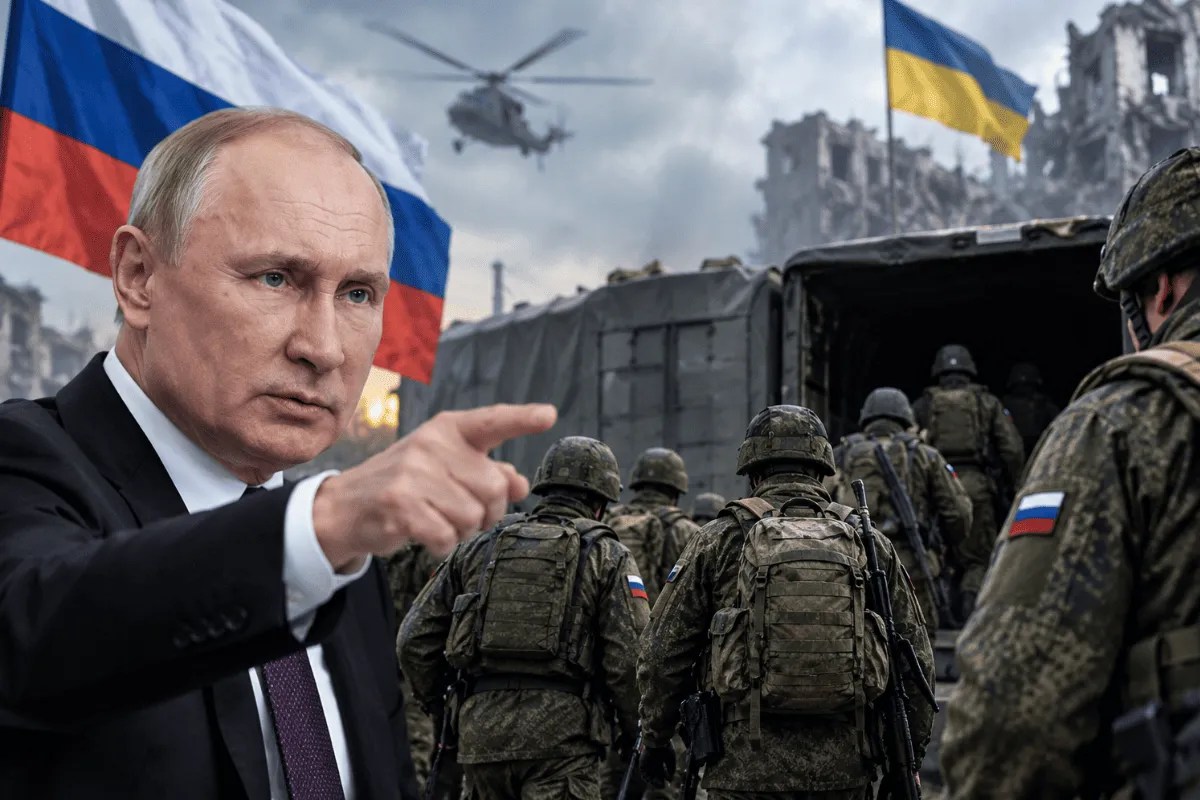
Ink dries quickly on cheap paper. Sometimes, it dries before the man holding the pen realizes what he has signed away.
In quiet rooms across borders far from the frost and mud of eastern Europe, advertisements flicker on cheap screens. They do not speak of artillery craters or drone-filled skies. They speak of stability. They speak of clearing old debts, of sending money back to a family waiting in a dusty courtyard thousands of miles away, of a clean passport and a fresh start. Sixteen lakh rupees. To a young man watching his savings dwindle to nothing, that number looks less like a wage and more like an exit.
Russia’s military recruitment apparatus has shifted gears. As the protracted war in Ukraine grinds through battalions, the search for manpower has expanded outward, drawing in foreign nationals through financial incentives, promises of citizenship, and administrative labyrinthine contracts. It is a quiet pipeline running from bustling metropolitan hubs and quiet rural towns alike, turning global economic anxiety into fuel for a distant front.
Consider how it starts.
A text message. A casual conversation with an acquaintance who claims to have found work abroad—logistics, security, warehouse management in Saint Petersburg or Moscow. The terms are generous. The ticket is paid. Only after arrival, as foreign citizens find themselves steered away from civilian depots and toward military registration offices, does the reality harden. The contract, written in Cyrillic, becomes a binding instrument. Sign here, or find yourself stranded in a foreign city with an expired visa and no way home.
This is not a conscription of force at the outset; it is a conscription of circumstance.
Global labor migration has always been driven by desperation. When local economies stagnate, young men look outward. They become construction workers in the Gulf, delivery riders in European capitals, factory hands in industrial corridors. Recruitment brokers know this vulnerability intimately. They pivot effortlessly from offering civil employment to dangling military contracts under the guise of auxiliary support or non-combat zones.
By the time the truth sets in—when the training grounds appear on the horizon and the rifles are handed out—the administrative walls have closed. Passports are routinely collected for "processing." Movement is restricted. The promised salary of roughly sixteen lakh rupees, equivalent to a small fortune in many developing economies, serves as both the hook and the golden handcuff.
The mechanics of this recruitment reveal a distinct structural adaptation. Modern warfare consumes immense amounts of human capital. When domestic political costs limit sweeping new mobilization waves, governments look to alternative reservoirs of personnel. Foreign nationals from South Asia, Central Asia, and parts of Africa represent an available demographic: often economically squeezed, desperate for upward mobility, and isolated from domestic political safety nets.
Diplomatic missions have begun issuing urgent advisories. Foreign ministries in New Delhi and other capitals have repeatedly warned citizens against taking up dubious job offers abroad that promise lucrative security or support roles in Russia, only to find themselves funneled into combat zones. Families back home speak of relatives who left for a warehouse job and stopped answering their phones three weeks later.
There is an eerie silence that follows these departures.
A phone call home might happen once every fortnight. The voice is clipped, cautious, reassuring in a way that sounds rehearsed. Everything is fine. The food is okay. We are still training. But the background noise tells a different story—the low rumble of heavy diesel engines, the sharp wind of a northern steppe, the flat, tired cadence of men who know they are living on borrowed time.
Behind the geopolitical chessboard lie individual human equations. A father trying to pay for his daughter’s college tuition. A brother trying to clear ancestral debt. These are not ideological combatants. They harbor no geopolitical grievances against Kyiv, nor do they bear any personal malice toward the men in the trenches opposite them. They are economic casualties of a different kind, caught in a gravitational pull that draws the poor of the world into the conflicts of the wealthy and powerful.
When the contract is signed, the individual ceases to be a person with a name and a history. He becomes a unit of operational capacity.
The tragedy of this dynamic is its predictability. In every major conflict of the modern era, the peripheries bleed for the centers. Empires and states rely on the disenfranchised to fill the gaps where patriotism fails. Financial desperation is a more reliable recruiting sergeant than national pride ever was.
As diplomatic channels scramble to repatriate those who realize their mistake too late, the recruitment pipelines adapt. They shift phrasing. They use new intermediary agencies, untraceable messaging apps, and hidden transit routes through third countries. The digital footprint is erased almost as quickly as it is created.
The sixteen lakh rupees rarely arrive in full, and when they do, they often return as death benefits sent to grieving families who never wanted the money in the first place. They wanted their son back. They wanted the phone call that didn't sound rehearsed.
The snow falls quietly over the plains of eastern Europe, blanketing the churned earth, the abandoned equipment, and the unmarked graves. Somewhere, a phone buzzes on a nightstand in a quiet house thousands of miles away. Another message arrives. Another promise of work. Another signature waiting to be dried on a page that nobody reads until it is far too late.



