In a small wood-paneled kitchen in the high Alpine village of Isenthal, the radio isn’t just an appliance. It is a lifeline. To the woman stirring a copper pot of polenta, the voice coming through the speakers in Rumantsch—a language spoken by fewer people than could fill a mid-sized football stadium—is the only proof that her culture still breathes. If that voice goes silent, a part of Switzerland dies with it.
But down in the sleek, glass-fronted offices of Zurich, a different conversation is happening. It’s about 335 Swiss francs. That is the current annual mandatory fee every household pays to fund the Swiss Broadcasting Corporation (SRG SSR). To some, it is a small price for national identity. To others, it is an outdated tax, a relic of a pre-streaming era that has no business reaching into the pockets of citizens who might prefer Netflix or YouTube.
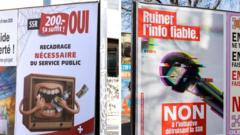
Switzerland is currently hurtling toward a democratic collision. A right-wing initiative, cheekily titled "200 francs is enough," has gathered enough momentum to force a national referendum. The proposal is simple, brutal, and seductive: slash the annual license fee from 335 francs to 200.
On the surface, it looks like a win for the taxpayer. Who doesn't want an extra 135 francs in their pocket at the end of the year? But beneath the arithmetic lies a question that goes to the very marrow of what it means to be a country.
The Invisible Architecture of a Nation
Switzerland shouldn't work. It is a geographical impossibility held together by four languages, dozens of cantons with fierce independent streaks, and a deep-seated suspicion of centralized power. What binds a French-speaking watchmaker in Geneva to a German-speaking banker in St. Gallen and a stone-mason in the Italian-speaking Ticino?
It isn't just the chocolate or the mountains. It is the shared information space.
The SRG SSR is the invisible architecture that allows these disparate groups to talk to one another. When a national debate happens, it happens across all linguistic borders simultaneously. The public broadcaster is legally mandated to provide the same quality of news, culture, and entertainment to the tiny Rumantsch minority as it does to the massive German-speaking majority.
This is where the math gets complicated.
Producing high-end television in four languages is an economic nightmare. If Switzerland were a purely commercial market, the French and Italian stations would likely go bankrupt within a month. The German-speaking market would survive, but it would be flooded with cheap imports from Germany. The "Swiss-ness" of the media—the specific focus on local politics, local sports, and local values—would evaporate.
Consider the hypothetical case of Lukas, a 24-year-old software developer in Basel. Lukas hasn't turned on a traditional television in three years. He gets his news from social media and his entertainment from subscription services. To Lukas, the 335-franc fee feels like paying for a landline telephone he doesn't own. He sees the "200 francs is enough" initiative as a common-sense correction.
"Why," he asks over a craft beer, "should I subsidize a soap opera in Italian that I can't even understand?"
It’s a fair question. It’s the kind of question that wins elections. But Lukas isn't seeing the second-order effects. He isn't seeing that the public broadcaster is the largest employer of filmmakers, musicians, and journalists in the country. He isn't seeing that without the SRG, the private media landscape—already gasping for air as Google and Meta swallow advertising revenues—would have no benchmark for quality.
The Sovereignty of the Story
We live in an age of fragmented reality. In many countries, the "public square" has been replaced by algorithmic echo chambers. You have your truth; I have mine. Switzerland has largely avoided the worst of this polarization because of its system of direct democracy, which requires a shared set of facts for the citizens to vote on several times a year.
The public broadcaster acts as the referee. When the Swiss go to the polls, they aren't just voting on feelings; they are voting on a common foundation of information provided by a source that, while not perfect, is constitutionally bound to neutrality.
If the "200 francs" initiative passes, the SRG estimates it would lose about 40 percent of its budget. That isn't just a haircut; it’s an amputation.
The first things to go would be the "expensive" programs: investigative journalism, documentaries, and the minority language services. The very things that make the broadcaster "public" rather than "commercial." What remains would be a hollowed-out version of a national voice, forced to compete with clickbait and sensationalism to prove its "relevance."
There is a historical irony here. Switzerland is one of the wealthiest nations on earth. It prides itself on its "Swiss Made" brand—a hallmark of quality, precision, and durability. Yet, when it comes to the cultural infrastructure that preserves its own soul, a vocal segment of the population is arguing for the bargain-bin option.
The right-wing Swiss People’s Party (SVP), the main driver behind the initiative, argues that the SRG has become a "state within a state," bloated by bureaucracy and biased toward a left-liberal worldview. They argue that a leaner broadcaster would be more efficient and more accountable.
Efficiency is a seductive word. We use it to justify everything from self-checkout lanes to the death of local bookstores. But culture is inherently inefficient. Teaching a child a disappearing language is inefficient. Maintaining a full orchestra is inefficient. Running a news bureau in a remote mountain valley is inefficient.
But these inefficiencies are the very things that give a society its texture.
The Cost of Free
The debate is often framed as "The State vs. The Individual." But that is a false dichotomy. In Switzerland, the state is the individual. The citizens own the broadcaster. They are the shareholders.
The government, sensing the very real anger of taxpayers like Lukas, has tried to offer a middle ground. They proposed a counter-plan to lower the fee to 300 francs. It was a tactical move, an attempt to bleed the pressure out of the radical 200-franc proposal.
It didn't work. The initiators of the "200 francs" movement held their ground. They know they have tapped into a deep vein of modern resentment: the feeling that we are paying for things we don't use, and that "the elites" are spending our money on projects that don't reflect our lives.
But look closer at the countries that have dismantled their public media. Look at the information deserts in the United States, where local newspapers have folded and been replaced by partisan rage-factories. Look at the rise of "infotainment" where the loudest voice wins, regardless of the truth.
When you stop paying for a public broadcaster, you don't actually save money. You just change the currency. You pay in the loss of local accountability. You pay in the erosion of national consensus. You pay in the slow, quiet disappearance of the stories that make you who you are.
Imagine that kitchen in Isenthal again. If the signal goes dark, the woman doesn't just lose a radio station. She loses her seat at the national table. She becomes an island. And when a country becomes a collection of islands, it is no longer a country. It is just a map.
The Swiss will eventually walk to their local schoolhouses or drop their envelopes in the mail. They will decide if 135 francs is worth the price of a shared reality. They will decide if they want to live in a nation that speaks to itself, or a collection of individuals who only listen to their own echoes.
The vote isn't really about a license fee. It’s a referendum on the value of belonging. It’s a test of whether a modern, digital society can still find a reason to invest in the invisible threads that hold it together.
The silence that follows a "yes" vote wouldn't happen all at once. It would happen slowly, program by program, language by language, until one day, the Swiss look around and realize they have plenty of money in their pockets, but nothing left to say to each other.