Satire inside the halls of power rarely bites the hand that feeds it. Most of the time, it just decorates the cage.
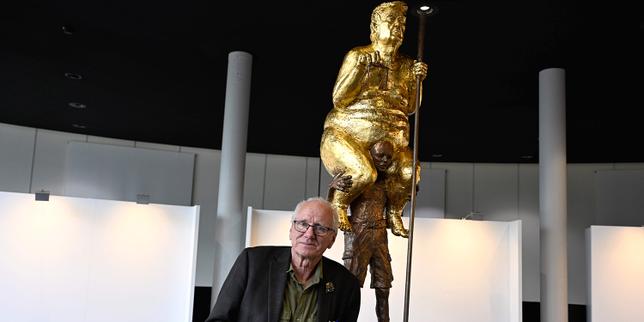
When a provocative sculptor like Jens Galschiøt plants a satirical piece aimed at Donald Trump inside the European Parliament, the usual press cycle kicks in immediately. Headlines frame it as a brave clash of values. A subversive jab. A defiant stand against populism right under the glass domes of Brussels.
That framing is lazy. Worse, it is analytically backwards.
The lazy consensus assumes that mocking a polarizing political figure inside a major legislative institution carries real political weight—that ridicule inside the Parliament somehow undermines Trump's appeal, shifts transatlantic power dynamics, or forces uncomfortable reckonings. Look closely at how political communication and institutional theater actually work, and that story falls apart.
Satire in an institution like the European Parliament does not disrupt the establishment. It flatters it.
Defining the Terms Before We Confuse Ourselves
People throw around words like satire, subversion, and political dissent as if they are interchangeable. They are not.
Satire uses irony, exaggeration, or ridicule to expose vice, folly, or abuse of power. Subversion, by contrast, weakens or overturns an established system from within or without. Institutional display—putting an edgy artwork or protest piece into a sanctioned corridor or exhibition space—is something else entirely. It is managed dissent.
Understanding that distinction changes everything. Real satire punches upward at targets that hold authority over the audience or the venue. When a piece mocking Donald Trump appears inside the European Parliament, who is the actual audience? Eurocrats, MEPs, accredited journalists, lobbyists, and staffers who already lean heavily toward institutional norms and multilateralism.
Mocking a figure who is already unpopular among the majority of that room is not a high-wire act. It is preaching to a choir wearing lanyards.
In political communication theory—think of the classic framing work by Robert Entman or agenda-setting research pioneered by Maxwell McCombs and Donald Shaw—the power of a message depends heavily on salience, venue, and audience disposition. When a symbol reinforces existing attitudes in a friendly environment, it produces attitude reinforcement, not persuasion or disruption.
In fact, it often hands the target a gift. A populist leader thrives on portraying distant elites, supranational institutions, and cosmopolitan critics as out-of-touch adversaries. A satirical jab inside Brussels can easily be repackaged miles away as proof that "the elites" are obsessing over him instead of solving real problems.
A joke told inside a fortress to people who already agree with the garrison does not breach the walls. It just echoes off the stone.
The Wrong Question Everyone Keeps Asking
Search behavior around stories like Jens Galschiøt bringing political satire aimed at Donald Trump into the European Parliament usually circles around predictable questions: Did the sculpture anger Trump? What does this say about EU-US relations? Is political art allowed in Parliament?
Those questions miss the point.
Asking whether a satirical artwork angers a global political figure treats international politics like a schoolyard insult contest. Donald Trump's political brand has been built for decades on spectacle, counter-punching, and turning criticism into fuel. A sculpture in Brussels does not dent a movement rooted in domestic grievances, media ecosystems, and voter alignment across the Atlantic.
Asking about "EU-US relations" based on a piece of political art confuses symbolic posturing with hard leverage. Trade tariffs, defense spending commitments, industrial policy, energy supply chains, and security guarantees move on interests and statutory authority, not gallery optics.
And asking whether political art "belongs" in Parliament misses how legislatures operate. Parliaments have always been spaces where symbolism and procedure collide. The real question is far sharper:
Who actually benefits from turning a satirical stunt into a news story inside a legislative building?
Usually, three groups cash in immediately:
- The artist, who gets international press coverage, name recognition, and institutional visibility that street-level protest rarely buys.
- Politicians and commentators, who get a ready-made prop to signal their identity or values without passing a single piece of legislation.
- Media outlets, which get a clean, visually compelling clash between a recognizable public figure and a high-profile institution.
Meanwhile, the underlying political friction remains untouched.
Dismantling Common "People Also Ask" Assumptions
Does political satire in the European Parliament change public opinion?
Rarely in the way commentators claim. Public opinion shifts slowly through lived economic conditions, trusted messengers, and repeated exposure—not a single viral visual from a parliamentary corridor. For undecided or skeptical voters, institutional satire often looks like insider smugness rather than persuasive argument.
Why do artists target figures like Donald Trump in European spaces?
Because high-contrast symbols travel fast. Attaching a work to a globally recognized lightning rod guarantees immediate relevance across borders, even when the local institution has zero direct control over the target.
Is shock value the same as political impact?
No. Shock gets attention for twenty-four hours. Impact requires changing incentives, coalitions, rules, or behavior. Most political art generates attention without leverage.
Battle Scars From Buying Into Symbolic Noise
I have watched organizations, campaigns, and brands blow serious money chasing symbolic moments while ignoring actual mechanics.
Years ago, I saw a well-funded advocacy group pour six figures into a splashy public stunt timed to a major international summit. The visuals were sharp. The press release had all the right moral urgency. For two days, people in policy circles talked about how clever it was.
Three weeks later, the legislation they cared about stalled in committee because they had neglected quiet coalition work with swing lawmakers. The stunt felt bold in the moment. In hindsight, it was expensive comfort food for insiders.
That is the trap of symbolic politics. It feels like action. It photographs well. It gives people a rush of righteous certainty. Yet it often substitutes for the slow, unglamorous work that actually moves power.
Imagine a scenario where a campaign has a choice between funding a high-profile satirical installation near a summit venue or funding months of targeted field research, policy drafting, and direct outreach to persuadable decision-makers. The installation wins the applause at the launch party. The groundwork changes the outcome six months later.
Where This Contrarian Take Can Backfire
Being contrarian does not mean being right by default. There are real downsides to dismissing symbolic and satirical work too quickly.
First, underestimating cultural signaling. Politics is not purely spreadsheets and treaties. Cultural symbols help define what a community considers acceptable, ridiculous, or dangerous over long stretches of time. Treating all symbolism as meaningless can blind you to slow cultural shifts.
Second, over-indexing on cynicism. When every gesture is analyzed purely through the lens of self-interest, PR incentives, and institutional theater, you can sound detached or nihilistic. Sincere conviction and genuine provocation still exist, even inside imperfect systems.
Third, ignoring coalition morale. Sometimes an expressive act does not persuade opponents at all, yet still energizes allies who feel isolated or exhausted. Morale is not policy, but demoralized coalitions rarely win anything.
Admitting those limits keeps the critique honest. Satire inside an institution is not zero; it is simply much weaker and much more self-serving than the breathless coverage suggests.
How to Read Political Spectacle Without Getting Played
If you want to cut through the noise whenever an artist, activist, or politician stages a provocative moment inside a major institution, run it through a simple filter.
Check the Incentive Structure
Ask who designed the moment and who gets quoted. If the primary winners are people already inside the media-political loop, treat it as content first and politics second.
Separate Spectacle From Leverage
List what actually changes if the stunt succeeds wildly. If the answer is "a few headlines and some heated posts," you are looking at theater, not power.
Watch Where the Reaction Happens
Notice whether the loudest outrage or praise comes from the target's camp or the host institution's camp. Real disruption forces the target onto the defensive; safe mockery mostly entertains people who already agree with you.
Invest in Friction That Matters
If you care about a political issue, spend your energy where decisions are drafted, funded, and enforced—not where cameras are waiting for an easy shot.
Stop mistaking applause inside the bubble for impact outside it.