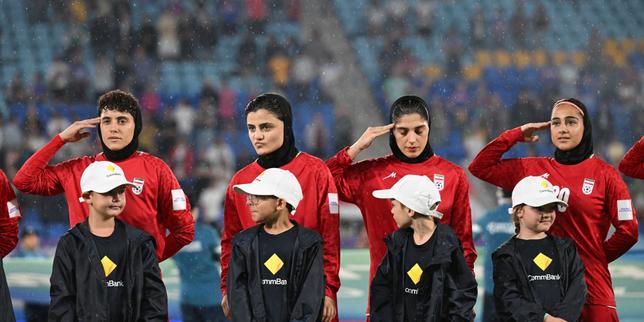
The arrival of several members of the Iranian women’s national soccer team in Australia marks a rare intersection of international sport, high-stakes diplomacy, and the personal intervention of a U.S. President. While the move is being framed as a humanitarian victory, the internal mechanics of the deal reveal a complex arrangement between Donald Trump and the Australian Prime Minister. These athletes did not simply find a path to safety through standard refugee channels. Instead, their relocation was the result of a calculated diplomatic maneuver designed to address regional tensions while providing a visible win for Western democratic values.
The situation began to coalesce when members of the Iranian squad, fearing state-sanctioned retribution for their advocacy of women’s rights and their refusal to adhere to strict domestic codes during international play, sought an exit strategy. In Iran, female athletes operate under a microscope. Every goal scored is shadowed by the threat of the morality police. When the players made it clear they could no longer return to Tehran without facing imprisonment or worse, the machinery of global politics hummed to life.
The Canberra Connection and the Trump Factor
The catalyst for this specific asylum package was a direct conversation between Donald Trump and the Australian leadership. This was not a standard bureaucratic handoff. It was an executive-level request. By moving these players to Australia rather than the United States, the administration managed a delicate balance. It allowed the U.S. to claim credit for orchestrating the rescue while utilizing Australia’s existing resettlement infrastructure and its geographic proximity to Asian sporting hubs.
Australia has long maintained a complicated relationship with its own border policies, but the opportunity to host world-class athletes with a massive symbolic profile proved too significant to pass up. For the Australian Prime Minister, agreeing to this request served as a "diplomatic deposit." It strengthened the ANZUS alliance and offered a moment of moral clarity that offset more contentious domestic debates over migration. The players were not just fleeing a regime; they were being moved like pieces on a chessboard to signal a unified front against Iranian domestic policy.
Security Risks and the Reality of Transnational Repression
Escaping the borders of Iran is only the first step. The reality for these women is that the reach of the Iranian state does not end at the Persian Gulf. Investigative looks into similar defections show a pattern of "transnational repression," where family members remaining in Iran are harassed or detained to exert pressure on the athletes abroad.
Security experts familiar with these types of extractions note that the Iranian Revolutionary Guard Corps (IRGC) views high-profile defections as a direct embarrassment to the Islamic Republic's image. These women are no longer just soccer players. They are now dissidents. This transition brings a lifetime of vigilance. In Australia, they will likely require ongoing protection, a cost and a logistical burden that rarely makes the front-page headlines celebrating their arrival.
The Iranian government’s official stance usually involves accusations of "foreign meddling" or "moral corruption." By framing the players as puppets of Western intelligence, Tehran attempts to devalue their agency. However, the sheer bravery required to walk away from one's home, career, and family speaks to a desperation that propaganda cannot easily mask.
The Infrastructure of a High Profile Defection
How does a professional athlete actually disappear? It requires a blend of athletic scheduling and clandestine communication. Most of these deals are brokered during international tournaments where players have a brief window of relative freedom away from their minders.
- The Contact Phase: Players or their representatives reach out to a third-party NGO or a sympathetic embassy.
- The Vetting Phase: Intelligence agencies verify that the athletes are not being used as plants by their home government.
- The Extraction: Often occurring hours before a scheduled flight back to their home country, the athletes are moved to a secure "black site" or a diplomatic compound.
- The Legal Fast-Track: This is where the Trump-Australia phone call proved vital. Standard asylum claims can take years. These players were processed in weeks.
This fast-tracking is a point of contention for some immigration advocates. It highlights a "celebrity tier" of asylum where those with talent or political value leapfrog thousands of others waiting in camps. While the rescue of the soccer players is objectively good for their safety, it exposes the inherent inequality of a system where your value to a superpower determines your speed to freedom.
Survival Beyond the Pitch
The transition from a professional athlete in a state-controlled system to a refugee in a capitalist democracy is jarring. These women have lost their salaries, their training facilities, and their fan base in an instant. While Australia has a robust women’s soccer league (the A-League Women), the path to a professional contract is not guaranteed.
Integration is more than just finding a team. It involves navigating a new language, a new legal system, and the psychological weight of knowing you may never see your parents again. The Australian government’s commitment must extend beyond the initial photo op. If these women are not provided with long-term career support and mental health resources, the "victory" of their asylum will be short-lived.
Impact on the Future of Iranian Sport
Tehran is already reacting. Reports suggest that the vetting process for female athletes traveling abroad is being tightened to an extreme degree. "Guarantors" are often required—family members who must sign documents or put up property as collateral to ensure the athlete returns.
This creates a chilling effect. Other talented women may now be denied the chance to compete internationally because the state fears another high-profile defection. The success of these players in reaching Australia is a beacon for some, but for those still in Iran, it might have just made their cage even smaller.
The international sporting community, including FIFA, has been notoriously slow to act against Iran’s treatment of women. While individual nations like the U.S. and Australia take specific action, the overarching governing bodies continue to allow Iran to participate in global events despite clear violations of the Olympic Charter’s non-discrimination clauses. This deal, as significant as it is, remains a localized solution to a systemic human rights crisis in sports.
The Geopolitical Aftermath
By facilitating this move, the Trump administration signaled a shift in how it uses "soft power." Instead of just sanctions, it used the human element of sport to highlight the flaws of a rival regime. It was a move designed for maximum media impact.
The players are now in a safe harbor, but they remain symbols in a larger cold war. Every interview they give and every goal they score on Australian soil will be viewed through a political lens. They are no longer just athletes; they are the living evidence of a diplomatic deal that circumvented the traditional world order to save a handful of lives while millions more remain behind the curtain.
Check the official Australian Department of Home Affairs briefings for updates on the players' visa status and integration programs.