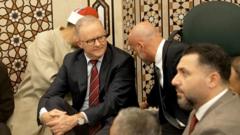
Political theater is dying. We just watched another scene of its slow, public expiration at a Sydney mosque. The headlines want you to believe that Anthony Albanese being heckled during a Ramadan event is a "security breach" or a "disrespectful disruption" of a holy month. They are wrong.
The media focuses on the noise. They analyze the decibel level of the shouting. They count the number of protesters. They treat the event like a logistics failure. If the PM can’t speak without being interrupted, the narrative goes, then the "social fabric" is tearing. Learn more on a connected topic: this related article.
That is the lazy consensus. It assumes that the goal of a political visit to a religious space is a photo op where everyone smiles, eats dates, and pretends the world outside the room isn't on fire.
The real story isn't that the PM was shouted down. The real story is that he thought he could show up with a script and a smile while ignoring the visceral, bleeding reality of his constituents' lives. The heckling wasn't a glitch in the system. It was the system finally speaking back in a language the Canberra bubble doesn't understand. Additional journalism by Associated Press highlights similar perspectives on the subject.
The Myth of the Neutral Space
Politicians love "outreach." They view mosques, churches, and community centers as stage sets. They walk in, wear the appropriate head covering, offer a few words of greeting in a local language, and expect a round of polite applause.
This is an extractive relationship. The politician gets the "multicultural" badge of honor. The community gets a handshake and a fleeting sense of being "seen."
But 2024 and 2025 changed the math. You cannot walk into a room full of people who are watching their families die in Gaza or Lebanon and expect them to play their part in your PR campaign. To demand "respect" for the office in that moment is a height of arrogance that most commentators fail to grasp.
Respect is a two-way street. When a government’s foreign policy appears—to a specific segment of the population—to be at odds with the very sanctity of life, the "sanctity" of a political speech becomes irrelevant. The protesters didn't "ruin" the event. They made it honest.
The High Cost of Performance
I have spent years watching how these "sensitive" events are staged. The advance teams check the exits. They vet the guest list. They try to ensure that only "friendly" community leaders are within whispering distance of the leader.
It is a curated reality. And it is failing.
When Albanese is heckled, the immediate response from the press gallery is to pearl-clutch about "extremism" or "polarization." They miss the nuance. This isn't about people becoming more radical; it's about people becoming more desperate.
If you provide no formal channel for genuine grievance, the informal channel becomes a megaphone at a dinner table. If the Parliament House petitions are ignored and the meetings with ministers result in nothing but platitudes, the mosque becomes the only place left to be heard.
The "status quo" approach to community engagement is a zombie. It’s dead, but it keeps walking because nobody has the courage to tell the PM’s office that the era of the easy photo op is over.
The Foreign Policy Disconnect
Let’s talk about the elephant in the room that the mainstream reports skipped: the actual substance of the heckle.
The protesters weren't shouting about tax brackets or infrastructure spending. They were shouting about Gaza. They were shouting about a perceived double standard in how the Australian government values human life based on geography.
Whether you agree with their stance or not is secondary to the political reality: a significant portion of the Australian electorate now views domestic appearances through a global lens. You cannot be a "friend of the community" at 6:00 PM on a Friday and a "silent observer of catastrophe" at 9:00 AM on a Monday.
The disconnect is a form of cognitive dissonance that the government is trying to bridge with better "messaging." You don't need better messaging. You need a better policy. Or, at the very least, you need the guts to stand in that room and explain the current policy without a teleprompter.
Why "Civil Discourse" is a Trap
We are constantly told that we need more "civil discourse." This is usually a code word for "be quiet while I tell you why I’m doing what I’m doing."
In a healthy democracy, civility is a luxury of the heard. For the unheard, civility is a cage. When a group feels that their most fundamental concerns are being dismissed by the highest office in the land, "civility" feels like complicity.
The Sydney mosque event should be a wake-up call for every political strategist in the country. If you can’t walk into a community space and answer the hard questions, don’t go. Don't hide behind the "Ramadan spirit" to avoid political accountability. Ramadan is about reflection, truth, and sacrifice. It isn't a shield for a Prime Minister to hide behind.
The Professionalization of Offense
The media reaction to this event is a masterclass in the "professionalization of offense." Instead of reporting on why people are angry, they report on the fact that anger exists, as if it were a strange weather phenomenon.
- "The PM was visibly shaken."
- "Security was forced to intervene."
- "Community leaders expressed regret."
These are all tropes designed to center the politician as the victim. Albanese is not the victim here. He is the most powerful man in the country. He has a security detail, a press corps, and a taxpayer-funded salary. The victims are the people who feel so ignored by their own government that they feel the need to scream at a dinner.
Stop Trying to Fix the "Optics"
The advice Albanese is likely getting right now is to "tighten security" or "choose more controlled environments."
That is exactly the wrong move.
If you hide from the noise, you prove the protesters right. You prove that you only care about the community when they are silent and grateful.
The bold move—the move a real leader would make—is to put down the microphone, sit down at the table, and stay there until the last person has finished shouting. You don't "fix" a heckling incident with a press release. You fix it with presence.
Imagine a scenario where the PM, instead of being ushered out by security, told his guards to stand back. Imagine if he pulled up a chair and said, "I hear you. Tell me exactly what you want me to do, and I will tell you why I can or cannot do it."
That would be a disruption of the status quo. That would be leadership. Instead, we got a hasty exit and a news cycle about "unacceptable behavior."
The Brutal Truth Nobody Admits
The truth is that the Labor party is terrified of losing its base in Western Sydney and similar hubs. They are trying to walk a tightrope between international alliances and domestic demographics.
But you can't walk a tightrope in a windstorm.
The heckling at the mosque is a signal that the tightrope has snapped. The "balanced approach" is being viewed as "no approach." When you try to please everyone, you end up being shouted at by everyone.
The PM didn't fail a security test in Sydney. He failed a sincerity test. He treated a sacred community gathering as a checkbox on a calendar, and the community treated him like a politician who had overstayed his welcome.
If the government wants to stop the heckling, they don't need more guards. They need more courage. They need to stop pretending that they can separate the "local" from the "global." In 2026, every local event is a global stage.
If you aren't prepared to defend your record in front of a room of people who hate what you’re doing, then you have no business being in the room at all.
Politics isn't a dinner party. It’s a conflict of values. The moment we try to sanitize it with "civility" and "protocols," we lose the very essence of what makes a democracy function. The shouting in that mosque wasn't the sound of a failing society. It was the sound of a society that is finally, painfully, waking up to the reality that a handshake and a "Ramadan Mubarak" aren't enough to pay for silence.
Stop complaining about the noise and start listening to the words.