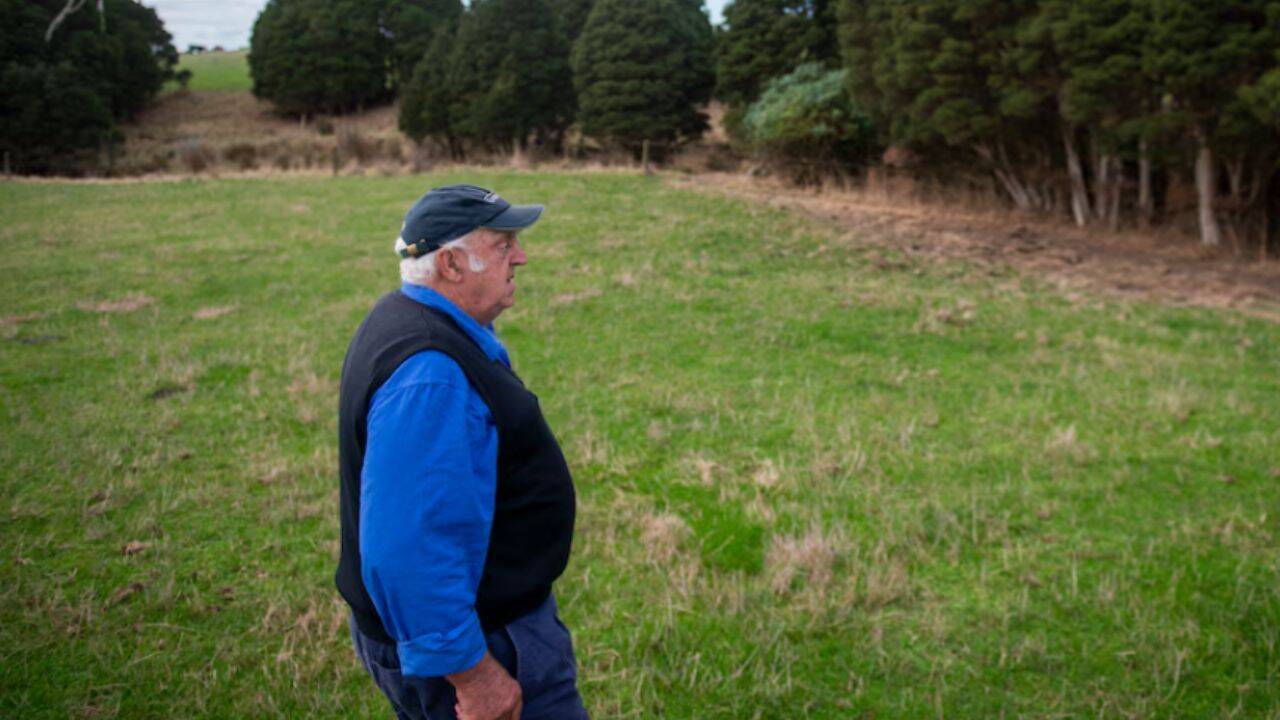
Every few months, the internet falls in love with the exact same story. A retired grazier spends decades putting trees back into a paddock he once bulldozed. Thirty years later, rare birds show up. Cue the soft-focus photography, the swelling acoustic guitar soundtrack, and the collective sigh of a global audience desperate to believe that ecological redemption is as simple as planting a few saplings and walking away.
It makes for a great weekend read. It is also an expensive fantasy.
The lazy consensus in environmental journalism runs on a comforting loop: humans break nature, humans feel guilty, humans stop touching the land, and nature magically resets to a pristine Eden. The narrative relies on a profound ignorance of how biological systems actually function. Reversing land clearing by letting a paddock revert to scrub does not fix an ecosystem. Often, it just locks in a degraded state under a green canopy.
I have spent two decades walking tracts of so-called restored pasture across dry regions, watching millions of dollars in carbon offsets and philanthropic grants vanish into thickets of useless woody weeds. I have seen landowners turn functional, biodiverse grasslands into biological deserts because they bought into the pastoral fairy tale that more trees automatically equal more health.
Time to dismantle the mythology.
The Myth of the Passive Return
The central error in the standard tree-planting fable is the assumption of linear succession. The premise states that if you remove the tractor, the soil remembers what it used to be.
It does not.
When a paddock is cleared, farmed, and grazed for decades, the underlying hydrology changes permanently. Soil microbiology shifts from fungal-dominated forest networks to bacteria-dominated systems adapted to disturbance. Compaction layers form beneath the surface, preventing deep root penetration. Exotic annual grasses invade, outcompeting native seeds and altering fire regimes.
When you simply step back and let woody vegetation colonize an exhausted, compacted paddock, you rarely get a thriving old-growth forest. You get a dense monoculture of opportunistic pioneer species—stiff, woody shrubs that choke out sunlight, monopolize dwindling soil moisture, and prevent actual biodiversity from taking root.
The twenty-four bird species moving into the reformed paddock in every feel-good news report are not a sign of a recovered ecology. They are generalists moving into a new edge habitat. They are the avian equivalent of raccoons living behind a strip mall. They survive because they are adaptable, not because the land has healed.
True ecological restoration requires active, aggressive intervention, not passive neglect. It requires mechanical soil disruption, targeted grazing mimicry, and sometimes the intentional introduction of destructive forces to break stagnation. Nature is not a wounded patient resting quietly in a hospital bed. Nature is a brutal, chaotic engine of competition. If you leave it alone without the right baseline conditions, you get garbage.
The Carbon Accounting Shell Game
Let us address the financial engine driving this obsession: carbon credits and corporate greenwashing.
Every time a landowner fences off a creek and lets wattles take over, corporate boardrooms pop champagne. They buy the carbon offsets generated by that regrowing biomass to justify burning more fossil fuels elsewhere. The math looks clean on an Excel spreadsheet. Trees weigh carbon. Trees grow. Carbon is sequestered.
Except biological carbon storage is wildly unstable.
A dense thicket of unmanaged regrowth in a fire-prone climate is not a permanent carbon bank. It is a ticking matchstick. When a high-intensity bushfire tears through a passive regeneration zone—fueled by the dense, dry ladder fuels that accumulate when land is locked up and ignored—that stored carbon goes straight back into the atmosphere in an afternoon.
Worse, the obsession with above-ground woody biomass blinds us to where the real carbon lives: deep in the soil profile, maintained by the trampling hooves and heavy grazing of ruminants.
Grasslands store vast amounts of carbon deep underground through root exudates stimulated by grazing pressure. When you remove livestock entirely to let trees grow, you often cut off the engine that drove soil carbon accumulation in the first place. The trees suck up the remaining moisture, the soil biology starves, and the landscape dries out.
We are trading resilient, drought-tolerant perennial grass systems for brittle, fire-susceptible scrublands, and calling it progress because it photographs well from a drone.
The Cost of Doing Nothing
The most insidious part of the passive restoration movement is the moral superiority attached to it. The underlying message is that human presence is inherently toxic, and the highest virtue is absence.
This view ignores the reality of how these landscapes evolved. Australian ecosystems, in particular, were never wild wilderness areas untouched by human design. For millennia, Indigenous fire-stick farming shaped the vegetation, keeping woody weeds in check, maintaining open grassy woodlands, and preventing the catastrophic fuel loads we see today.
Locking up land and throwing away the key is not preservation. It is abandonment.
When you stop managing a landscape, you do not restore it to pre-colonial perfection. You simply hand the steering wheel over to invasive predators, noxious weeds, and catastrophic fire risks. Feral cats, foxes, and rabbits thrive in unmanaged thickets. Blackberry and gorse take over the creek lines. The local council ends up footing the bill to bulldoze the firebreaks that the passive conservationist refused to maintain.
Real land management is messy, expensive, and demands constant, hands-on labor. It requires using livestock as a tool to mimic migratory herds, churning the soil surface, dropping seeds, and compressing organic matter into the earth. It requires putting fire back on the ground intentionally, even when it looks ugly and black in the short term.
The next time you read a heartwarming story about a farmer who walked away from his land and watched the birds return, ask yourself what is happening beneath the canopy. Ask what is choking out the soil. Ask how long that illusion will stand before the next drought or the next fire burns it down to ash.
Stop romanticizing neglect. Start doing the hard work of management.