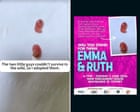
The screen glowed in the quiet of a Tuesday evening, casting a cool blue light over the cluttered desk. On the display was an image that had already been shared thousands of times across social media feeds. It showed two tiny, translucent figures, nestled side by side. They looked fragile. To the untrained eye scrolling quickly through a timeline packed with outrage and emotion, they looked like the earliest stages of human life.
An anti-abortion activist had posted the image, weaponizing it as a profound testament to human development. The caption pulsed with certainty. It was designed to make people stop, feel a surge of awe or protective anger, and hit the share button.
They did. By the thousands.
But if you zoomed in—if you looked past the emotional framing and examined the anatomy with a clinical eye—the narrative began to fray. Those weren't human fingers. Those were webbed patagia.
The internet, in its endless, chaotic capacity for absurdity, had just mistaken two fetal sugar gliders for human twins.
The Speed of the Scroll
We live in an information ecosystem where speed trumps scrutiny. Every day, we subject our brains to a high-velocity firehose of data, images, and text. We don't read anymore; we skim. We don't analyze; we react.
Consider how a typical user interacts with their phone. A thumb swipes upward in a rhythmic, almost hypnotic motion. A video of a cat. A political meme. A breaking news headline. A tragic update from a war zone. Each piece of content gets perhaps two seconds of attention before the brain decides whether to engage or discard.
When an image aligns perfectly with what we already believe, our critical thinking defenses drop entirely. Psychologists call this confirmation bias, but that sterile term doesn't quite capture the visceral reality of it. It feels like a spark. A sudden warmth in the chest that says, See? I knew I was right.
In that exact moment of validation, the urge to share becomes almost biological. You want your digital tribe to feel what you just felt. So you tap the screen.
You don't check the source. You don't reverse-image search the file. You don't ask if a marsupial native to Australia might be masquerading as a human embryo. You just propagate the signal.
The activist who posted the sugar gliders wasn't necessarily running a calculated disinformation campaign. It is far more likely they were a victim of the same system they sought to influence. They saw a picture that touched their heart, assumed it was what they wanted it to be, and passed it on.
This is how modern propaganda functions. It doesn't require master conspirators in dark rooms. It only requires well-meaning people who are moving too fast to think.
When Nature Laughs at Our Certainty
Biology is beautiful, weird, and incredibly repetitive. In the earliest stages of embryonic development, the tree of life looks remarkably uniform. A human embryo, a pig embryo, and a bird embryo share structural similarities that can easily confuse anyone without a degree in evolutionary biology.
Enter the sugar glider. Petaurus breviceps. A small, nocturnal marsupial that glides from tree to tree in the rainforests of Australia and New Guinea. When they are born, they are the size of a grain of rice. They crawl into their mother’s pouch to continue developing, looking like tiny, hairless pink jellybeans.
When stripped of context and viewed through a low-resolution smartphone screen, a photograph of these fetal marsupials possesses a haunting, ethereal quality. They look undeniably alive. They look sentient.
But they are not us.
The humor of the situation—the dark, internet-era irony of a fierce political debate being derailed by a tree-dwelling possum—is obvious. But beneath the comedy lies a deeply unsettling truth about our relationship with reality. If we cannot reliably distinguish between a human being and a Australian marsupial in our public discourse, what chance do we have when confronted with truly sophisticated deception?
This wasn't even a deepfake. It wasn't the product of high-end generative artificial intelligence or a coordinated state-sponsored cyber attack. It was just a regular photograph, completely mislabeled, allowed to wander through the digital wild because no one bothered to look at the paws.
The High Cost of Cheap Outrage
Every time a community rallies around a falsehood, a piece of collective trust dies. It doesn't matter which side of the political spectrum you occupy. When an error this glaring is exposed, the opposition doesn't just correct the record; they weaponize the mistake to delegitimize the entire movement.
The critics pounced immediately, mocking the activist, mocking the cause, and painting everyone who shared the post with the same brush of gullibility. The conversation shifted instantly from a nuanced discussion about ethics and human rights to a circus of ridicule.
This is the real tragedy of the digital age. The loudest voices drown out the thoughtful ones, and the currency of the realm is outrage rather than truth.
Imagine a hypothetical high school student preparing for a debate on bioethics. They want to understand the arguments deeply. They go online to research, hoping to find philosophy, legal precedent, and scientific data. Instead, they run into a wall of memes, mockery, and arguments centered on whether a picture shows a baby or a sugar glider.
The algorithm rewards the friction. It feeds on the conflict because conflict keeps eyes on screens, and eyes on screens generate ad revenue. The platform doesn't care if the image is a human or a marsupial, as long as you keep arguing about it in the comments section.
Anchoring to the Truth in a Sea of Noise
How do we protect ourselves from becoming characters in the next internet farce? It requires a deliberate, painful slowing down.
It means resisting the urge to react instantly. If a post makes you feel an intense rush of anger, satisfaction, or vindication, that emotion should act as a warning light. It means the content has successfully bypassed your intellect and targeted your nervous system.
Before you share, ask three simple questions:
- Where did this image actually come from?
- What is the context missing from this frame?
- Am I sharing this because it is true, or because it makes me look good to my friends?
The answers are often uncomfortable. They require us to admit that we don't know everything, that our eyes can be deceived, and that the world is far more complex than a social media feed suggests.
The sugar glider incident will eventually fade into the background noise of internet history, replaced by a new controversy, a new mislabeled photo, a new wave of public indignation. But the lesson remains.
The screen on the desk finally went dark, reflecting the quiet room. Outside, the world continued to spin, full of real people, real stakes, and genuine human complexity, all waiting to be discovered by anyone willing to put down the phone and look.