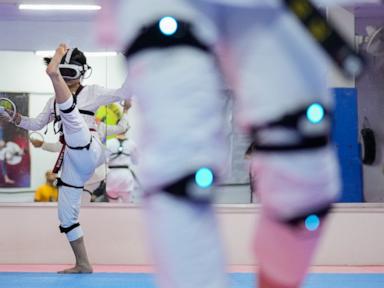
The sweat dripping off Min-jun’s chin is entirely real. The burning in his thighs is real. The gasp for air that catches in his throat as he executes a spinning hook kick? That is real, too.
But the opponent who just dodged his foot does not exist. Read more on a connected issue: this related article.
Min-jun is standing in the center of a brightly lit training hall in Seoul, wearing a traditional white dobok. Bound to his head is a sleek, strapped-on visor, and strapped to his shins are lightweight motion trackers. To an outside observer, he looks absurd. He is kicking the empty air, grunting at ghosts, and dancing a frantic choreography with a shadow world.
For decades, martial arts adhered to a strict, almost sacred ritual. You stepped onto a canvas mat. You bowed to your instructor. You faced another human being, felt the static electricity of their presence, and braced for the impact of bone against padding. It was an art form defined by friction. Further journalism by NBC Sports explores related perspectives on the subject.
Now, that friction is being rewritten in lines of code.
Traditional taekwondo is facing a quiet existential crisis. Participation numbers fluctuate, young people find the repetitive drilling of forms tedious, and Olympic sparring has occasionally faced criticism for becoming too tactical, lacking the explosive drama of its early days. To save the sport, its custodians did something unthinkable: they handed it over to the programmers.
The Ghost in the Ring
To understand how we arrived at a point where a martial artist is fighting a digital simulation, look at how taekwondo scoring worked for generations.
Historically, human judges sat ringside, clicking mechanical counters when they saw a kick land cleanly on a protector. It was a system built on flawed human perception. A judge might blink. A view might be blocked. A crowd’s roar might subconsciously influence a decision.
In a bid for absolute fairness, the World Taekwondo federation introduced Electronic Protector and Scoring Systems (PSS) in the late 2000s. Suddenly, body protectors and socks were embedded with electronic sensors. A point only registered if a strike hit with a precise, pre-determined amount of pressure.
It solved the bias problem, but it birthed a new monster.
Fighters quickly realized they did not need to throw beautiful, powerful, cinematic kicks to win. They just needed to trigger the sensor. Matches transformed into awkward, single-legged tapping contests. Athletes flicked their feet like scorpion tails, aiming for the edge of a guard rather than executing a true martial strike. The soul of the sport began to leak out of the ring.
This is where Virtual Reality (VR) enters the story, not as a gimmick, but as a correction mechanism.
Hypothetically, imagine a young practitioner named Sarah. She lives in a small town with no elite taekwondo dojangs nearby. In the old world, her Olympic dreams would die in her living room. In the new world, she slips on a headset.
The software maps her skeleton in real-time. It does not just measure if her foot hits a target; it analyzes the trajectory, the rotation of her hips, the speed of her knee extension, and the angle of her ankle. The system can detect if she is cheating the system with a lazy tap. The digital opponent reacts instantly, capitalizing on her poor posture.
The game forces her to be a better martial artist because the algorithm demands structural perfection to score.
When the Mat Becomes a Screen
The shift goes deeper than training. It is fundamentally changing the competitive landscape. Virtual taekwondo tournaments are no longer a sci-fi concept; they are happening right now on global stages.
In these arenas, two athletes stand meters apart, never physically touching. They wear VR headsets that superimpose a digital avatar over their movements. When they kick, their virtual selves strike in a shared digital colosseum.
Consider the logistical transformation here:
- Weight classes disappear: Because there is no physical impact, a 60-kilogram fighter can safely face an 85-kilogram fighter in a pure test of speed, strategy, and precision.
- Gender barriers melt: Mixed-gender divisions become completely viable, focusing entirely on technical execution.
- The injury rate plummets: Broken noses, concussions, and torn ACLs from brutal collisions are eliminated. The wear and tear on an athlete’s body is strictly cardiovascular and muscular.
- Accessibility expands: An athlete with a physical disability that prevents them from taking full contact can compete on an even playing field in a virtual environment.
But this evolution brings a heavy dose of skepticism. Purists argue that removing physical danger strips the martial art of its psychological core.
There is an undeniable truth to that. Fear is a teacher. The knowledge that a heavy shin guard might smash into your ribs if you drop your hands forces a specific kind of mental focus. Can an athlete truly develop grit when their opponent is made of pixels?
When you speak to coaches who have integrated these systems, the answer is surprising. They note that the mental fatigue in virtual sparring is often higher than in traditional combat. In a physical ring, there are lulls in the action—moments where fighters circle each other, feeling out the distance, resting in the clinch.
In the virtual ring, the pacing mimics high-speed gaming. The digital environment demands continuous, frantic movement. The spatial awareness required to track a virtual opponent while staying within the boundaries of a real-world safety mat requires an intense level of cognitive load.
It is a different kind of exhaustion. Your lungs burn just as hard, but your brain burns harder.
The Gamification of Discipline
For a twelve-year-old growing up with a smartphone glued to their palm, standing in a line punching the air for an hour can feel like a punishment. Taekwondo masters are realizing that to compete for a teenager's attention, they have to speak the language of video games.
The smartest software developers are leaning heavily into gamification. They are turning basic drills into high-score challenges.
Instead of a coach shouting counts, a student faces a screen showing floating targets that must be smashed with specific kicks within a time limit. They earn experience points. They unlock digital belts. They view leaderboards comparing their kick speed to teenagers across the globe.
It sounds cynical to a traditionalist who values the quiet, meditative aspects of martial arts. But look at the result: kids are staying on the mats longer. They are practicing their technique at home because they want to beat a high score, accidentally building the muscle memory and cardiovascular endurance that traditional training sought to instill.
The technology acts as a bridge. It meets the digital native where they are, using the psychological loops of modern gaming to cultivate ancient physical discipline.
The Unresolved Equation
We are still in the messy, experimental phase of this convergence. The tech is not flawless. There are moments of latency where a fighter's foot moves faster than the sensors can track, causing a fraction of a second delay that can ruin a competitive match. The headsets can feel heavy and sweaty during intense, prolonged use.
There is also the question of cost. A set of high-end motion trackers and virtual reality hardware is expensive, threatening to create a divide between wealthy clubs that can afford digital arenas and underfunded gyms left behind in the analog world.
Yet, watch Min-jun in that Seoul training center. He takes off the visor. His hair is matted with sweat, his chest heaving as he grips his knees. He turns to a monitor to review the data from his session.
The screen displays a three-dimensional heat map of his kicking angles. It shows that his left roundhouse kick is consistently two degrees off-center when he gets tired, exposing his flank to a counter-attack. It is a microscopic flaw that no human coach could have spotted with the naked eye during a chaotic sparring session.
He smiles, straps the visor back on, and steps back into the empty room.
The future of martial arts is not a choice between the ancient ways and the digital frontier. It is the realization that the ancient ways can be sharpened by a digital blade. The mat remains a sacred space for self-discovery, even when the mat is made of light.