Silence.
That is the first thing you notice when you step off the beaten track in the Sahara, far beyond the reach of cell towers and paved roads, where the wind polishes the gravel plains until they shine like dark mirrors. I have spent enough time in arid basins to know how quickly the desert strips away your sense of scale. Without trees, buildings, or even a stray cloud to anchor your eyes, a pebble ten feet away can look like a boulder on the horizon. You learn to read the ground differently. You stop looking for shapes and start looking for colors that do not belong.
In 2011, somewhere in the vast, sun-baked expanse of Northwest Africa, a meteorite hunter spotted a color that did not belong.
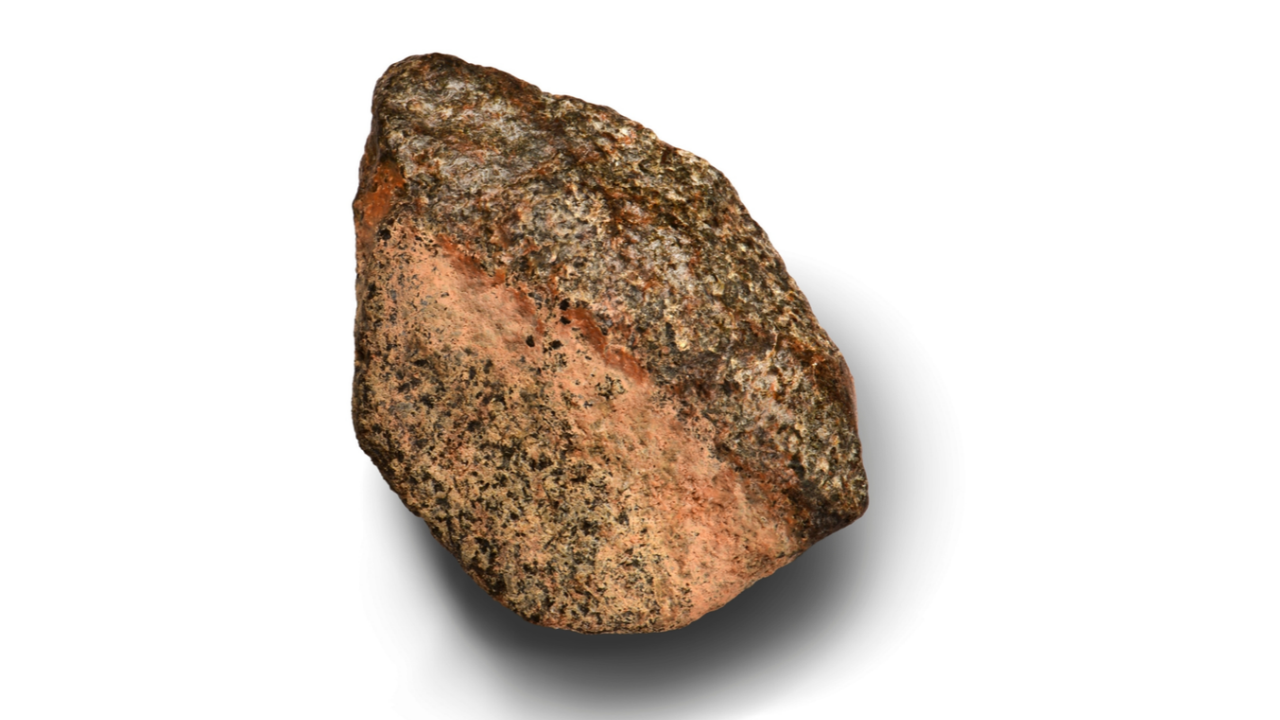
It was a stone no bigger than a clenched fist, weighing just 320 grams. To a casual observer, it looked like a scrap of rusted iron or a chunk of dark concrete. Yet when researchers sliced it open, the interior revealed a striking, pinkish hue speckled with white and dark mineral grains. They cataloged it as Northwest Africa 7034, though the scientific community quickly gave it a name that stuck like a campfire story: Black Beauty.
For over a decade, Black Beauty has sat under the most sophisticated microscopes on Earth, forcing planetary scientists to rewrite what they thought they knew about our neighboring world. And now, thanks to a NASA-funded study led by researchers analyzing the finest atomic structures inside that pink stone, we are staring at a 4.1-billion-year-old receipt from a time when Mars was not a frozen, radiation-blasted wasteland, but a wet, dynamic planet with a thick atmosphere and churning crust.
We spend billions of dollars launching nuclear-powered rovers across thirty-four million miles of empty space to scoop up dust and drill into red bedrock. We engineer sky cranes and supersonic parachutes, holding our breath during seven minutes of terror while waiting for a ping from Jezero Crater. Yet the oldest, most revealing piece of Martian crust we have ever held in our hands did not arrive on a rocket. It fell out of the sky, landed in the sand, and waited for someone to pick it up.
A Time Capsule Forged in Violence
To understand why a pink rock from the Sahara keeps astrophysicists awake at night, you have to understand how rare it actually is.
Of the tens of thousands of meteorites recovered on Earth, fewer than four hundred come from Mars. Almost all of them are relatively young volcanic rocks—basalts that cooled from lava flows a few hundred million years ago. They tell us about the recent geological death throes of the Red Planet, not its birth. They are like finding a single page torn from the epilogue of a thousand-page novel.
Black Beauty is different. It is a breccia—a geological mosaic made of smashed fragments from dozens of different rocks, fused together by the unimaginable heat and pressure of asteroid impacts. Think of it as a planetary scrapbook. When an asteroid slams into a planet, it acts like a giant shovel, excavating material from deep underground and fusing surface debris into a single, chaotic stone.
Inside NWA 7034, scientists found zircons—tiny, nearly indestructible crystals that act as geological stopwatches. By measuring the decay of uranium into lead inside these microscopic grains, researchers pinned down their age. Four point one billion years. Some components stretched back even further, to 4.48 billion years ago, just after the solar system itself finished coalescing from a disk of gas and dust.
Consider what that number means.
Earth has almost no rocks left from 4.1 billion years ago. Plate tectonics, erosion, volcanoes, and oceans have swallowed our earliest crust, melted it down, and recycled it over and over again. Our planet erased its own baby pictures. Mars, because it is smaller and cooled faster, never developed Earth-style plate tectonics. Its ancient surface simply froze in place, preserving a record of the early solar system that no longer exists anywhere on our own world.
When you look at the pink minerals inside Black Beauty, you are looking at the exact era when life was first flickering to life on Earth. You are looking at the twin sibling that took a different turn.
The Invisible Fingerprint of Water
Let us put a hypothetical researcher in the lab—call her Maya—staring at a thin section of Black Beauty through an atom probe tomograph. To the naked eye, the slice of rock is thinner than a human hair, mounted on glass. Under the beam, individual atoms are peeled away one by one and mapped in three dimensions, revealing a chemical landscape invisible to any optical lens.
What is Maya actually looking for? Not fossils. Not little green microbes frozen in stone. She is looking for chemical scars.
In the latest NASA-funded investigation, scientists examined nanoscale variations in iron, oxygen, and trace elements trapped within the rock's oldest mineral grains. If Mars had always been the bone-dry desert we see in rover panoramas today, those atoms would sit in neat, predictable arrangements, forged solely by dry magma cooling in a vacuum.
Instead, the atomic maps showed evidence of alteration by hot, liquid water.
Water leaves a distinct chemical signature when it interacts with cooling rock. It oxidizes iron, shifts isotopes, and deposits trace elements into microscopic fractures like mineral rust creeping through a crack in a cast-iron pipe. The pink coloration itself—driven by oxidized iron-rich feldspars and fine-grained matrix material—is a visual whisper of a wetter past.
The study revealed that roughly 4.1 billion years ago, during a period known as the Noachian epoch, the Martian crust was not just damp. It was actively cycling water through fractures, driven by the heat of volcanic activity and massive meteor impacts. Imagine hydrothermal vents—similar to the hot springs bubbling on the floor of Earth's oceans or beneath Yellowstone—pumping warm, mineral-rich water through dark volcanic rock.
On Earth, those exact hydrothermal environments are where many biologists believe life first assembled its chemical building blocks.
I remember the first time I held a piece of volcanic basalt from Iceland next to a piece of oxidized desert sandstone. One was heavy, black, and sharp; the other crumbled slightly at the edges, stained pink and orange by iron that had met water and air. Seeing that transition in your own palms makes geology stop feeling like an abstract timeline of Latin names and start feeling like a physical biography. Black Beauty captures that exact transition on another world. It proves that ancient Mars had the water, the heat, and the chemical ingredients necessary to sustain a habitable environment long before Earth's continents had even finished forming.
The Long Fall Home
How does a rock sitting on the surface of Mars end up in a Moroccan market stall?
The mechanics sound like science fiction, yet the physics are brutally straightforward. Roughly five to ten million years ago, an asteroid several kilometers wide slammed into the southern highlands of Mars—specifically in a heavily cratered region near the Terra Cimmeria-Sirenum province, which orbital mapping later identified as the likely launchpad for Black Beauty.
The impact did not just dig a crater. It superheated the atmosphere and accelerated debris outward at speeds exceeding five kilometers per second—the escape velocity of Mars. Most of that rock fell back onto the Martian surface. A tiny fraction escaped the planet's gravity entirely, drifting into the dark void between worlds.
For millions of years, that 320-gram lump of pink and black stone tumbled through interplanetary space, bombarded by cosmic rays that left faint isotopic tracks in its outer crust like notches carved into a prison wall. Slowly, gravitational nudges from Jupiter and the inner planets tugged its orbit inward until it crossed paths with Earth.
It hit our upper atmosphere at tens of thousands of miles per hour, wrapped in a fireball that burned away its outer layers while its core remained cold—rock is a terrible conductor of heat, so a brief blaze through the air barely warms the interior. It landed silently in the Sahara, where dry air prevented terrestrial rust from ruining its pristine Martian chemistry.
Had it landed in the Amazon rainforest or the bottom of the Pacific Ocean, it would have dissolved or vanished forever. The desert kept it safe until human hands found it.
Why a Fistful of Dust Changes Everything
It is easy to read a headline about a 4.1-billion-year-old rock and shrug. Bills still need paying. Traffic still backs up on the highway. What difference does it make whether an asteroid knocked a pink pebble off Mars before humans even walked upright?
Because we are currently standing at the edge of the most ambitious sample-return effort in human history, and Black Beauty is our roadmap.
NASA and its international partners have spent years caching core samples on the floor of Jezero Crater using the Perseverance rover, debating the staggering engineering costs and political hurdles of bringing a few hundred grams of Martian rock back to Earth in the 2030s. Critics frequently ask why we need to bring rocks home when rovers already carry miniature laboratories on their backs.
Black Beauty answers that question in a single glance.
The instruments used in this NASA-funded study—synchrotron radiation beams, nanoscale secondary ion mass spectrometers, atom probe tomographs—weigh tons, require massive electrical grids, and occupy entire rooms. You cannot strap them to a rover and shoot them to Mars. Only by holding a physical piece of another planet inside a terrestrial laboratory can we read the atomic fine print hidden inside a single crystal grain.
More than that, this pink stone forces us to confront a sobering truth about planetary survival.
Mars did not lose its oceans overnight. It lost them because its core cooled, its magnetic field collapsed, and the solar wind slowly stripped away its atmosphere atom by atom, turning a blue-skied, water-rich world into a frozen rust bucket. Looking at a 4.1-billion-year-old fragment of wet Martian crust is like looking into a mirror that shows what happens when a planet loses its protective shield.
I think about that rock sitting in a dark cabinet in a research facility—a small, unassuming stone that survived the violent birth of the solar system, endured eons of hydrothermal boiling on an alien shore, rode a column of impact fire into deep space, survived a fiery plunge through Earth's sky, and landed in the sand just waiting for someone curious enough to look closer.
Somewhere out there in the gravel plains of the Sahara, half-buried under windblown quartz, another piece of that same ancient ocean floor is still waiting to be picked up.