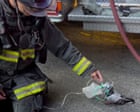
In urban emergency response, wild animals represent a systemic blind spot. While municipal fire departments regularly train for domestic pet resuscitation, wild avians are excluded from standard operational frameworks. The recent encounter in East Oakland, where Oakland Fire Department Engine 29 administered supplemental oxygen to an urban pigeon (Columba livia) suffering from acute smoke inhalation following a vehicle fire, highlights a critical intersection of biological vulnerability and emergency medical response.
To evaluate the validity of this intervention, we must bypass the sentimental narratives of local media and examine the mechanics of avian respiration, the chemical composition of vehicle fire smoke, and the physiological limitations of standard human emergency equipment applied to non-mammalian biology.
The Avian Respiratory Bottleneck
The respiratory system of a bird is fundamentally different from that of a mammal, making it uniquely vulnerable to airborne toxins. Mammals rely on a bidirectional, tidal lung system where incoming fresh air mixes with outgoing stale air. Birds, conversely, utilize a unidirectional flow system powered by a complex network of non-vascular air sacs that act as bellows to pump air through a rigid, highly vascularized lung structure.
This unidirectional design relies on two complete cycles of inhalation and exhalation to move a single volume of air through the system:
- Inhalation 1: Air flows through the trachea into the posterior air sacs.
- Exhalation 1: Air moves from the posterior air sacs into the lungs (paleopulmonic parabronchi), where gas exchange occurs.
- Inhalation 2: Air moves from the lungs into the anterior air sacs.
- Exhalation 2: Air is expelled from the anterior air sacs out of the body.
Because the avian lung does not expand or contract, and because gas exchange occurs continuously across a thin blood-gas barrier, birds possess an incredibly high oxygen exchange efficiency. This efficiency, which supports the metabolic demands of flight, becomes a severe vulnerability during a fire.
The high rate of ventilation and thin respiratory membrane mean that toxic gases and particulate matter are absorbed at a rate exponentially faster than in mammals. In a smoke-filled microenvironment, such as the underpass of a highway vehicle fire, a bird’s respiratory system is flooded with toxins almost instantly.
The Chemical Insult of Vehicle Fire Effluent
The smoke generated by a vehicle fire is a highly concentrated cocktail of toxic gases and suspended particulates. Unlike wood smoke, combustion of modern automotive materials (polyurethane foam, synthetic plastics, wiring insulation, and petroleum products) produces highly hazardous combustion products:
- Carbon Monoxide (CO): CO binds to hemoglobin with an affinity roughly 200 times higher than oxygen in mammals, and similarly high in avians, forming carboxyhemoglobin ($COHb$). This effectively halts systemic oxygen transport.
- Hydrogen Cyanide (HCN): Produced by the combustion of nitrogen-containing polymers, $HCN$ inhibits cytochrome c oxidase in the mitochondrial electron transport chain. This arrests aerobic respiration, forcing cells into anaerobic metabolism and lactic acidosis.
- Acrolein and Formaldehyde: These volatile organic compounds cause immediate mucosal irritation, leading to severe bronchoconstriction and pulmonary edema.
- Ultrafine Carbonaceous Particulates: These particles bypass upper respiratory filtration, settling directly into the parabronchi and air sacs, creating physical barriers to gas exchange and triggering a severe inflammatory response.
The clinical presentation of the pigeon—characterized by ataxia, gasping (orthopneic dyspnea), and lethargy—is a direct consequence of this multi-layered chemical insult.
The Mechanics and Limits of Emergency Oxygen Delivery
The intervention by the Engine 29 crew involved placing a pediatric or small mammal non-rebreather oxygen mask over the pigeon's beak to deliver supplemental oxygen ($FiO_2$ approaching $100%$). While clinically beneficial, this approach faces significant physical and anatomical limitations.
+-----------------------------------------------------------------------+
|                       OXYGEN DELIVERY FLOW                            |
+-----------------------------------------------------------------------+
|  [Standard O2 Regulator] ---> [Mammalian Mask] ---> [Ambient Air Gap] |
|                                                             |         |
|  [Avian Respiration: Unidirectional] <----------------------+         |
+-----------------------------------------------------------------------+
The Dead Space Problem
Standard emergency masks are designed to fit the facial contours of humans or, occasionally, dogs and cats. They do not form a hermetic seal over an avian beak. Consequently, a massive ambient air gap is introduced. The actual fraction of inspired oxygen ($FiO_2$) delivered to the bird is significantly lower than the flow rate setting on the regulator would suggest, as the oxygen is diluted by ambient air drawn in during inhalation.
High-Flow vs. Low-Flow Dynamics
Directing a high-flow oxygen stream (typically $10\text{--}15\text{ L/min}$ from standard field regulators) directly at an animal with a tiny tidal volume can cause positive-pressure injury to the delicate air sacs. In avian medicine, oxygen therapy is ideally conducted in a sealed chamber where concentration can be controlled without forcing pressurized gas directly into the upper respiratory tract.
In this field scenario, the success of the intervention was likely due to the "blow-by" effect. By holding the mask close to the beak without a tight seal, the firefighters created a localized microenvironment enriched with oxygen. This elevated the partial pressure of oxygen ($PaO_2$) in the lungs, facilitating the displacement of carbon monoxide from hemoglobin molecules through competitive binding, even under suboptimal delivery conditions.
Public Safety and Biosafety Trade-offs
While the field treatment of a wild bird is a powerful public relations asset, it presents real-world operational and biosafety risks that municipal departments must evaluate.
The primary concern is pathogen transmission. Pigeons in urban centers are reservoirs for several zoonotic pathogens, including Chlamydia psittaci (psittacosis), Cryptococcus neoformans, and various strains of Avian Influenza. Administering oxygen via equipment intended for subsequent human use, or even reuse on domestic pets, risks cross-contamination.
In this instance, the Oakland Fire Department mitigated this risk by disposing of the mask immediately after use. However, this introduces a secondary issue: resource consumption. In high-density urban environments, emergency services operate under tight supply constraints. The disposal of medical consumables for non-human, non-domestic species represents a minor but measurable depletion of active field inventory.
The Strategic Framework for Wildlife Encounters
Municipal emergency services require a clear, structured decision-making matrix when encountering distressed wildlife during active incidents. Ad-hoc interventions, while humane, can disrupt operational readiness.
                       [Distressed Wildlife Encountered]
                                      |
                 +--------------------+--------------------+
                 |                                         |
        [Species Classification]                  [Species Classification]
          Domestic / Pet                           Wild / Non-Domestic
                 |                                         |
      [Apply Standard Protocols]                     [Safety Assessment]
                 |                                         |
     (Resuscitate & Transport)                    +--------+--------+
                                                  |                 |
                                             [Bio-Hazard]     [No Bio-Hazard]
                                                  |                 |
                                            (Do Not Touch)   (Assess Airway)
                                                                    |
                                                            [Field Treatment]
                                                            * Blow-by O2 only
                                                            * Dispose of mask
                                                            * Do not intubate
The protocol relies on three distinct operational pillars:
- The Safety Vector: Under no circumstances should personnel attempt airway management (such as intubation) on wild avians. Interventions must remain non-invasive (blow-by oxygen only) to prevent physical injury to the handler and avoid aerosolizing pathogens.
- The Resource Vector: Field treatment must only be initiated if it does not delay the restoration of engine readiness or the response to pending calls.
- The Sanitation Vector: Any equipment that makes contact with or comes into close proximity to a wild animal must be classified as single-use biohazardous waste and discarded immediately. If disposable alternatives are not available, the intervention should be denied to preserve equipment integrity for human life-safety operations.