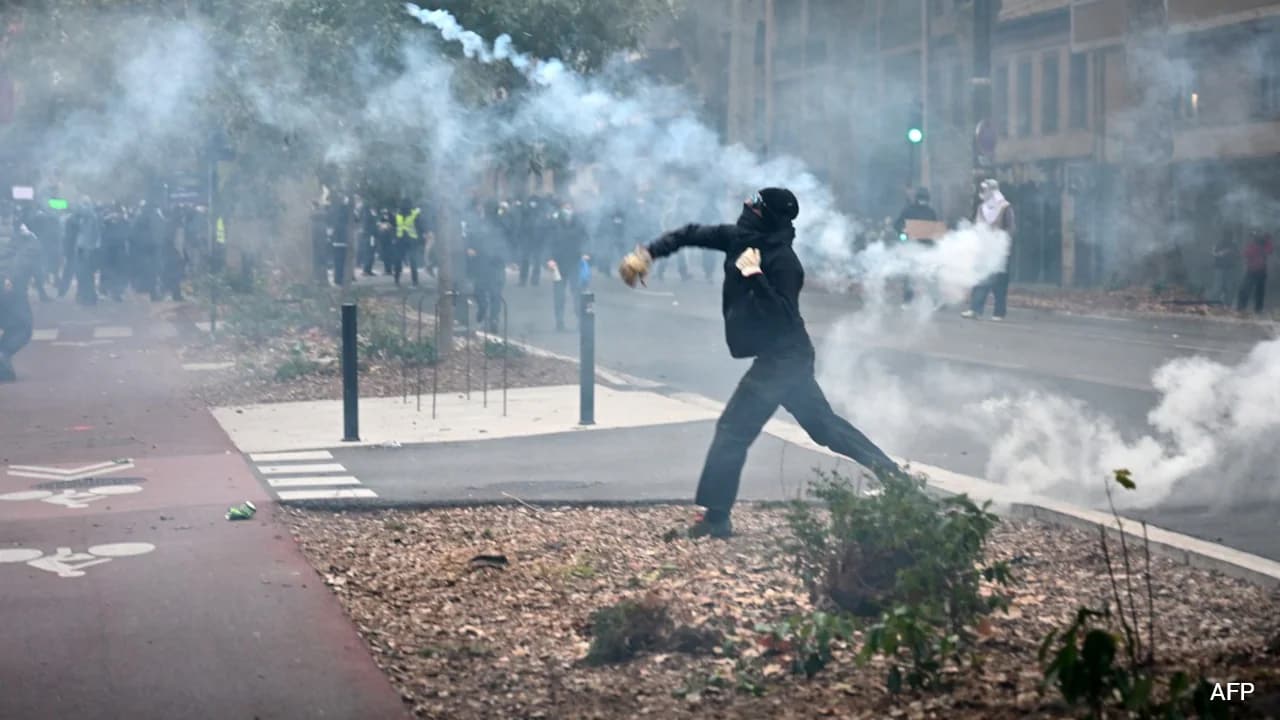
Tear gas hangs thick over the Place de la République while trash bins burn on side streets. You've seen the viral clips on your feed whenever clashes break out as hundreds of thousands protest in France.
Most international coverage reduces these moments to simple chaos. Headlines scream about burning barricades, shattered bank windows, and riot police charging down wide Parisian boulevards. That framing misses almost everything that actually matters.
If you've ever spent time in Paris, Lyon, or Marseille during a major union mobilization, you know the reality looks very different on the ground. It's organized, deeply historical, and rarely just a spontaneous tantrum.
The Anatomy of a French Mass Mobilization
To understand why street battles erupt during mass demonstrations, you first need to look at who shows up. A typical national day of action brings out an unlikely coalition. You'll find schoolteachers walking beside refinery workers, hospital nurses marching behind rail engineers, and university students handing out flyers.
French labor unions like the CGT (Confédération Générale du Travail) and the CFDT (Confédération Française Démocratique du Travail) don't just organize these marches. They choreograph them.
Every major protest follows a strict route negotiated days in advance with the local préfecture (police headquarters). Sound trucks blast music and speeches. Union stewards wearing brightly colored vests link arms to form a protective cordon around their members.
For hours, the atmosphere feels almost like a massive street festival mixed with a political rally. Families bring kids. Retirees carry hand-painted cardboard signs.
Then the fringes arrive.
Who Actually Starts the Clashes?
Police and journalists refer to the violent fringe groups as casseurs (literally "breakers") or the Black Bloc. These aren't union members looking to negotiate a better pension or higher wages. They're decentralized, loosely organized anti-capitalist militants who dress identically in black hoodies, masks, and goggles to avoid facial recognition and tear gas.
They infiltrate the head of the march, known as the cortège de tête. Once the crowd reaches a strategic bottleneck, they target symbols of state power and corporate wealth. Bank branches, luxury storefronts, insurance offices, and bus shelters take the brunt of the damage.
The French Interior Ministry routinely deploys thousands of CRS (Compagnies Républicaines de Sécurité) and BRAV-M motorized police units to contain them. When police fire tear gas canisters and stun grenades into the front lines to disperse the casseurs, the gas doesn't discriminate. It drifts straight back into the peaceful crowds of teachers, nurses, and retirees.
Panic spreads fast. People run, choke on the fumes, and suddenly the evening news has footage of a city in flames.
Why France Strikes While Other Countries Just Complain
Americans and Brits often look at French protests with a mix of bewilderment and annoyance. Why do French workers walk off the job over raising the retirement age by two years, or over proposed cuts to public transit subsidies?
It comes down to a fundamentally different social contract.
In the United States, political power flows primarily through lobbying, campaign donations, and ballot boxes every two to four years. In France, the street is considered a legitimate, constitutionally protected fourth branch of democracy.
French political culture is built on the concept of the rapport de force—the balance of power. The prevailing belief among French unions and citizens is simple. Politicians will ignore voters between elections unless those voters make the country ungovernable for a day or two.
Look at the numbers. Union membership in France is actually quite low compared to Scandinavian countries—hovering around 10% of the workforce, according to data from the French Ministry of Labor (DARES). Yet unions punch way above their weight because collective bargaining agreements cover over 90% of French workers. When the CGT or CFDT calls a strike, non-union workers join because the outcome directly affects their paychecks and working conditions.
The Trap of Article 49.3
You can't talk about modern French street clashes without mentioning Article 49.3 of the French Constitution. This controversial provision allows the Prime Minister to force a bill through the National Assembly without a parliamentary vote, unless the opposition can muster enough votes to pass a motion of no confidence and topple the government.
Successive French governments have used 49.3 to push through unpopular economic reforms—from labor law overhauls to pension age hikes.
Every time a government triggers 49.3, protest turnout explodes overnight. People who stayed home during peaceful negotiations suddenly flood the streets after dinner. To the average French citizen, bypassing Parliament proves that peaceful institutional channels are broken. When people feel their elected representatives have been sidelined, frustration boils over into confrontation.
What the Police Tactics Reveal About French Politics
If you watch closely during these clashes, you'll notice how differently French police operate compared to law enforcement in Germany or the UK.
German police rely heavily on de-escalation tactics, keeping visible riot gear out of sight until violence actually occurs. French policing doctrine—known as maintien de l'ordre—takes the opposite approach. It relies on overwhelming visual deterrence, perimeter containment, and aggressive crowd dispersal.
Human rights organizations, including Amnesty International and the Council of Europe, have repeatedly criticized French authorities for the heavy use of LBD 40 launchers (which fire hard rubber projectiles) and explosive sting-ball grenades. During major protest waves like the Yellow Vests (Gilets Jaunes) movement and the pension reform battles, hundreds of protesters and several journalists suffered severe injuries from police projectiles.
At the same time, police unions argue their officers face unprecedented levels of violence. Demonstrators routinely hurl paving stones, Molotov cocktails, and heavy fireworks directly at police lines. Hundreds of officers end up hospitalized during major mobilization cycles.
It's a vicious cycle. Heavy-handed police tactics radicalize previously peaceful demonstrators, while escalating street violence pushes the Interior Ministry to authorize tougher crowd-control measures.
The Economic Reality Behind the Smoke
When hundreds of thousands of people march and millions strike, the economic disruption is immediate.
- Public Transit: High-speed TGV trains grind to a halt, and Paris Metro lines run on skeleton schedules, forcing commuters to walk miles or work from home.
- Energy and Fuel: Refinery workers block fuel depots, leading to long lines at gas stations and temporary shortages across entire regions.
- Garbage Collection: Municipal sanitation strikes leave thousands of tons of uncollected trash rotting on Parisian sidewalks, providing ready-made fuel for street fires.
- Tourism and Retail: High-end shops along the Champs-Élysées board up their windows with plywood, losing millions in daily revenue as tourists cancel trips.
Yet economists often point out that the long-term macroeconomic impact is smaller than headlines suggest. The French economy usually absorbs the shock within a few quarters. Lost retail sales get postponed rather than erased, and industrial output catches up once supply chains clear.
The real cost isn't measured in GDP points. It's measured in political capital. A president or prime minister who survives a mass protest wave often emerges deeply wounded, unable to pass meaningful legislation for the rest of their term.
How to Read the Next Big French Protest
Next time you see breaking news about clashes in Paris, look past the burning scooters and tear gas clouds. Pay attention to three specific indicators that actually tell you whether the government is in real trouble.
- Check the turnout gap. Both the Interior Ministry and the CGT release official crowd counts after every march. They never agree. The police count is always much lower, and the union count is always higher. Watch the trend in the police numbers—if the Interior Ministry admits that more than a million people marched nationwide, the government is facing a genuine crisis.
- Watch the refineries and power grids. Peaceful marches in city centers rarely force a French government to back down. Blockades of fuel depots, ports, and electricity distribution centers do. When the energy sector strikes indefinitely, the clock starts ticking for politicians.
- Look at public opinion polls. French voters are remarkably tolerant of strike disruptions—up to a point. Polling firms like Ifop and Elabe track public support daily during major movements. As long as a majority of the public blames the government rather than the unions for the chaos, protesters hold the upper hand.
If you're planning to travel to France during a period of political tension, don't cancel your trip out of fear. Protest routes are published publicly in local newspapers like Le Monde and Le Figaro at least 24 hours in advance. Avoid the specific boulevards listed on the route between noon and 7:00 PM, download the Citymapper or Bonjour RATP app for live transit updates, and walk a few blocks away from the main squares. Two streets over from a tear gas cloud, you'll usually find locals calmly drinking espresso at sidewalk cafes, arguing about politics as they always do.