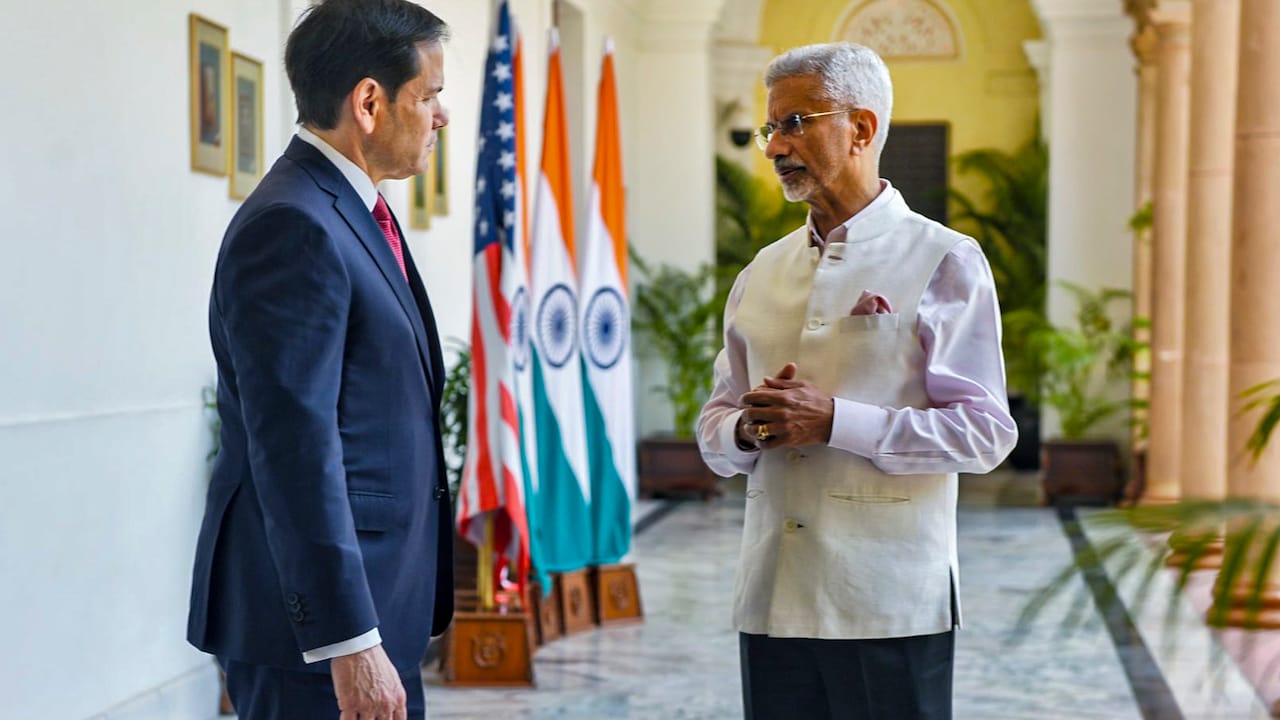
The maritime stand-off in the Gulf of Oman just turned into a first-rate diplomatic crisis between Washington and New Delhi. Three Indian civilian sailors are dead, killed by US naval strikes on commercial tankers attempting to bypass the American blockade of Iranian ports.
When Indian External Affairs Minister S. Jaishankar called US Secretary of State Marco Rubio to lodge a fierce, unambiguous protest against the killings, he didn't get an apology. He got a warning.
According to the US State Department, Rubio flatly told his Indian counterpart that violations of the American blockade and the illicit transport of Iranian oil "will not be tolerated." The US expects all commercial vessels to immediately comply with military orders in the Strait of Hormuz.
This exchange exposes a massive, uncomfortable rift between two strategic partners who are supposed to be aligned. It shows how the Trump administration's aggressive maritime strategy is colliding head-on with India's dependency on global shipping networks and the realities of merchant seafaring.
The Collateral Damage of Operation Epic Fury
The US military established its strict naval blockade on April 13, following the collapse of the Islamabad Talks. Since then, the US Central Command (CENTCOM) has aggressively policed the waters, intercepting dozens of ships. But this week, the enforcement turned lethal.
Within a few days, US forces targeted three separate foreign-flagged merchant vessels carrying large Indian crews off the coast of Oman.
- MT Marivex: A Palau-flagged tanker targeted by US forces. All 24 Indian crew members were safely rescued.
- MT Settebello: Another Palau-flagged vessel struck by the US Navy. This strike resulted in the tragic deaths of three Indian mariners.
- MT Jalveer: A Guinea-Bissau-flagged tanker hit by US military aircraft, which fired two Hellfire missiles directly into the vessel's engine room to disable it. It carried 20 Indian crew members.
New Delhi didn't take this lying down. The Ministry of External Affairs summoned US Chargé d'Affaires Jason Meeks twice in less than 48 hours. When Jaishankar escalated the issue directly to Rubio, he called the lethal actions against commercial shipping completely unjustified.
The American response, however, was icy. The official readout from the State Department, delivered via spokesperson Tommy Pigott, didn't offer a single word of condolence or regret for the dead Indian nationals. Instead, Washington doubled down on enforcement, signaling that civilian crew presence won't protect ships carrying suspected Iranian cargo.
Why Washington is Taking Such a Hard Line
To understand Rubio's stubborn stance, you have to look at what the US is trying to accomplish in the region. The White House wants a complete economic chokehold on Tehran. President Donald Trump even took to Truth Social to deflect blame, claiming Iran's own failed drone strikes were targeting Indian ships and complicating the security environment.
Washington's logic is brutal but simple: if you enter the blockaded zone or ignore commands from US naval assets, you are treated as a hostile entity or a sanctions-evader. The US view is that the shipowners and operators are knowingly running a illegal gauntlet, and the crews are caught in the crossfire of their employers' decisions.
But this ignores how the global shipping industry actually functions.
The Human Cost Hidden Behind Flag States
Here is what most casual observers get wrong about this crisis: none of the attacked ships were flying the Indian flag. They were registered in open registries like Palau and Guinea-Bissau—what the maritime world calls "flags of convenience."
But while the ships belong to obscure corporate entities on paper, the flesh and blood operating them are overwhelmingly Indian.
India is one of the world's largest suppliers of merchant seafaring talent. Right now, official data indicates that over 600 Indian sailors are working on vessels near the Strait of Hormuz. Broaden the lens to the wider Gulf region, and you're looking at nearly 18,000 Indian nationals working aboard foreign merchant ships.
Indian Seafarers in the Region (June 2026)
---------------------------------------------
Immediate Strait of Hormuz Area:  622 sailors
Wider Gulf Region Total:          ~18,000 sailors
These mariners don't choose the ship's cargo, its destination, or its compliance strategies. They are employees doing a highly dangerous job. By firing Hellfire missiles into engine rooms and disabling tankers with lethal force, the US Navy is treating civilian workers as enemy combatants. That's exactly why domestic anger is boiling over in India, prompting figures like Congress MP Shashi Tharoor to question how a supposed "friend" can be so deeply insensitive.
The Hypocrisy of Free Maritime Commerce
The diplomatic fallout here is massive. For years, the cornerstone of the US-India strategic partnership in the Indo-Pacific has been a shared commitment to the "rules-based international order" and the protection of free, unimpeded maritime commerce.
Yet, India now finds its own citizens killed not by state-sponsored pirates or rogue militias, but by the US Navy enforcing a unilateral blockade.
Jaishankar has previously voiced India’s deep anxieties about these disruptions. India imports more than 80% of its energy needs, and a massive chunk of its crude oil and liquefied petroleum gas (LPG) traditionally transits right through this volatile waterway. The conflict has already warped global energy markets, driving up fuel prices for state-run Indian retailers and sparking domestic inflation.
India finds itself in an impossible position. New Delhi has carefully maintained strong, functional relationships with the US, Israel, Iran, and the Gulf Arab states. It doesn't want to see energy markets constricted or weaponized. But Washington’s current "with us or against us" policy leaves zero room for strategic ambiguity.
What Happens Next
This crisis won't simply blow over with a boilerplate diplomatic statement. If you are a maritime operator, a cargo insurer, or a government regulator, you need to watch three critical friction points immediately.
First, check crew nationalities on your supply lines. Shipowners employing South Asian crews must expect intense scrutiny and potential pushback from labor unions and families who don't want their relatives sailing into a live fire zone controlled by an uncompromising US Navy.
Second, watch the energy insurance premiums. Shipping through the Gulf of Oman is about to get prohibitively expensive. The risk isn't just shadow-war sabotage anymore; it's direct kinetic strikes by western military forces.
Finally, watch New Delhi's defensive posture. India has a history of deploying its own naval assets to escort Indian-flagged merchant vessels during regional crises. If India decides to send warships to protect its seafaring nationals from US overreach, we could see a terrifying scenario where two partner navies face off in the same crowded waters.
- Audit your maritime supply chains: Verify the registration flags and transit routes of any vessels carrying your commodities through the Gulf.
- Track war-risk insurance premiums: Expect sudden spikes for any freight passing through the Oman and Hormuz zones over the coming days.
- Monitor Indian naval deployments: Watch for any signs that New Delhi is shifting its own guided-missile destroyers into the Gulf of Oman to safeguard its seafarers.