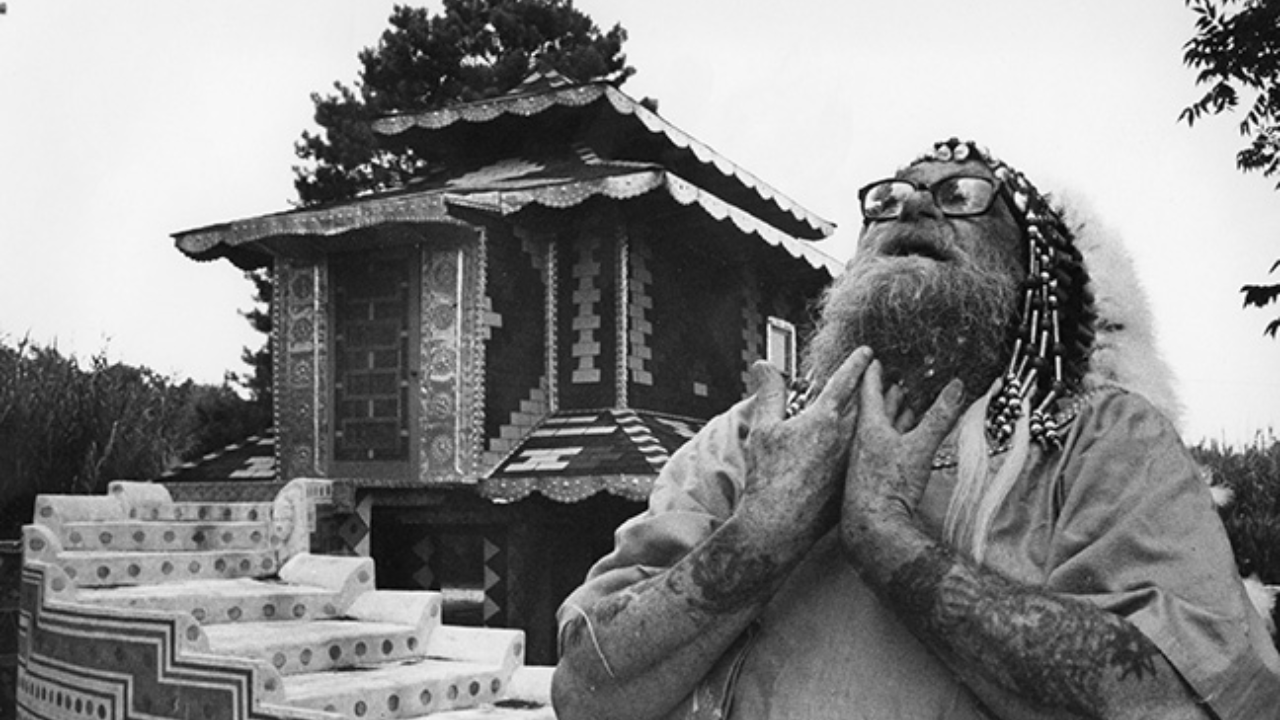
We romanticize the eccentric hermit who spends decades turning a humble farmhouse into a neon-drenched fever dream. Every culture loves the solitary outsider battling convention with brush and mortar. Eddie Owens Martin built Pasaquan out of raw grit, visions from space gods, and a staggering amount of concrete in rural Georgia. Art critics swoon. Preservationists drop millions restoring the beaded columns, the psychedelic murals, the sprawling masonry.
They are celebrating a monument to total functional irrelevance.
Let us stop pretending that single-handed outsider architecture serves any purpose beyond feeding our desperate need for quirky weekend tourism. Pasaquan gets framed as a triumph of visionary independence. It is actually a masterclass in spatial waste. Seven acres of prime Georgia land subjugated to an impenetrable private cult of personality, completely detached from community utility, economic viability, or actual human habitation.
If you want to understand why our built environment is broken, look right at the shrines we worship. We adore properties that reject every rule of urban density, sustainability, and shared progress, just because the guy who built them wore handmade dresses and spoke to deities named Omega.
The Myth of Authentic Eccentricity
The standard narrative surrounding Eddie Owens Martin goes something like this. A gay sharecropper's son leaves rural Georgia for New York, reinvents himself as St. EOM, receives prophecies from interdimensional travelers, and returns home to transform his mother's property into a six-acre visionary environment.
It is a great story for a Sunday supplement feature. It completely ignores the structural reality of what an isolated folk art compound actually represents.
Pasaquan sits in Buena Vista, Georgia. It is a monument built by someone who wanted to escape society, constructed in a way that makes society entirely impossible to sustain around it. The site requires constant, expensive structural intervention just to keep the weather from dissolving the concrete pantheons. Millions of dollars in grants from the Kohler Foundation and regional universities go toward keeping a dead man's private hallucination standing.
Consider the opportunity cost. Seven acres in a rural county converted into a museum of one man's psyche. No housing. No local enterprise. No integration into the agricultural or economic fabric of the region. Just a fenced-off garden of concrete snakes and totem poles that tourists visit twice a month before driving back to Columbus for dinner.
We call this preservation. I call it an expensive monument to antisocial isolation.
The Architecture of Exclusion
Outsider art communities love to preach about breaking boundaries. Pasaquan is a masterclass in building walls.
Eddie Owens Martin did not create a commons. He created a fortress. Every square inch of mortar and paint was designed to keep the mundane world out while projecting his personal mythology inward. When we praise this approach, we endorse the idea that space should serve individual ego rather than collective survival.
Look at the mechanics of what it takes to maintain a place like Pasaquan today. It takes armies of conservators using chemical sealants to stop the Georgia humidity from turning the painted stucco back into dust. The original creator walked away from normal social responsibilities to build his empire of signs. Now, modern taxpayers and institutional donors pick up the tab for his perpetual-motion machine of self-expression.
Real genius builds things that other people can use, modify, and inhabit. Outsider art demands preservation in amber. It treats the viewer as a passive consumer of a dead man's internal monologue. You are not allowed to touch, change, or add to the vision. You are simply there to gawk at the weirdness.
The Opportunity Cost of Folk Shrines
Let us talk about land use. Buena Vista does not suffer from a shortage of concrete snakes. It suffers from a lack of dynamic economic density, resilient local housing, and functional infrastructure.
When millions of cultural preservation dollars get funneled into restoring painted brick walls in the middle of nowhere, those funds vanish from places where human beings actually need shelter and mobility. We prioritize the aesthetic whims of a mid-century mystic over the material needs of the living county.
The defenders of folk art environments argue that these places inject soul into sterile landscapes. This argument relies on a false binary. The choice is not between a sterile strip mall and a seven-acre yard full of cosmic concrete deities. The choice is between productive, human-scaled stewardship of land and the narcissistic fossilization of private property.
Eddie Owens Martin lived his life on his own terms. Good for him. Turning his private hermitage into an institutionalized pilgrimage site teaches us the wrong lesson entirely. It teaches us that spatial rebellion means checking out, building a fence, and leaving your mess for the next generation to curate.
How to Actually Support Real Creatives
If you want to support genuine artistic innovation, stop funding the maintenance bills of dead hermits. Stop treating isolated eccentricity as the highest form of cultural achievement.
- Fund Density, Not Relics: Put money into community land trusts that allow living artists to secure affordable housing and studio space within functional neighborhoods, rather than remote rural compounds.
- Reject the Hermit Narrative: Challenge the romantic trope that true art requires total alienation from community responsibility. Art built at the expense of human connection is just expensive yard ornamentation.
- Demand Utility: Evaluate public art and architectural preservation based on what it gives back to the immediate locality, not how many Instagram check-ins it generates for cultural tourists.
Pasaquan stands as a glittering, noisy reminder of what happens when personal ego gets absolute dominion over land. It is time to stop worshipping the ghosts of outsider isolationists and start building spaces that actually serve the living.
Stop saving shrines to antisocial art. Build communities that do not require a psychic to escape them.