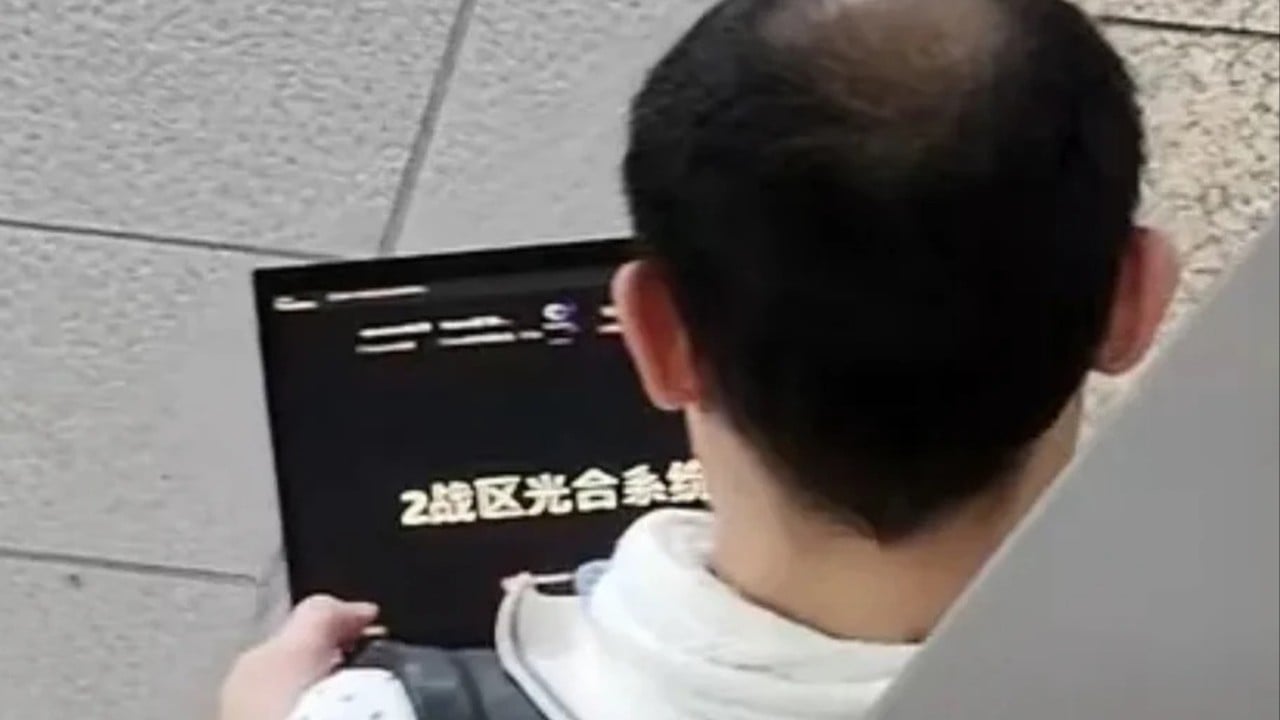
A routine afternoon commute through Taipei Main Station nearly turned into an international security incident last week after a bystander mistook a commuter’s financial management lecture for a Chinese military infiltration. The episode began when a citizen noticed a 48-year-old unemployed supplement salesman named Kao sitting on the Bannan Line platform, staring intently at a laptop screen displaying the phrase “Second Theatre Command.” Convinced he was a mainland operative harvesting intelligence, the observer photographed the screen, uploaded the warning to social media, and fired off urgent reports to the National Police Agency, the Criminal Investigation Bureau, the Mainland Affairs Council, and the Ministry of Justice Investigation Bureau.
Before facts could catch up with internet outrage, Democratic Progressive Party (DPP) Legislator Michelle Lin amplified the panic. Sharing the snapshot on her official Facebook account, Lin publicly questioned whether the commuter was operating the “Guanghe Public Opinion Monitoring System,” a commercial-grade data scraping tool frequently associated with mainland influence operations. She demanded an immediate multi-agency investigation into whether the citizen was actively passing real-time public sentiment data across the strait.
The state security apparatus moved swiftly, tracing Kao to his residence in Shilin District by the following morning. The investigation concluded within hours with no charges filed and no state secrets compromised. Kao was merely waiting for a friend while listening to an online seminar about personal finance. The ominous-sounding label on his monitor was simply the course ID and login portal for the lecture series, titled the Second Theatre Command Guanghe System.
This incident exposes a deeper institutional vulnerability. When high-ranking elected officials amplify unverified citizen journalism without basic verification, they risk turning routine public life into a hyper-vigilant witch hunt.
The Anatomy of Civil Surveillance Panic
Taiwan exists under an undeniable, continuous shadow of gray-zone aggression. Real threats exist. Beijing maintains active military commands—including the Eastern Theatre Command—tasked with operational planning for cross-strait contingencies. Cyber espionage units regularly target Taiwanese semiconductor firms, government agencies, and legislative aides using sophisticated spear-phishing campaigns.
The public knows this. National security education campaigns frequently urge citizens to remain vigilant against suspicious behavior.
Yet, vigilance without context degenerates into paranoia. A man holding a laptop in a public transit hub is not an anomaly in a hyper-connected metropolis of millions. The threshold for what constitutes a national security threat has shifted dramatically downward, driven by a toxic mix of political polarization and digital mob mentality.
When a politician with a large digital footprint validates a random snapshot, it creates immediate institutional pressure. Police forces and investigative bureaus cannot simply ignore a public allegation made by a sitting lawmaker, regardless of how flimsy the initial evidence appears. Resources that should be dedicated to tracking actual state-sponsored threat actors are redirected toward tracking down an unemployed citizen watching an online lecture about stock portfolios.
The Cost of Weaponized Suspicion
The fallout from the Taipei Main Station false alarm extends far beyond one man's startling morning encounter with local law enforcement. Opposition lawmakers quickly seized on the blunder to criticize the ruling party for fostering a political atmosphere of reckless accusation. Accusations of internal witch hunts began ricocheting through the legislature, deepening an already toxic partisan divide.
This dynamic plays directly into external interference strategies. If a society becomes so fractured and trigger-happy that citizens actively report each other over ambiguous text on a screen, the adversary achieves a psychological victory without firing a shot. Social cohesion erodes from the inside out.
Consider the technical realities of actual intelligence gathering. Real operatives do not sit on crowded subway platforms with glowing banners proclaiming their military affiliation in plain view. Modern espionage relies on quiet persistence, encrypted channels, compromised credentials, and zero-day exploits delivered through sterile digital environments. The theatrics of a man openly broadcasting a military designation on a crowded platform run counter to every baseline principle of clandestine operations.
Yet the myth of the clumsy, ubiquitous spy persists because it fits neatly into an emotionally charged narrative.
Re-Engineering Public Defense Against Paranoia
Safeguarding a democracy against sophisticated foreign interference requires hardening institutions, not empowering digital vigilantes. Security agencies have repeatedly emphasized that handling public threat reports requires analytical discipline. Jumping from a generic phrase on a screen to a conclusion of treason damages public trust in legitimate oversight bodies.
The individual whose snap judgment triggered the police deployment walked away believing they had done their civic duty. The politician who shared the post moved on to the next news cycle. Meanwhile, Kao spent his morning explaining his browser history to detectives because an algorithm and an anxious commuter decided that digital literacy looked like subversion.
As geopolitical tensions persist, the real test of resilience is not whether a society can spot an enemy everywhere, but whether it retains the clarity to recognize when there is nothing there at all.