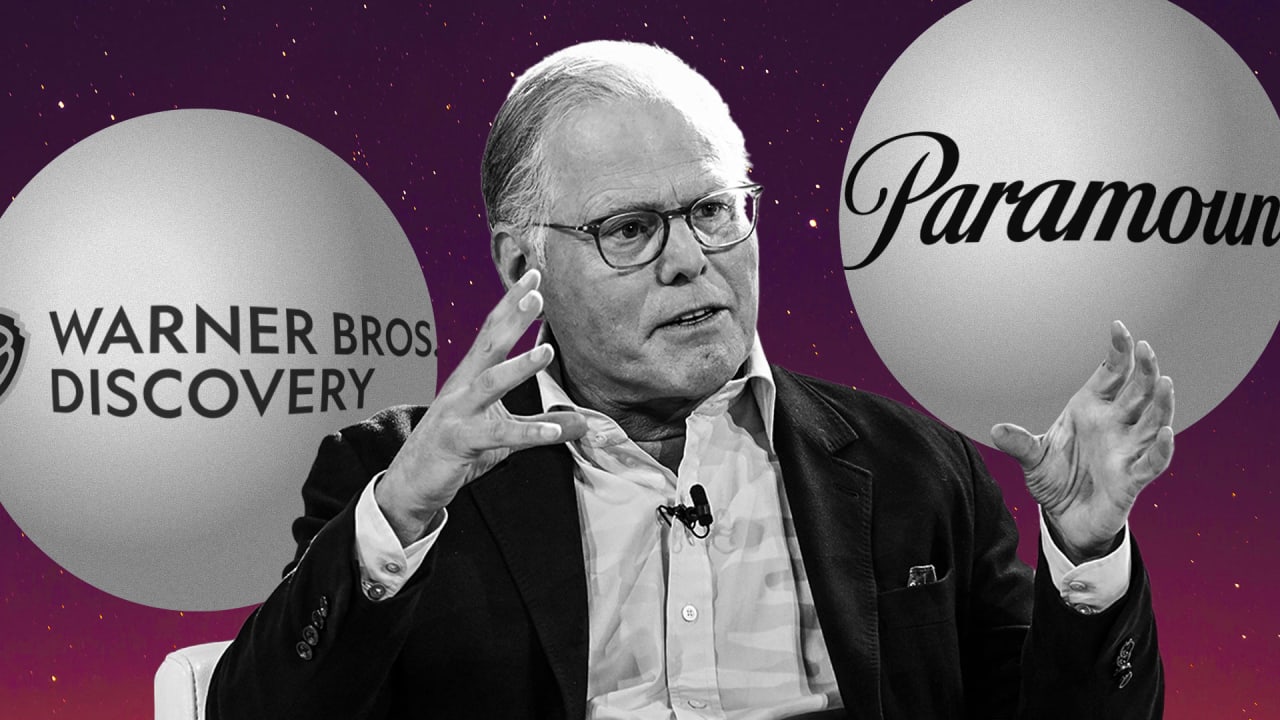
The proposed acquisition of Warner Bros. Discovery (WBD) by Paramount Global represents a terminal consolidation event in the linear media cycle, driven not by growth potential, but by the necessity of debt restructuring and overhead suppression. While public discourse often focuses on "content libraries," the actual value of this transaction sits in the intersection of tax-loss harvesting, the consolidation of distressed linear assets, and the desperate attempt to achieve a critical mass of Monthly Active Users (MAUs) to rival Netflix and Disney. This isn't a play for market dominance; it is a defensive maneuver to prevent a total collapse of the legacy television ecosystem.
The Debt-to-Equity Compression Trap
The primary hurdle for a Paramount-WBD merger is the combined debt load. WBD entered the market with approximately $40 billion in debt following the Discovery-WarnerMedia spinoff, while Paramount carries roughly $14 billion. In a high-interest-rate environment, the cost of servicing this combined $54 billion creates a structural ceiling on innovation.
The merger's success hinges on a specific financial mechanism: the Free Cash Flow (FCF) to Debt Service Ratio. To make the math work, the combined entity must achieve "synergies"—a euphemism for the aggressive elimination of redundant departments. The logic follows a three-step compression:
- Redundancy Liquidation: Removing duplicate global marketing teams, HR infrastructure, and legal departments.
- Linear Sunset Acceleration: Bundling declining cable networks (CNN, MTV, HGTV, Nickelodeon) into a single entity to maximize carriage fees from remaining cable providers before the terminal decline of the medium.
- Content Amortization: Using the combined library to lower the average cost of content per subscriber on a unified streaming platform.
The Streaming Unit Economic Threshold
Streaming platforms fail or succeed based on their Average Revenue Per User (ARPU) versus their Content Spend Per Subscriber. Individually, Paramount+ and Max (formerly HBO Max) occupy the "mid-tier" of the market. They are large enough to incur massive production costs but small enough to suffer from high churn rates.
When users finish a "prestige" series like The Last of Us or Yellowstone, they often cancel their subscription. This is the Churn Spiral. By merging, the entity attempts to build a "Value Wall" where the sheer volume of diverse content—spanning live sports, news, children’s programming, and cinema—makes the service indispensable.
The technical objective is to move from an Optional Service (high churn) to a Utility Service (low churn). If the combined entity can keep its churn rate below 2% while maintaining an ARPU of $12.00, it can theoretically reach a breakeven point on its $5 billion+ annual content budget.
Antitrust and the Monopsony of Creative Talent
The Federal Trade Commission (FTC) and the Department of Justice (DOJ) view mergers through the lens of consumer harm, but a Paramount-WBD deal presents a unique "Monopsony" risk. A monopsony occurs when there is only one (or very few) buyers for a product—in this case, creative labor and intellectual property.
- Production Bottlenecks: If the number of major studios shrinks from five to four, the "greenlight" power is concentrated. This reduces the bidding wars for scripts, acting talent, and production crews.
- The Sports Rights Conglomerate: A combined Paramount-WBD would control an overwhelming share of NFL, NBA, March Madness, and MLB rights. This creates a vertical monopoly that could force cable providers—and eventually digital platforms—to pay exorbitant fees, which are then passed on to the consumer.
The regulatory pushback will likely focus on The Blockbuster Clause. Regulators may demand the divestiture of certain assets, such as the CBS broadcast network or specific cable channels like CNN, to ensure that news and local broadcasting remain competitive.
The Technology Debt and Backend Integration
Most analysts ignore the catastrophic complexity of merging two massive digital infrastructures. Max and Paramount+ run on different tech stacks, recommendation engines, and user databases.
The Migration Risk is significant. When Discovery+ merged with HBO Max, user data loss and interface lag were prevalent. A three-way integration involving Paramount's legacy systems introduces technical debt that can take years to resolve. During this "integration lag," the company risks losing subscribers to more agile competitors like YouTube or Netflix, who do not have to pause innovation to fix backend plumbing.
Intellectual Property Cannibalization
There is a law of diminishing returns in content libraries. While owning both Star Trek and DC Comics sounds powerful, the cost of maintaining these franchises often grows faster than the audience. This is IP Fatigue.
The combined entity faces a "Budgetary Zero-Sum Game." If the company spends $300 million on a new DC film, that is $300 million not spent on expanding the Yellowstone universe. Without the influx of new capital, the studio is forced to cannibalize its own sub-brands to keep the most profitable ones alive.
The Strategic Forecast: The Portfolio Clearance Sale
The likely outcome of a Paramount-WBD merger is not a permanent media titan, but a "clean-up" operation designed for an eventual sale to a Big Tech firm (Apple, Amazon, or Google).
Legacy media companies are currently in the Liquidation Phase of their lifecycle. They are aggregating assets to make themselves a more attractive "turnkey" solution for a tech giant that wants a massive library but doesn't want to build a studio from scratch.
The immediate tactical move for the board of directors is clear:
- Issue a Hard Cap on Linear Production: Immediately freeze all non-essential development for cable channels.
- Unified Backend Launch: Prioritize a single application interface over brand identity. The brand is the content, not the app name.
- Debt-for-Equity Swaps: Aggressively pursue restructuring to lower the interest burden before the next major economic downturn.
The merger is a mathematical necessity, but it is not a cure. It is a high-stakes attempt to buy time in a market that has already moved toward creator-led platforms and algorithmic distribution. Success depends entirely on the speed of the cuts and the stability of the remaining subscriber base.