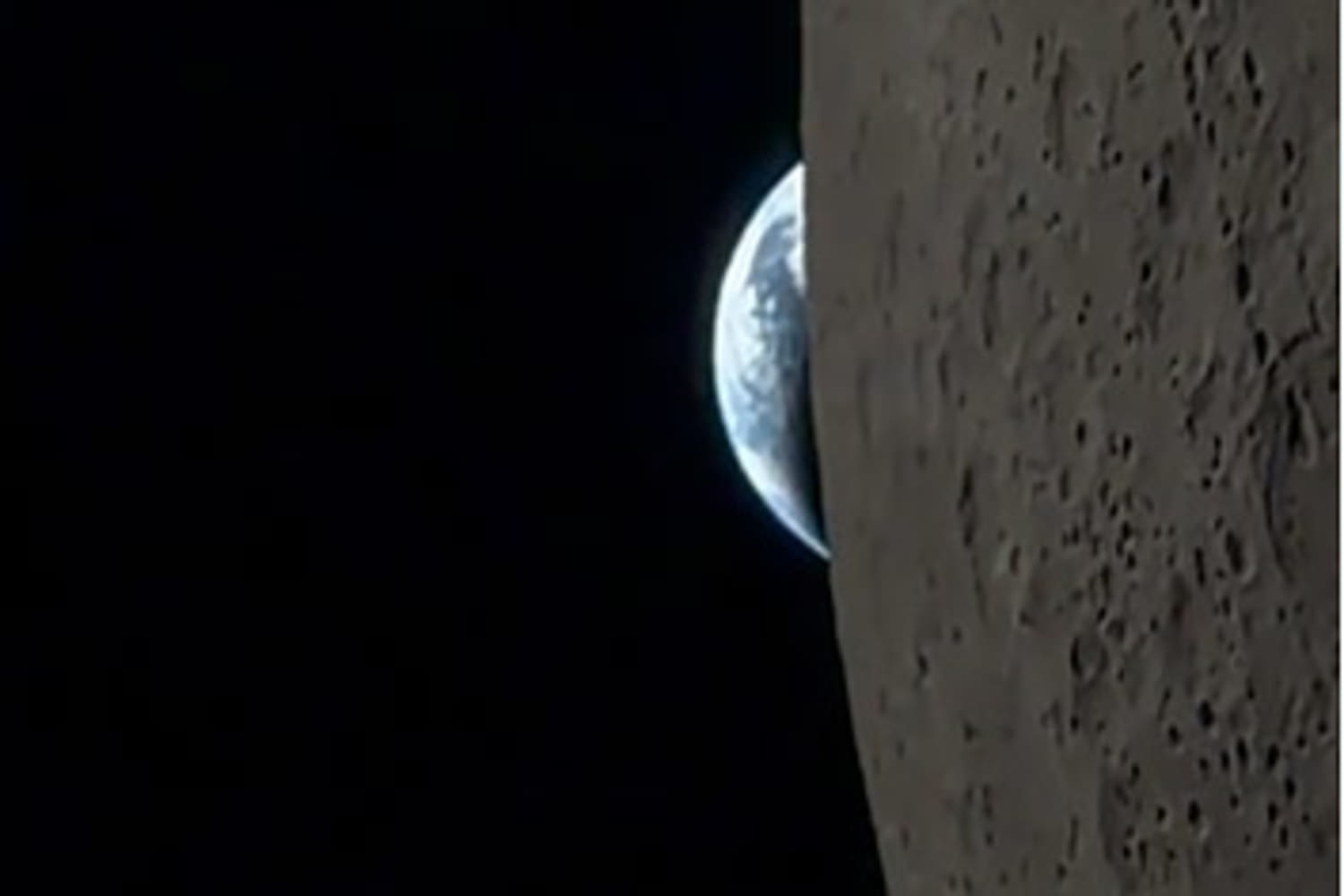
The capture of an "Earthset" by an Artemis II astronaut using a standard iPhone represents a convergence of high-stakes orbital mechanics and the peak of consumer-grade optical engineering. While the media often frames such events through the lens of aesthetic wonder, a rigorous analysis reveals a sophisticated intersection of celestial geometry, radiation shielding constraints, and the democratization of imaging sensors. This event validates the operational utility of Commercial Off-The-Shelf (COTS) hardware in Deep Space Environment (DSE) conditions, proving that the gap between specialized aerospace instrumentation and high-end consumer electronics has narrowed to a point of functional parity for specific documentation tasks.
The Geometry of Earthset Dynamics
An Earthset is not a common lunar occurrence for those on the Moon’s surface; it is a phenomenon largely restricted to observers in lunar orbit or those positioned at the lunar limbs. Because the Moon is tidally locked to Earth, the Earth remains relatively stationary in the lunar sky from most vantage points on the near side. The "setting" motion witnessed by the Artemis II crew is a direct function of the spacecraft’s velocity and its specific trajectory relative to the lunar horizon. If you found value in this article, you should read: this related article.
To understand the visual data captured, one must calculate the relative angular velocity. The spacecraft travels in a Free Return Trajectory, a specific orbital path designed to ensure that if propulsion systems fail, the Moon's gravity naturally slingshots the capsule back toward Earth.
The velocity of the Orion capsule during this phase exceeds 2,000 miles per hour relative to the lunar surface. As the vehicle rounds the far side of the Moon and emerges into the light of the Sun, the Earth appears to "rise" or "set" against the lunar limb. The precision required to capture this on a handheld device involves managing three distinct variables: For another look on this event, check out the recent update from CNET.
- Relative Motion Compensation: The astronaut must stabilize the sensor against the spacecraft’s vibration and its own orbital progression to prevent motion blur.
- Dynamic Range Management: The lunar surface reflects high-intensity solar radiation (high albedo), while the Earth provides a mid-range luminance, and the vacuum of space represents a near-zero black point.
- Limb Sharpening: The crispness of the lunar horizon in the footage is due to the lack of an atmosphere on the Moon, which eliminates the Rayleigh scattering that typically softens horizons on Earth.
COTS Integration in Deep Space Vehicles
The decision to use an iPhone for primary visual documentation on a multi-billion dollar mission is not an aesthetic choice but a strategic one rooted in the Optimization of Mass and Power (OMP). Spacecraft design operates under a brutal weight-to-thrust ratio. Every gram of equipment requires a corresponding increase in propellant.
The Reliability-Agility Tradeoff
Traditional space-hardened cameras involve long development cycles. By the time a "space-rated" camera is flight-ready, its sensor technology is often five to ten years behind the current market leaders. NASA’s shift toward COTS hardware allows mission specialists to utilize the most advanced Computational Photography (CP) engines available. These engines use multi-frame synthesis and neural processing to overcome physical lens limitations, such as small apertures and limited focal lengths.
However, the use of consumer hardware in the Van Allen belts and beyond introduces a Stochastic Failure Risk.
- Single Event Upsets (SEUs): High-energy protons or cosmic rays striking a CMOS sensor can cause "hot pixels" or permanent sensor damage.
- Memory Corruption: Radiation can flip bits in the device's RAM or NAND flash, leading to file corruption during the write process.
- Thermal Throttling: In a vacuum, heat does not dissipate via convection. The iPhone’s internal processor generates heat that must be managed through conduction into the astronaut's gloves or the spacecraft's internal atmosphere, otherwise, the device will shut down to protect its circuitry.
The Optical Physics of the Lunar Limb
The footage captured by the Artemis II crew highlights a specific optical phenomenon: the absence of an atmospheric interface. When observing an Earthset from the Moon, the transition from the lunar surface to the blackness of space is instantaneous. This creates a "knife-edge" diffraction pattern.
In standard terrestrial photography, the atmosphere acts as a low-pass filter, blurring high-frequency spatial details. In the vacuum of the lunar orbit, the iPhone’s sensor is receiving unfiltered photons. This results in an unprecedented level of detail in the "Earthrise" or "Earthset" transition, where the Earth’s atmosphere appears as a thin, fragile blue meniscus. This specific visual data point is critical for calibrating Earth observation models, as it provides a clean side-profile of the Earth’s atmospheric layers against a true-black background.
Strategic Implications for Lunar Documentation
The Artemis II mission serves as a high-fidelity test case for the Human-Machine Interface (HMI) in high-stress orbital environments. The use of a familiar interface (iOS) reduces the cognitive load on the astronaut. In the seconds available to capture a celestial alignment like an Earthset, the friction of operating a complex, manual aerospace camera can lead to missed opportunities.
The "iPhone Earthset" is a demonstration of Redundant Documentation Systems. While the Orion capsule is outfitted with fixed, high-resolution ESA and NASA cameras, the handheld COTS device provides:
- Dynamic Framing: The ability to track the Earth as it moves behind the lunar limb without reorienting the entire spacecraft.
- Instantaneous Metadata: Each frame is timestamped and synchronized with the mission clock, allowing ground control to cross-reference the visual data with the spacecraft’s telemetry (altitude, pitch, yaw, and velocity) with millisecond precision.
The Architecture of the Visual Payload
The specific footage in question utilizes a telephoto lens assembly which, in modern smartphones, uses a "folded optics" or periscope design to achieve focal lengths previously impossible in slim form factors. For an astronaut, this allows for a tight crop on the Earth while maintaining the lunar limb in the foreground for scale.
The underlying logic of this capture is the Inverse Square Law of Light. As the spacecraft moves further from the Sun and closer to the Moon, the intensity of light reflected off the lunar regolith becomes a dominant factor in exposure settings. The iPhone’s software must rapidly calculate a weighted average exposure to ensure the Earth (the subject) is not blown out by the reflected glare of the Moon (the foreground).
Structural Constraints of the Orion Windows
The footage is further mediated by the composition of the Orion’s windows. These are not standard glass but multiple panes of high-strength alumino-silicate and fused silica. Each layer introduces a potential for:
- Internal Reflection: Light bouncing between the panes can create ghost images of the Earth.
- Chromic Aberration: The thickness of the panes can slightly shift the wavelengths of light, though NASA’s optical coatings are designed to minimize this in the visible spectrum.
- Polarization: Depending on the angle of the sun, the windows may polarize the light, affecting how the Earth’s oceans appear in the final video.
The astronaut’s role is to minimize these artifacts by placing the camera lens as close to the inner pane as possible without making physical contact, which could transmit spacecraft vibrations directly into the sensor's optical image stabilization (OIS) system, potentially causing "jello effect" or rolling shutter distortion.
Analytical Framework for Future Mission Documentation
As NASA moves toward the Artemis III lunar landing, the "iPhone Earthset" establishes a baseline for the Asymmetric Information Value of mission media. While scientific instruments provide raw data, these high-fidelity visual assets provide contextual data that is vital for post-mission analysis of crew perspective and situational awareness.
The success of this capture mandates a shift in how aerospace entities view consumer technology. The "Cost-per-Pixel" of a COTS-captured Earthset is orders of magnitude lower than that of a custom-built lunar camera, with a quality delta that is negligible for the purposes of public engagement and secondary scientific review.
Future mission profiles should prioritize the integration of AI-driven image enhancement on-device. By utilizing local machine learning clusters within the smartphone, astronauts can de-noise low-light far-side footage in real-time, providing ground control with immediate high-fidelity feedback before the data is even downlinked via the Deep Space Network (DSN).
The deployment of COTS hardware in the Artemis program signals the end of the era of specialized, isolated space tech. We are now entering an era where the primary constraint on space documentation is no longer the hardware’s capability, but the orbital mechanics and radiation environments that define the mission’s path. The strategic path forward involves not just better cameras, but better algorithms to handle the extreme lighting and radiation challenges of the lunar environment.
Mission planners must now formalize the use of COTS devices as "Tier 2" mission sensors, integrating them into the official data-handling architecture rather than treating them as personal mementos. This requires a rigorous hardening of the software stack and a systematic approach to shielding that does not compromise the device's weight-saving advantages. The Earthset video is not merely a social media asset; it is a proof-of-concept for the next generation of lean, high-efficiency space exploration.


:max_bytes(150000):strip_icc()/Term-Definitions_monopoly-fa34a19571eb4168876f3a6947aa1a6f.jpg)