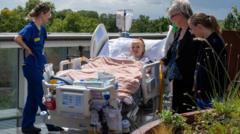
The physical isolation of intensive care units (ICUs) generates measurable physiological and psychological decay in critically ill patients. Standard ICU environments—characterized by synthetic, high-frequency auditory alarms, uninterrupted artificial spectrum lighting, and a total absence of natural airflow—accelerate ICU psychosis and delirium. Clinical data indicates that ICU delirium affects up to 80% of mechanically ventilated patients, directly correlating with extended lengths of stay, higher institutional costs, and increased mortality rates.
The deployment of an open-air or rooftop intensive care ward represents an operational shift from passive environmental management to active, spatial therapy. This analysis deconstructs the structural engineering, clinical mechanics, and patient-outcome vectors required to transition critical care from a sealed internal envelope to an unsealed outdoor infrastructure.
The Dual-Vector Benefit Framework
An outdoor intensive care environment operates on two distinct therapeutic vectors: biological resynchronization and psychological grounding. Traditional clinical architecture treats the patient as an organism to be insulated from the external biosphere. An open-air design treats the external biosphere as a non-pharmacological intervention.
                  ┌────────────────────────────────────────┐
                  │ Outdoor Clinical Environment Deployment │
                  └───────────────────┬────────────────────┘
                                      │
             ┌────────────────────────┴────────────────────────┐
             ▼                                                 ▼
┌───────────────────────────┐                     ┌───────────────────────────┐
│ Biological Vector         │                     │ Psychological Vector      │
├───────────────────────────┤                     ├───────────────────────────┤
│ • Circadian Alignment     │                     │ • Delirium Abatement      │
│ • Natural Photo-Spectrum  │                     │ • Sensory Grounding       │
│ • Melatonin Regulation    │                     │ • Cognitive Anchoring     │
└───────────────────────────┘                     └───────────────────────────┘
Biological Resynchronization via Photo-Spectrum Alignment
The primary biological driver is the restoration of the circadian rhythm. Hospitalized patients exposed exclusively to fluorescent or LED illumination experience a disruption in suprachiasmatic nucleus activity. This disruption suppresses the natural pulse-waves of cortisol and melatonin secretion.
- Natural Light Density: Sunlight provides a dynamic, full-spectrum Lux gradient that cannot be replicated by internal lighting fixtures. Exposure to natural daylight anchors the sleep-wake cycle, lowering the baseline requirement for sedative infusions such as dexmedetomidine or propofol.
- Neurological Stability: Stabilizing the circadian pacemaker directly mitigates the neurological volatility that precipitates acute brain dysfunction in critical care settings.
Psychological Grounding and Sensory De-escalation
ICU delirium is largely a function of sensory deprivation combined with cognitive overload. Patients lose their orientation to time and space because the internal environment offers no variable reference points.
- Contextual Anchoring: Visual access to a changing sky, moving air currents, and distant geographic horizons provides immediate, low-cognitive-load spatial orientation.
- Auditory Decoupling: Replacing the persistent acoustic profile of an indoor unit—where mechanical hums and alarm frequencies average between 60 to 80 decibels—with natural ambient soundscapes lowers sympathetic nervous system arousal. This shifts patient physiology away from a chronic fight-or-flight state, reducing systemic inflammatory markers driven by elevated cortisol.
Mechanical and Structural Constraints of Unsealed Care Envelopes
Transitioning critical care equipment outside requires solving a complex engineering problem. A rooftop or open-air ICU must maintain the exact physiological monitoring capabilities of a closed cleanroom while operating within a variable, unconditioned microclimate.
┌───────────────────────────────────────────────────────────────────────────┐
│              Rooftop ICU Structural Integration Challenge                 │
├───────────────────────────────────────────────────────────────────────────┤
│                                                                           │
│   [Ambient Weather Vectors]     ───►  ┌───────────────────────────────┐   │
│   (Temp, Humidity, Wind, Rain)        │ Variable Microclimate         │   │
│                                       └──────────────┬────────────────┘   │
│                                                      │                    │
│                                                      ▼                    │
│   [Clinical Infrastructure]     ───►  ┌───────────────────────────────┐   │
│   (Gases, Power, HVAC, Bounds)        │ Fixed Structural Shell        │   │
│                                       └───────────────────────────────┘   │
│                                                                           │
└───────────────────────────────────────────────────────────────────────────┘
Power and Utility Distribution Logistics
Patient lifelines—specifically continuous renal replacement therapy (CRRT) machines, mechanical ventilators, and high-volume infusion pumps—demand uninterrupted electrical and gas connectivity.
- Enclosed Utility Conduits: Standard internal headwalls rely on wall-recessed medical gas pipelines (oxygen, medical air, vacuum). Outdoor conversion requires weatherized, insulated umbilical booms or raised flooring tracks to prevent moisture ingress and thermal degradation of lines.
- Emergency Backups and Power Security: Electrical distribution must meet strict wet-location standards, utilizing isolated power systems with line isolation monitors to eliminate ground-fault risks during precipitation events.
Environmental Vector Protection Mechanics
The open-air design cannot simply expose vulnerable patients to raw weather conditions. It requires a hybrid structural shell capable of rapid modulation.
- Retractable Kinetic Architectural Barriers: Automated glass or polymer panels must deploy within a 90-second window based on real-time meteorological sensor data (wind velocity exceeding 30 knots, precipitation detection, or ambient temperatures dropping below 18°C or exceeding 30°C).
- Micro-Zone HVAC Stabilization: Even when open, the immediate patient zone requires a laminar airflow boundary layer. This air curtain acts as a thermal and particulate barrier, preventing urban pollutants, pollen, or opportunistic fungal spores (such as Aspergillus) from settling on patient access lines or surgical wounds.
Infection Control and Pathogen Dynamics
A common critique of open-air clinical design centers on the loss of HEPA-filtered positive pressure environments. A rigorous assessment of airborne pathogen behavior reveals that outdoor air volume can change the infection risk profile favorably, provided specific operational parameters are met.
Dilution Volume vs. Filtration Efficiency
Indoor ICUs rely on air handling units to achieve 6 to 12 air changes per hour (ACH) to dilute microbial loads. An outdoor environment offers an effectively infinite dilution volume. The immediate dispersal of expelled respiratory droplets drastically reduces the viral or bacterial payload density around the patient. This structural reality alters the transmission dynamics of nosocomial infections:
$$R_{\text{transmission}} \propto \frac{\text{Pathogen Density} \times \text{Exposure Time}}{\text{Volumetric Airflow}}$$
Because the denominator approaches infinity in an unsealed environment, the probability of cross-contamination via aerosol pathways drops substantially.
Fomite and Vector Disinfection Protocols
The absence of a sealed perimeter introduces risks related to avian, insect, and particulate vectors.
- Sterile Field Maintenance: Central venous catheters, arterial lines, and endotracheal tubes require secondary physical shields. Standard transparent dressings must be supplemented with water-resistant, ultraviolet-C (UV-C) stable antimicrobial wraps to counter the degradation caused by solar radiation.
- Surface Cleaning Protocols: Horizontal surfaces in an outdoor ward accumulate particulate matter at three to four times the rate of an indoor unit. Disinfection schedules must scale from a standard twice-daily cadence to a high-frequency, metric-driven cycle managed by dedicated environmental services teams utilizing fast-evaporating, non-corrosive chemical agents.
Clinical Triaging and Patient Selection Matrix
Not every critical care patient is a candidate for outdoor transfer. The operational framework requires a strict, objective scoring system to determine eligibility, eliminating subjective clinical bias and ensuring patient safety.
| Patient Parameter | Inclusion Criteria | Absolute Exclusion Criteria |
|---|---|---|
| Hemodynamic Stability | Mean Arterial Pressure (MAP) $\ge$ 65 mmHg on stable or down-titrating single-agent vasopressor support. | Escalating dual-agent vasopressor requirements; active cardiac arrhythmias requiring immediate cardioversion. |
| Ventilatory Status | $FiO_2 \le 0.50$; PEEP $\le$ 10 $cmH_2O$; stable minute ventilation without acute respiratory distress. | Open-lung ventilation strategies; prone positioning protocols; nitric oxide delivery requirements. |
| Neurological State | RASS score of -2 to +1; patient capable of purposeful interaction or demonstrating signs of early hypoactive/hyperactive delirium. | Active status epilepticus; ICP (Intracranial Pressure) monitoring devices in place with unstable pressures. |
| Thermoregulation | Core body temperature between 36.5°C and 37.5°C without the use of invasive cooling blankets. | Therapeutic hypothermia protocols post-cardiac arrest; severe autonomic dysreflexia. |
The workflow for patient transition must follow a strict, multi-step sequence to guarantee continuous monitoring during the transit phase.
┌────────────────────────┐     ┌────────────────────────┐     ┌────────────────────────┐
│ 1. Matrix Clearance   │ ───► │ 2. Transport Prep      │ ───► │ 3. Umbilical Handshake │
│ Verify all inclusion  │      │ Shift to wireless      │      │ Connect to outdoor     │
│ metrics are met.       │      │ monitoring & transport │      │ power, gases, and telemetry.
└────────────────────────┘      │ ventilator systems.    │     └────────────────────────┘
                               └────────────────────────┘
The second step requires shifting the patient to wireless telemetry and a transport ventilator. This step represents the highest risk window due to potential line dislodgement or monitoring dropouts.
The final step—the umbilical handshake—occurs at the outdoor bed space, where the patient is reconnected to stationary power, gases, and high-bandwidth telemetry. The entire process requires a minimum of three trained clinicians: one intensive care physician, one critical care nurse, and one respiratory therapist.
The Economics of Spatial Therapeutics
Implementing a rooftop or open-air intensive care infrastructure requires a high upfront capital expenditure. A thorough cost-benefit analysis demonstrates that financial recovery is achieved by reducing the total cost of care per patient encounter.
Direct Cost Reductions Via Length of Stay Optimization
ICU bed days are among the most expensive components of hospital operations. A significant portion of these costs is driven by complications resulting from prolonged sedation and subsequent delirium.
- Sedation De-escalation: By using natural environmental stimuli to accelerate sedation weaning, hospitals can reduce the consumption of expensive intravenous sedatives and anesthetic agents.
- Delirium-Induced Stay Reduction: Clinical models indicate that reducing the duration of ICU delirium by 1.5 days decreases the average ICU length of stay by roughly 12%. This quickens bed turnover rates and increases the hospital’s capacity for high-margin elective surgical admissions.
Long-Term Institutional Asset Valuation
Beyond immediate operational savings, an open-air clinical asset provides long-term strategic value to healthcare systems.
- Epidemiological Resilience: In the event of a novel airborne pandemic, an open-air ward serves as a pressure-valve isolation zone. It allows the hospital to treat highly infectious patients without contaminating the main internal HVAC infrastructure.
- Clinician Burnout Mitigation: The physical benefits of the outdoor environment extend directly to nursing and medical staff. Exposure to natural light and open space reduces cognitive fatigue and clinical error rates during long shifts, improving staff retention metrics and lowering recruitment costs.
Strategic Implementation Mandate
Healthcare networks looking to build or retro-fit open-air clinical spaces must avoid treating these installations as architectural novelties or green spaces. They must be integrated as high-performance medical devices.
The immediate next step for engineering and clinical leadership teams is the execution of a micro-climate simulation study on target facility rooftops. This study must collect continuous data over a 365-day cycle, measuring localized wind shear, particulate matter distribution ($PM_{2.5}$ and $PM_{10}$), and thermal volatility.
Only when these baseline parameters are mapped can the physical layout, kinetic glass structures, and utility umbilical configurations be engineered to ensure absolute clinical continuity. The future of critical care architecture belongs to systems that can fluidly dissolve the barrier between controlled medical technology and the natural biological environment.
/i.s3.glbimg.com/v1/AUTH_5dfbcf92c1a84b20a5da5024d398ff2f/internal_photos/bs/2022/7/q/6M5eaAQBGuPVBPz0xKuQ/whatsapp-image-2022-12-24-at-17.52.03.jpeg)