Numbers don't always tell the whole story. When news breaks that the Venezuela earthquake death toll rises to 235, it sounds like a tragic but standard disaster headline. The reality on the ground is infinitely more terrifying. This isn't just a sudden spike in casualties. It's a full-blown catastrophe threatening to swallow entire coastal communities whole.
Emergency officials are already warning that the current number is a fraction of what's coming. With thousands injured and tens of thousands missing, the true scale of this disaster is only beginning to surface. If you look closely at what happened along the coast, you'll see a crisis that's stretching local resources past their absolute breaking point.
The Anatomy of a Seismic Doublet
The destruction wasn't caused by a single violent tremor. Instead, Venezuela was battered by a rare phenomenon known as a seismic doublet. Two massive tectonic shifts ripped through the region almost simultaneously.
The first shock hit as a magnitude 7.2 earthquake near San Felipe. Just 39 seconds later, a second, even larger 7.5 magnitude quake struck southeast of Yumare. Hits like this are a death sentence for older infrastructure. The first quake fractures the foundations, and the second one brings the entire building down.
Because the quakes were incredibly shallow, happening at a depth of only 10 kilometers, almost all the tectonic energy hit the surface directly. It shook cities more than a thousand miles away, triggering building evacuations as far as the Brazilian Amazon. In Venezuela itself, the back-to-back hits completely overwhelmed local emergency lines within minutes.
Ground Zero in La Guaira
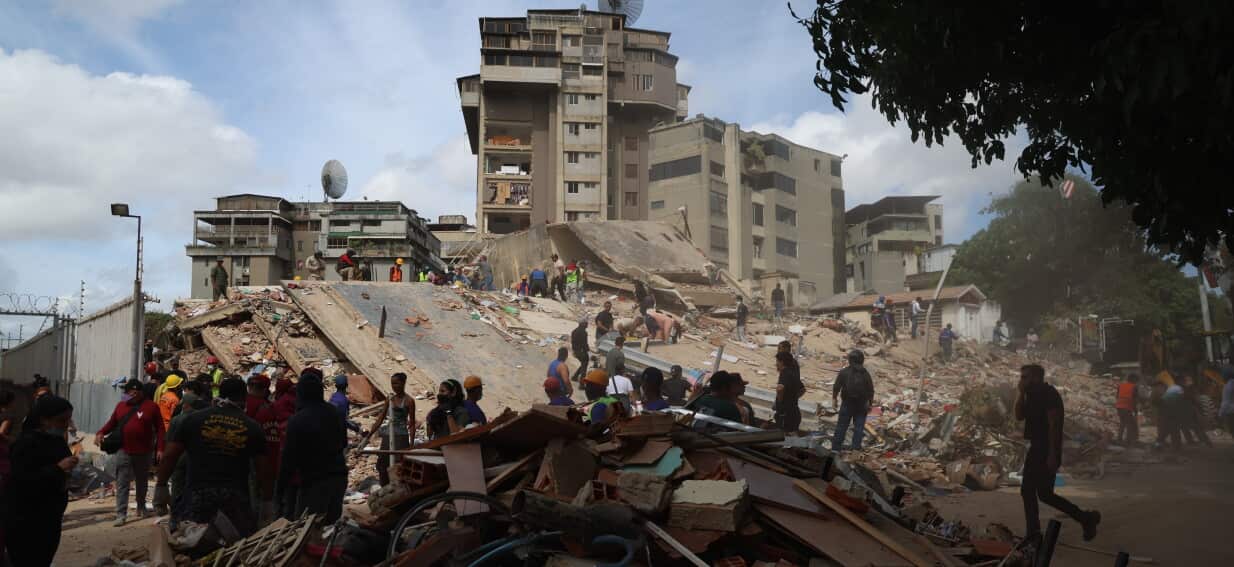
The northern coastal state of La Guaira has essentially been declared a total disaster zone. Acting President Delcy Rodriguez confirmed that this region took the heaviest hit. Entire blocks of high-rise apartment towers have been flattened into grey mounds of twisted steel and broken concrete.
The cities of Catia La Mar, Caraballeda, and the capital city of La Guaira are currently buried under thick blankets of dust and debris. If you walk down the streets, you can smell leaking natural gas and scorched electrical wires everywhere. Local residents aren't waiting around for heavy machinery that might never arrive. They are digging through the rubble with their bare hands, desperately listening for any signs of life.
The human cost here is gut-wrenching. In one neighborhood, an entire 14-story apartment complex collapsed into its own footprint. Survivors describe the building swaying violently from side to side before the stairwells completely disintegrated. Those who made it out had to slide down mountains of broken concrete to reach safety. Others weren't so lucky.
Why the Missing Person Lists Are Exploding
While Health Minister Carlos Alvarado confirmed that 235 people have passed away and at least 4,300 are treated for severe injuries, the most alarming statistic lies elsewhere. Grassroots tracking websites and community networks are reporting staggering figures for those unaccounted for. One unofficial registry managed by local groups lists more than 40,000 individuals as missing.
Why is there such a massive gap between the official death toll and the missing lists?
First, communications are completely dead across the worst-hit zones. Mobile phone towers are down, electricity is cut, and natural gas lines have been shut off to prevent secondary fires. Families simply can't check in on each other. Second, many communities are completely isolated. The main transportation hub, Simon Bolivar International Airport in Maiquetia, sustained severe structural damage and remains closed indefinitely. Metro services in Caracas are halted. Roads are blocked by fallen boulders and buckled asphalt, meaning rescue teams can't even reach certain towns to count the casualties.
The U.S. Geological Survey used predictive modeling to analyze the impact. Their historical data suggests a very high probability that the final death toll could climb into the thousands.
Hospitals on the Brink
The medical system is facing a secondary crisis. Eight regional hospitals in the disaster zone suffered severe structural damage during the twin quakes. Doctors and nurses had to rapidly evacuate patients out onto the streets while the earth was still shaking from over 138 recorded aftershocks.
At places like the Domingo Luciani Hospital, ambulances are arriving constantly. Medical staff are working under brutal conditions, using flashlights and backup generators to perform emergency surgeries. Children are showing up completely alone, pulled from the debris by neighbors, some wearing nothing but identification tape on their arms.
To deal with the massive overflow of trauma patients, emergency workers are setting up makeshift field hospitals in parking lots and open plazas. Public schools have been shut down and converted into temporary shelters and supply donation centers.
A Massive International Rescue Push
Local authorities understand they can't handle this nightmare alone. A massive international rescue operation is scrambling to get boots on the ground before time runs out for those trapped beneath the slabs.
The United States authorized $150 million in immediate humanitarian assistance and temporarily eased economic sanctions to ensure aid flows without bureaucratic delays. The U.S. military is deploying transport planes, helicopters, and two warships to provide logistical support off the coast. Nearby neighbors are moving fast too. Brazil is sending military cargo planes packed with specialized search-and-rescue firefighters. Colombia, Mexico, Chile, and Ecuador are sending highly trained canine units and seismic disaster response experts who know how to navigate unstable ruins.
Even humanitarian groups like World Central Kitchen are on the ground in Caracas, churning out thousands of hot meals for displaced families who lost absolutely everything in a matter of seconds.
Critical Priorities for the Next 48 Hours
The window for saving lives is shrinking rapidly. If you want to help or need to know what must happen next, the immediate focus centers on three specific actions.
First, heavy earth-moving equipment must be cleared to enter the coastal corridors. Private construction companies need to hand over their excavators and cranes to emergency teams immediately. Manual digging isn't enough when dealing with multi-story concrete slabs.
Second, clean drinking water and satellite communication terminals must be distributed to the isolated pockets of La Guaira and Carabobo. Starlink has stepped in to offer a month of free satellite internet service in the affected regions, which will help reconnect families and streamline rescue logistics.
Finally, if you are outside the affected areas, focus your efforts on donating blood, medical supplies, and non-perishable food to certified regional collection centers. Avoid trying to travel to the coastal zones yourself, as clear roads must be kept open exclusively for emergency vehicles and international rescue teams.