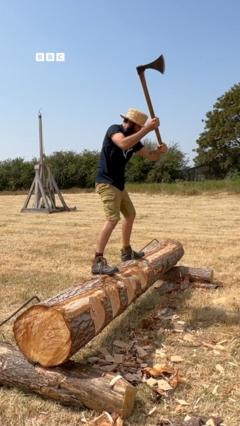
Watch a traditional timber hewing competition and the narrative is always the same. Nostalgic commentators fawn over the "lost art" of shaping logs with broadaxes. Spectators cheer as massive beams emerge from raw trunks. The underlying message is clear: this is pure, honest craftsmanship, a sacred heritage we must preserve at all costs to save the soul of woodcraft.
It is a beautiful lie.
The obsession with competitive British hewing championships does not preserve timber heritage. It traps it in a glass case, safe from real-world utility. While purists argue that these events honor historic techniques, they actually turn a once-vital industrial skill into an over-regulated, performative sport. Having spent two decades consulting for timber framing companies and evaluating supply chains, I can tell you that the romanticizing of the broadaxe has done more to alienate young craftspeople than to inspire them.
We are celebrating the museumification of labor. It is time to dismantle the myth of the noble hewer and look at what it actually takes to build a sustainable, modern timber culture.
The Efficiency Myth of the Broadaxe
The central premise of any hewing championship is that manual squaring represents the pinnacle of timber processing. Competitors spend hours sweating over a single oak log, scoring, juggling, and hewing until it is perfectly square. The crowd applauds the precision.
But let us be brutally honest about the physics and economics of this process.
Historically, hewing was never an art form. It was a brutal, exhausting economic necessity. Before portable sawmills and mechanized transport, you hewed a log because it was too heavy to haul out of the woods whole. You chopped off the sapwood and the bark to shed weight so a team of horses could actually drag the timber to the worksite.
Historical Hewing Goal: Raw weight reduction + basic structural utility
Modern Competition Goal: Aesthetic perfection + arbitrary rule adherence
When modern competitions judge a beam based on a perfectly flat, ripple-free surface, they invert history. True historic hewing left plenty of wane, erratic tool marks, and variations. By demanding cabinet-maker precision from a heavy framing tool, championships create an artificial standard that never existed in the real world.
Imagine a scenario where a modern construction site relied on this level of manual throughput. A single three-bedroom timber frame home requires roughly 150 to 200 individual structural components. If you hand-hew every piece to championship standards, your labor costs multiply by a factor of twenty. You have not preserved a craft; you have turned a structural building method into an elite luxury item accessible only to billionaires.
Why "Heritage Preservation" is Killing the Craft
Ask any championship organizer why these events matter, and they will give you a standard response: We are keeping the skills alive for the next generation.
They are achieving the exact opposite.
By framing hewing as a specialized competitive sport, they isolate it from the broader construction and forestry sectors. Young people entering the trades do not see a viable career path; they see a historical reenactment. They see an insular community that values arcane, localized rules over adaptable skill sets.
Consider how these competitions handle tool geometry. Many events mandate specific patterns of British or European broadaxes, punishing anyone who innovates with modern handle ergonomics or alternative bevel profiles. This rigid traditionalism ignores the fundamental nature of historic woodworkers: they were ruthless innovators. If an 18th-century shipwright had access to a high-tensile steel band saw or an electric chain mortiser, they would have abandoned their hand tools in a heartbeat.
True mastery is not about worshiping the tools of the dead. It is about understanding the material properties of the wood. When you focus entirely on the tool, you lose the plot. A master timber framer understands grain direction, moisture content, and structural load distribution. Those principles apply whether you are using a 10-pound side axe or a five-axis CNC machine.
The False Environmental Narrative
There is a growing, uncritical sentiment that manual hewing is the ultimate "green" forestry practice. The logic seems simple: no fuel consumption, no heavy machinery compacting the soil, and zero carbon footprint during processing.
This is a shallow, localized view of environmental impact.
Manual hewing is incredibly wasteful compared to modern thin-kerf milling. When a competitor hews a round log into a square beam, the exterior portions of the log—the chips and slabs—are hacked away into a pile of waste. In a competition setting, this material is typically bagged up for firewood or mulch.
Material Yield Comparison:
- Hand Hewing: ~55-60% usable structural timber (remainder converted to chips/waste)
- Modern Band Sawing: ~75-80% usable structural timber + precise side-boards for flooring/cladding
Modern sawmills do not just cut faster; they optimize the yield of the log. A thin-kerf band saw leaves a minuscule sawdust trail, allowing the operator to recover secondary boards from the outer dimensions of the log. What would be hacked into kindling by a competitive hewer becomes high-value cladding, lath, or flooring.
When we incentivize hand-hewing as the environmental gold standard, we ignore the macro-scale reality. To meet even a fraction of timber housing demand through manual processing, we would need to harvest significantly more trees just to make up for the volumetric waste generated by the axe.
Dismantling the Defective Logic of the Purist
Let us look at the questions that dominate the forums and community boards surrounding these championships. The premises are almost always flawed from the start.
"How can we make hand-hewn timbers competitive with modern milled lumber?"
You cannot, and trying to do so is a fool's errand. The question assumes that hand-hewing should compete on price or volume. It never will. The only way hand-hewing survives in the modern economy is when it is applied to specific, high-value historic restoration projects where matching the exact tool marks of a specific era is structurally or legally required.
If you are hand-hewing timber for a standard backyard pergola or a modern home, you are not being a purist; you are practicing inefficient hobbyism disguised as trade work.
"Won't the loss of manual hewing skills mean we lose our connection to historic architecture?"
No. Understanding how a building was made does not require you to replicate the physical suffering of the original builder. We can analyze tool marks, document joint configurations, and preserve historic structures using advanced scanning and conservation science.
The connection to historic architecture is maintained through rigorous scholarship and structural maintenance, not by turning the trade into a weekend race against a stopwatch.
The Real Future of Timber Mechanics
If we want to honor the spirit of traditional woodcraft, we need to stop looking backward and start looking at the frontier of wood technology. The real revolution in forestry and timber construction is happening where engineering meets raw material, not where steel hits bark.
Engineered Wood and Carbon Sequestration
Mass timber, cross-laminated timber (CLT), and glue-laminated beams are the true successors to the historic heavy timber frame. These technologies allow us to take fast-growing, sustainably managed softwoods and turn them into structural elements that can replace steel and concrete in skyscrapers. That is how you solve real-world housing and climate issues. A broadaxe cannot do that.
Hybrid Craftsmanship
The most successful modern timber framing firms do not ban power tools; they integrate them. They use industrial band saws to square the timbers efficiently, then use hand chisels, slick tools, and drawknives to execute the complex joinery where human touch actually matters. This hybrid approach keeps the craft economically viable, ensures high production standards, and provides sustainable, well-paying jobs for the next generation of builders.
Stop Looking Back
The British Hewing Championships and their global counterparts are entertaining spectacles. They are historical festivals, nothing more.
The moment we mistake them for the cutting edge of sustainable forestry or the savior of timber framing is the moment we surrender the future of the industry. Stop romanticizing the blisters, the sweat, and the inefficient tool paths of the past. If you want to save the craft of woodworking, put down the broadaxe, step away from the competition arena, and learn how to design structural timber systems that can actually compete in the 21st century.