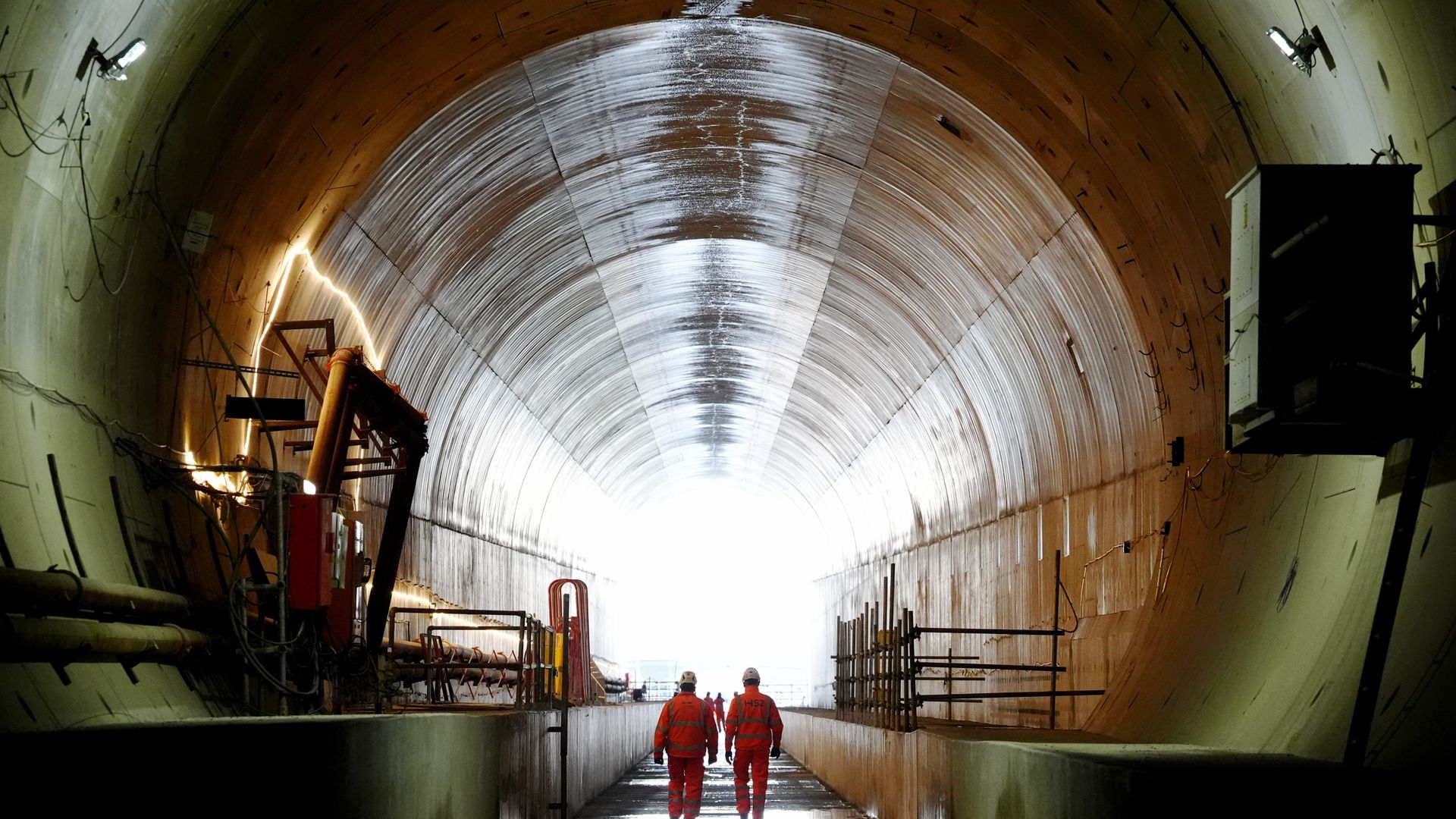
The Trillion-Dollar Speed Trap
Every mainstream media post-mortem on mega-infrastructure follows the exact same script.
The headline screams about a budget blowout. The subhead complains that the train will run 20 miles per hour slower than originally promised. The comments section fills with predictable outrage about government incompetence, bureaucratic bloat, and the absolute failure of modern engineering.
It is a comfortable, lazy consensus. It is also completely wrong.
The hand-wringing over the world’s "most expensive" high-speed rail lines—whether we are talking about the scaled-back iterations of HS2 in the UK, California’s central valley spine, or Europe’s latest cross-border tunneling projects—rests on a fundamentally flawed premise. We evaluate 21st-century civilization-building assets using the accounting logic of a local grocery store.
We are told that a project is a failure if the initial spreadsheet from a decade ago does not match the bank ledger today. We are told that speed is the only metric that matters, as if the primary goal of spending $100 billion is simply to help a corporate consultant get from an office in city A to a meeting in city B thirty minutes faster.
This is bean-counter myopia.
The astronomical price tag of modern high-speed rail is not a bug; it is a feature. The sheer, terrifying scale of the investment is precisely what forces an economy to upgrade its industrial capacity, realign its economic geography, and build internal supply chains that cannot be outsourced. If you are judging a rail network solely by its top speed and ticket price, you are missing the entire point of the asset.
The Speed Myth: Why Faster is the Wrong Metric
Let's dismantle the first lazy assumption: the obsession with top operational velocity.
When a project drops its planned top speed from 250 mph to 220 mph to save billions in aerodynamic wear, tunnel design, and power consumption, the critics treat it as a capitulation. They call it a downgrade.
In the real world of transport economics, chasing the absolute ragged edge of speed is a game of diminishing returns. The relationship between speed and energy consumption is not linear; it is exponential. Drag increases with the square of velocity. Power requirements increase with the cube of velocity.
[Speed: 200 mph] --> Base Energy Required
[Speed: 250 mph] --> ~95% More Energy Required (Almost Double)
Running a train at 250 mph instead of 200 mph requires nearly double the energy, exponentially increases the wear and tear on the catenary wires, and demands vastly wider curves that tear through prime real estate and protected ecosystems.
I have watched public agencies burn hundreds of millions of dollars trying to maintain a politically motivated speed target, only to realize that the time saved over a 200-mile journey is less than fifteen minutes. Fifteen minutes is not a transportation revolution; it is a rounding error.
The true value of high-speed rail is not speed. It is capacity and reliability.
When you build a dedicated high-speed line, you are not just building a track for a fast train. You are building a bypass. You are removing express passenger services from the existing legacy rail network. This frees up massive, invaluable slots on the old lines for freight trains and regional commuter services.
Every high-speed train running on its own grade-separated track means dozens of freight cars shifted off clogged interstate highways and ancient commuter tracks. The economic dividend is found in the unglamorous world of freight logistics and reliable suburban scheduling, not the flashy top-speed dashboard on the pilot's console.
The Luxury of the Fixed-Price Lie
"But the budget doubled!" cries the taxpayer alliance.
Yes. It did. And it will probably increase another 20% before the ribbon is cut. Welcome to major civil engineering.
The myth of the static infrastructure budget is a collective fiction we all agree to believe so projects can get approved in the first place. If governments presented the true, inflation-adjusted, worst-case-scenario cost of an unprecedented engineering project upfront, nothing would ever get built. The interstate highway system would be a series of dirt roads. The Hoover Dam would be a sandbag wall.
Consider the mechanics of a multi-decade mega-project. You are procuring specialized steel, heavy machinery, and rare engineering talent across a twenty-year window. During that time, global supply chains will collapse, inflation will spike, regulatory environments will shift, and interest rates will fluctuate.
Furthermore, mega-projects are inherently unique. You are not buying a fleet of standardized airplanes from a factory; you are boring a 20-mile hole through a mountain range with highly variable geology that no geological survey can map with 100% accuracy.
To demand that a project of this scale stick to a baseline estimate drawn up by an optimization consultant in an air-conditioned room a decade ago is a form of economic delusion.
The cost overruns are painful because they represent the true, unvarnished price of maintaining an industrial workforce in a modern economy with strict labor laws, environmental protections, and property rights. You can build high-speed rail cheaply and quickly if you have an authoritarian government that ignores eminent domain, disregards worker safety, and bypasses environmental reviews. If you live in a democracy that values those things, the cost of concrete is the least of your expenses. You are paying for the societal infrastructure required to build anything at all.
Megaproject Realism: The Price of Inaction
What is the alternative? The critics never seem to have an answer for this, because the alternative is far more expensive, completely invisible, and toxic to the environment.
Let's run a simple thought experiment. Imagine a scenario where a country decides to cancel its massive, over-budget rail project halfway through construction. The politicians congratulate themselves on fiscal responsibility. The cash stays in the treasury.
What happens to the growing demand for transit between those major economic hubs over the next thirty years? It does not vanish. It gets absorbed by the existing systems.
To match the passenger capacity of a single dual-track high-speed rail line operating at peak frequency, you would need to build:
- Up to six new lanes on the parallel interstate highways.
- At least two new runways and an entirely new terminal at the destination airports.
- Thousands of additional short-haul flights clogging up the airspace.
Now look at the ledger. The cost of acquiring land to widen an interstate through an urban core is astronomical. The environmental remediation required to build a new airport runway can tie up funds for decades. The compounding carbon penalty of millions of additional car trips and short-haul flights is a massive, unpriced liability.
But because highway maintenance and airport expansions are funded through fractured, opaque budgets—local taxes, federal grants, passenger facility charges—the true cost is hidden from the public view. High-speed rail puts its entire cost on one giant, terrifying bill. It invites the criticism that hidden, death-by-a-thousand-cuts highway spending completely avoids.
Dismantling the "People Also Ask" Common Logic
When you look at the public discourse surrounding massive rail budgets, the same flawed questions appear repeatedly. Let's address them with zero corporate spin.
Why can't we just upgrade the existing tracks instead of building new ones?
This is the most common trap. It sounds sensible, cheap, and pragmatic. It is actually an operational nightmare. Upgrading an active rail corridor while maintaining regular service is like trying to perform open-heart surgery on a patient while they are running a marathon.
You can only work in tiny, three-hour windows middle-of-the-night. Every tool must be cleared before the morning commuter rush. The labor costs skyrocket because of the inefficiencies of night shifts and safety protocols.
More importantly, legacy lines were built in the 19th century. They follow rivers and topography, meaning they are full of tight curves. No amount of signaling upgrades or new ballast can change the laws of physics: a train cannot take a sharp curve at 200 mph without derailing. You need a straight, flat, entirely new alignment. Anything less is burning money on a temporary band-aid.
Shouldn't autonomous vehicles and electric planes make rail obsolete?
This is technocratic fantasy billing itself as forward-thinking. An electric plane still faces the brutal physics of atmospheric lift, meaning it requires massive batteries that limit its capacity to a handful of passengers over short distances.
Autonomous vehicle caravans on highways do not solve the geometry problem. A highway lane can move roughly 2,000 cars per hour. Even automated, that capacity might double.
A single high-speed rail line can move 20,000 passengers per hour, per direction, using a fraction of the land footprint. You cannot code your way out of a spatial capacity constraint. Pixels do not replace concrete.
The Industrial Muscle Memory Dividend
Here is the truth that the treasury departments and financial journalists refuse to acknowledge: the primary value of a $100 billion infrastructure project is the creation of the capability to build the next one.
When a country has not built a major rail network in half a century, it loses its institutional knowledge. It lacks the engineers who know how to manage a tunnel boring machine through complex strata. It lacks the manufacturers who can fabricate high-spec track components. It lacks the project managers who understand how to sequence a multi-billion-dollar logistics chain.
The first project is always a financial bloodbath because you are paying to rebuild that entire ecosystem from scratch. You are paying for the mistakes, the learning curves, and the training of a new generation of civil engineers.
[Project 1: Rebuilding Ecosystem] ----> Massive Premium / High Overruns
[Project 2: Leveraging Muscle Memory] -> Standardized Costs / Controlled Timelines
If you cancel the project, or truncate it so that it runs from nowhere to nowhere, you ensure that every dollar spent up to that point is truly wasted. You freeze your industrial capability at zero. The next time you need to build something massive, you will have to pay the entry fee all over again.
The cost overruns are the tuition fees we pay for decades of underinvestment.
Stop Apologizing for the Cost
We need to discard the defensive, apologetic rhetoric that dominates infrastructure PR. Stop trying to convince the public that the project will pay for itself via ticket sales in twenty years. It won't. It shouldn't.
High-speed rail is a foundational public utility, not a corporate entity that needs to show a quarterly profit. We do not ask the military to turn a profit. We do not demand a return on investment from public parks or fire departments. We recognize that their value lies in the broader economic stability, security, and capability they provide to the entire system.
The nations that dominate the global economy understand this implicitly. They do not pause projects because a spreadsheet got messy or a tunnel hit a pocket of unexpected clay. They build because the alternative is stagnation. They build because a nation that loses the ability to execute mega-projects is a nation in decline.
The next time you see a headline mocking a delayed, over-budget rail line, ignore the hysteria. The price is high because the stakes are high. The budget blowout is temporary; the infrastructure is permanent. Stop counting pennies while the rest of the world builds the future.