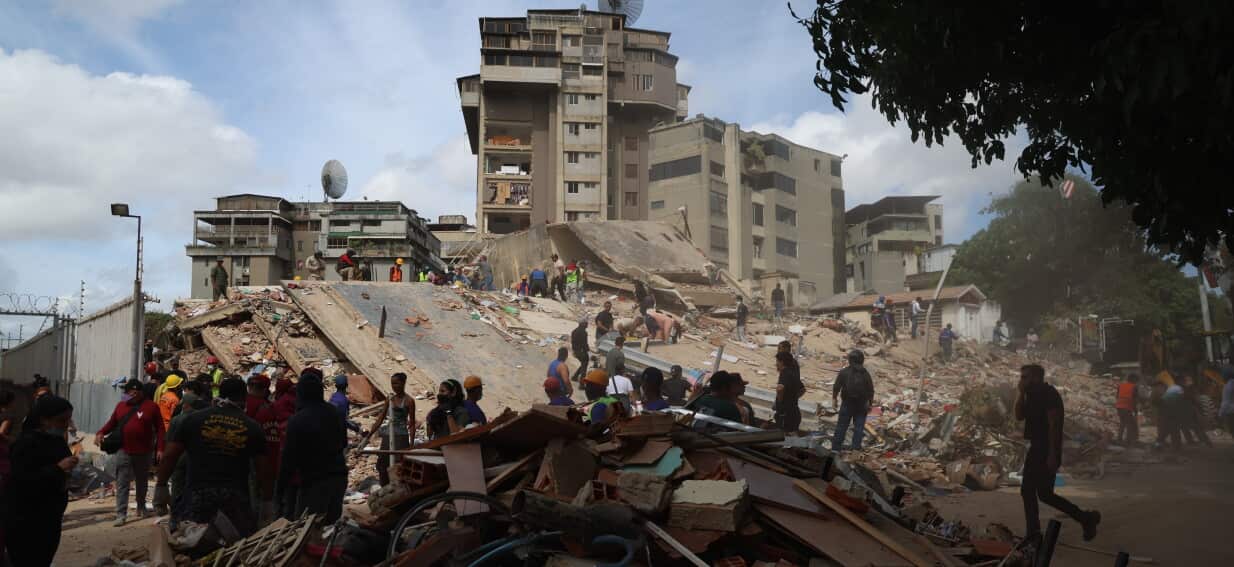
The official tally stands at 235 dead and over 4,300 injured following the catastrophic earthquakes that recently ripped through Venezuela. Health Minister Magaly Gutiérrez released these figures during a late-night broadcast, framing the government response as a swift, coordinated triumph of state infrastructure. But numbers issued from Miraflores Palace rarely tell the whole story. In a country where the medical system was already in a state of chronic collapse, a disaster of this magnitude does not just cause immediate casualties. It exposes the deep, systemic rot of an infrastructure entirely unprepared for reality.
Independent medical unions and disaster response experts on the ground paint a far more chaotic picture than the state-sanctioned narrative suggests. While the ministry counts the immediate victims pulled from the rubble, the true crisis is unfolding in the hallways of hospitals that lack basic running water, reliable electricity, and essential surgical supplies.
The Infrastructure Myth Meet the Richter Scale
Earthquakes do not kill people; collapsing buildings do. When the tremors struck Venezuela's northern coast, they hit an urban landscape shaped by decades of unregulated construction and deferred maintenance. The Health Ministry's report focused heavily on the natural unpredictability of the event, yet engineers have warned for years that the country's building codes exist only on paper.
Public housing projects built under various state initiatives over the last twenty years were supposed to be modern marvels. Instead, many suffered catastrophic structural failures. Cheap materials, a lack of oversight, and rushed timelines created a recipe for disaster. When the ground shook, these structures pancaked, trapping thousands.
The state’s emergency response apparatus, known as Civil Protection, found itself severely hindered from the first hour. Heavy machinery required to lift concrete slabs was either non-functional due to a lack of spare parts or grounded by localized fuel shortages. In many hard-hit neighborhoods, citizens used their bare hands and car jacks to dig out neighbors while official rescue teams waited for gasoline.
The Mirage of Emergency Medical Care
To understand why the injury count of 4,300 is a ticking time bomb, one must look inside the emergency rooms of Caracas, Valencia, and Maracay. The Health Minister assured the public that triages were fully operational. The reality on the ward floor is starkly different.
"We are operating by flashlight," says an orthopedic surgeon at a major public hospital in Caracas, speaking on the condition of anonymity for fear of state reprisal. "We have the patients, we have the doctors, but we do not have scalpel blades, sterile gauze, or antibiotics. Saying we are treating 4,300 people is a fantasy. We are warehousing them."
For years, Venezuelan hospitals have operated under a severe deficit of basic supplies. Patients routinely have to bring their own syringes, bandages, and even water to hospitals for scheduled surgeries. When thousands of trauma patients arrived simultaneously, the system did not just strain; it shattered.
- Power Grid Failures: The national grid, notoriously unstable, failed in multiple sectors immediately after the quakes. Backup generators in at least three major regional hospitals failed to kick in due to poor maintenance, leaving intensive care units in darkness.
- The Blood Bank Crisis: Blood banks across the country were already depleted before the disaster. Without blood bags, reagents for screening, or functioning refrigeration, treating massive internal bleeding became an impossibility for triage teams.
- Medical Brain Drain: Over the past decade, an estimated 30,000 medical professionals have left Venezuela. The remaining staff consists largely of overworked residents and a skeleton crew of specialists trying to manage a historic influx of complex trauma cases.
Contaminated Water and the Next Wave of Casualties
The immediate aftermath of a tectonic event is only the first phase of a public health emergency. The secondary crisis is often hydrological. The earthquakes ruptured major water mains across the northern region, mixing sewage lines with the municipal water supply.
Clean water is now the most critical currency in the disaster zones. Without it, field clinics cannot maintain sterility, and displaced populations crammed into temporary shelters face an immediate threat from waterborne pathogens. Outbreaks of acute diarrheal diseases and cholera are not just possibilities; they are statistical certainties under these conditions.
The government's response has been to deploy national guard trucks to distribute water, but distribution is uneven and heavily politicized. Communities known for opposition alignment report being bypassed by state aid caravans, forcing residents to rely on contaminated streams or expensive private cisterns.
Hospital Capacity vs. Actual Demand (Estimated Post-Earthquake)
--------------------------------------------------------------
Region          Official Injury Count    Functioning ICU Beds
Capital District        1,800                    140
Central Region          1,500                     85
Eastern Coast           1,000                     40
The data above highlights the severe mathematical disconnect between the volume of injured citizens and the physical capacity of the state to offer life-saving intervention. A patient with severe crush syndrome cannot wait three days for an open bed.
International Aid and the Sovereignty Barrier
Geopolitics complicates recovery efforts in Venezuela far more than in other disaster-struck nations. Offers of international assistance from neighboring countries and global NGOs have materialized quickly, yet the administration remains hesitant to grant open access.
Accepting large-scale foreign aid requires an admission of vulnerability that the current political apparatus loathes to make. Historically, the state has viewed international humanitarian workers with deep suspicion, often accusing them of espionage or political interference. While limited shipments from allied nations like Russia and China have arrived on the tarmac at Maiquetía airport, bureaucratic bottlenecks keep these supplies from reaching the actual frontlines of the crisis.
Customs clearance for medical equipment remains bogged down by paperwork. Shipments of specialized search-and-rescue gear from international groups sit in warehouses because operators cannot obtain the specific visas required to enter the disaster zones. Every hour a pallet of antibiotics sits on a runway is an hour where the mortality rate ticks upward.
The Accountability Gap
The Ministry of Health’s current strategy focuses entirely on narrative control. By keeping a tight lid on hospital mortality statistics and controlling all press releases regarding the casualty count, the government seeks to manage public anger. But grief is turning into fury in the barrios.
Families waiting outside hospital gates are tired of televised speeches promising aid that never arrives at the bedside. They see the reality every time they are handed a list of medicines they must purchase from private pharmacies just to keep their relatives alive. The 235 deaths reported by the minister represent only those who died before reaching a medical facility. The true toll will include those who die in the coming weeks from infections that should have been preventable, or surgeries that were delayed too long.
The ground has stopped shaking, but the structural failure of the state continues to claim victims. Venezuela’s catastrophe is not a temporary emergency that will end once the rubble is cleared; it is a permanent condition accelerated by a natural disaster.