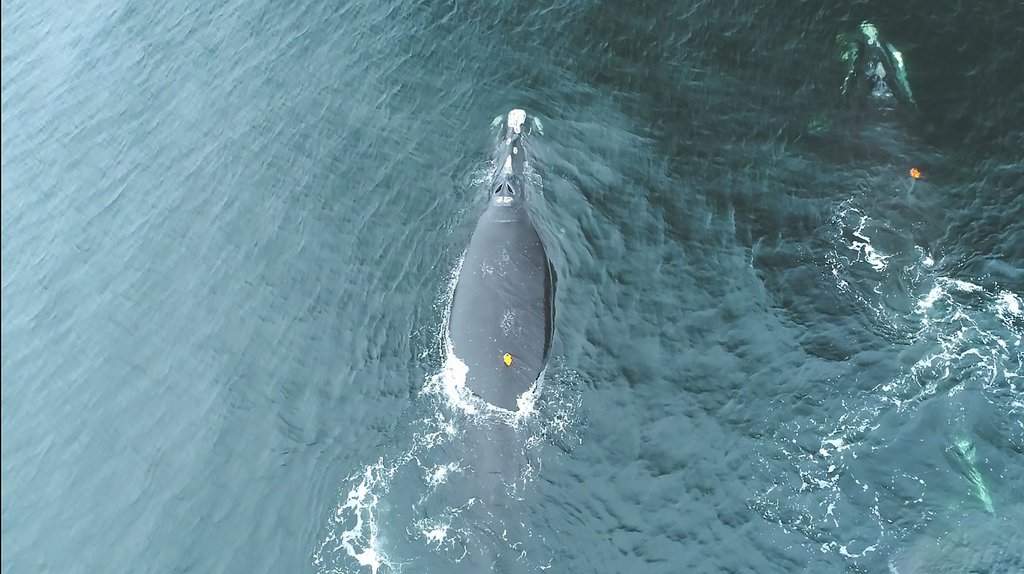
Marine conservation frameworks often treat whale-vessel collision risk as a simple spatial overlap problem. The dominant operational assumption dictates that if maritime traffic avoids designated seasonal management areas where Eubalaena glacialis aggregates, mortality rates should decrease proportionally. Empirical tracking data reveals a structural flaw in this paradigm. North Atlantic right whales are altering their subsurface vertical distribution, spending significantly more time foraging at or near the ocean surface where acoustic and visual detection by commercial vessels remains entirely inadequate. This behavioral shift creates a high-stakes velocity problem: as foraging shifts upward into the turbulent boundary layer, the response window for vessel operators collapses, rendering static mitigation zones obsolete.
The Kinematics of Surface Foraging
To understand why traditional mitigation measures fail, one must examine the hydrodynamic and energetic constraints governing right whale feeding. These mysticetes rely on continuous ram filtration, swimming forward with their mouths agape to harvest dense patches of copepods, specifically Calanus finmarchicus. Historically, this foraging behavior occurred throughout the water column, frequently at mid-depths or near the seafloor where copepod diapause stages aggregate.
Recent oceanographic shifts have concentrated copepod patches into shallower strata due to thermal stratification and altered circulation patterns in the Gulf of Maine and Canadian shelf waters. When prey density gradients invert toward the surface, the whales' cost-benefit optimization function changes. The energetic return of surface skimming outweighs the energetic cost of vertical ascent, even in high-traffic shipping lanes.
This surface concentration fundamentally alters collision kinematics. At depth, a whale's acoustic signature and bubble trails dissipate, and ambient noise masks propeller cavitation. At the surface, the animal operates within a turbulent zone of whitecaps, wave action, and high-frequency acoustic clutter.
- The acoustic shadow: Commercial vessel noise at the surface creates an interference pattern that masks the directional cues right whales need to localize approaching hulls.
- The visual blind spot: The bow wave of a displacement hull pushes water outward, masking a shallowly submerged or skimming whale until the vessel is within its stopping distance.
- The reaction latency: Unlike fast-swimming pelagic species, right whales exhibit sluggish vertical maneuverability when engaged in continuous-ram filtration, requiring precious seconds to break rhythm and dive or roll.
The Regulatory Disconnect and the Static Management Fallacy
Current regulatory regimes managed by agencies such as NOAA rely primarily on Static Management Areas and Dynamic Management Areas. These zones require vessels over a threshold length to restrict speeds to ten knots upon detection or during predictable seasonal windows.
The structural flaw in this policy lies in its temporal and spatial rigidity. Right whales do not observe municipal boundaries or static bathymetric boxes. As climate-driven ocean warming shifts prey fields northward into the Gulf of St. Lawrence and out of historical sanctuaries, the whales track the copepod biomass rather than the regulatory zones.
Furthermore, a ten-knot speed restriction, while mathematically proven to reduce the lethality of a strike, assumes operators have adequate notice of whale presence. When whales transition from deep water column transits to continuous surface skimming, their surfacing intervals become erratic. They no longer emit regular blows that spotters can log; instead, they skim just inches below the meniscus, invisible to radar and thermal imaging systems alike.
The Micro-Habitat Cost Function
Evaluating the survival mechanics requires examining the individual energy budget of a mother-calf pair or a lactating female. Right whales operate on razor-thin energy margins. The energetic expenditure of interrupted foraging—diving deep to avoid surface traffic—creates a metabolic deficit that directly impacts reproductive success.
Female right whales require immense caloric intake to gestate and nurse calves through their first year. When shipping lanes intersect optimal surface-foraging patches, animals face a binary choice: abandon high-density food sources and face reproductive failure, or remain in the traffic zone and accept an elevated hazard probability.
The systemic risk is thus compounded by the physiological imperative to feed. Mitigation strategies that rely solely on voluntary slowdowns or static speed boundaries ignore this economic pressure. If the food is at the surface in a shipping lane, the whale will be at the surface in a shipping lane.
Operational Interventions for Maritime Logistics
Addressing this operational hazard requires moving away from static spatial boundaries toward real-time telemetry and hydrodynamic vessel modifications. The following operational adjustments represent the minimum technical requirements for reducing strike probability under current behavioral realities.
- Implement real-time passive acoustic monitoring arrays integrated with automated vessel identification systems to ping commercial ships when vocalizing whales are within a five-mile radius.
- Redesign commercial vessel bow profiles to incorporate bulbous bows that actively deflect marine mammals downward rather than scooping them into the propeller wash.
- Mandate infrared thermal detection equipment on commercial vessels operating within known migration corridors to pierce surface glare and identify thermal signatures of breaching or skimming whales.
- Transition from seasonal speed restrictions to dynamic, speed-on-demand corridors that shift weekly based on oceanographic drifter data tracking Calanus finmarchicus density peaks.
The survival of the North Atlantic right whale population depends entirely on acknowledging that their behavior has adapted to changing oceans. Policies designed for historical migration routes cannot protect a species whose foraging geometry has shifted directly into the paths of global commerce.