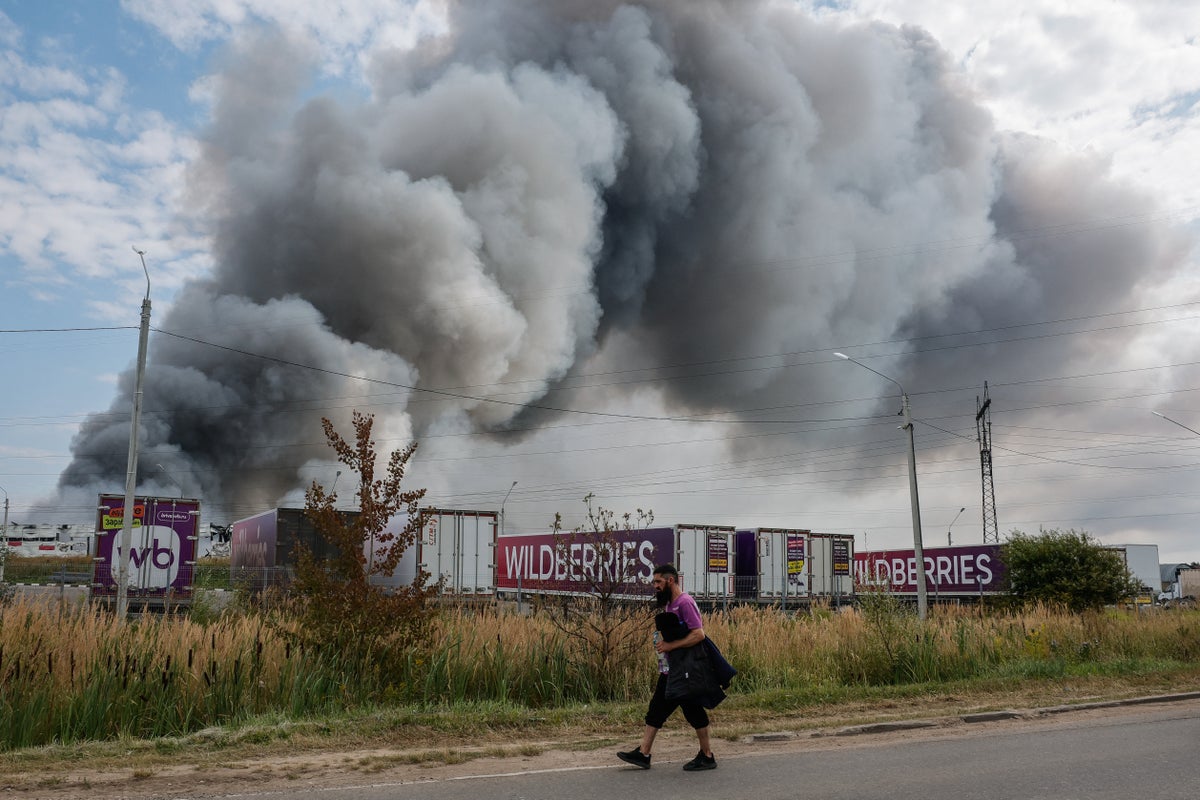
The air over Alexin smells like scorched plastic and burnt rubber long after the sirens fade. You can taste the metallic bite of the smoke miles away, a harsh reminder that logistics are never just lines on a spreadsheet. They are flesh. They are blood. They are concrete and steel collapsing into ash.
We forget this from a distance. We look at maps with arrows, numbers with plus signs, and casualties reduced to daily tallies. But logistics dictate the pulse of modern conflict. When you strike a massive distribution facility—the kind often dubbed a nation's answer to online retail giants—you aren't just breaking a supply chain. You are striking the beating heart of an economy at war, a sprawling nexus where everyday consumer goods share space with the quiet, urgent machinery of national mobilization.
Seven people died in the fire.
Seven human beings whose alarms went off that morning, who tied their boots, who walked into a towering cavern of steel shelving and automated belts, trusting that the roof over their heads would hold. It didn't.
The Scale of the Strike
The night sky tore open in ways the residents of the Tula region had not experienced before. It was the largest drone assault of 2026. Not a single localized strike, but a coordinated swarm, a humming armada of carbon-fiber wings cutting through the dark toward a target that locals euphemistically called the Russian Amazon.
Silence. Then the whistle. Then the flash.
To understand the magnitude, look at the geography. Alexin sits roughly two hundred kilometers from Moscow. It is a secondary artery, a place where vast warehouses act as the digestive tract for an industrial giant trying to feed a protracted front line. When Kyiv launched this wave of unmanned aerial vehicles, the objective was precise, cold, and calculated. Strip away the convenience. Burn the distribution nodes. Make the rear echelon feel the friction of the war they are supplying.
Smoke billowed for hours, turning the daytime sun into a bruised, orange smear. Firefighters fought a losing battle against a wall of flame fueled by thousands of square meters of consumer electronics, textiles, and hidden stockpiles. The roof caved in with a sound like thunder, burying the loading bays under tons of twisted girders.
The Human Cost Behind the Logistics
Let us step away from the satellite view for a moment. Imagine a hypothetical warehouse worker named Mikhail. (I use a hypothetical scenario here to ground the statistics, though the grief is entirely real for dozens of families across the region). Mikhail is thirty-two. He doesn't care about geopolitical chess or retaliatory doctrines. He cares about his shift ending at midnight, his mortgage, and the small sports car he is saving up to buy.
Mikhail wears a high-visibility vest that smells faintly of warehouse dust and cheap coffee. He spends his twelve-hour shifts walking ten miles across polished concrete floors, scanning barcodes, lifting boxes, and joking with coworkers during smoke breaks outside the loading docks.
On that night, Mikhail was near Sector Four, close to the automated sorting lines.
When the first drone hit the western perimeter wall, the concussion blew out the industrial skylights. Shards of safety glass rained down like coarse salt. The lights flickered, died, and emergency red LEDs kicked on, casting long, frantic shadows across mountains of cardboard.
Panic has a specific sound. It isn't screaming, not at first. It is the sound of heavy boots scrambling, of metal pallets tipping over, of collective breath catching in throats.
Mikhail didn't think about military strategy. He ran toward the fire exit, but the concussive blast had warped the heavy steel frame. Jammed. He threw his shoulder against it once. Twice.
That is the reality of war brought home. It is not an abstract policy failure. It is a jammed door in a burning building.
Why This Target Matters
Military analysts will parse the tactical brilliance or recklessness of this raid for months. Why target a civilian fulfillment hub? The answer lies in the gray zone of modern total war.
In the twenty-first century, the line separating a civilian distribution center from a military supply depot has dissolved completely. Modern armies do not run entirely on government-issued rations and state-controlled arsenals. They rely on commercial infrastructure, private logistics networks, algorithms, and civilian transport fleets to move everything from heavy-duty winter gear and optics to dual-use electronics that end up wired into guidance systems.
When a nation mobilizes for a prolonged conflict, its commercial giants become de facto logistics arms of the state. Striking them is an attempt to choke the supply lines at the source, forcing the enemy to choose between feeding civilian demand and equipping soldiers on the front.
Yet, the price of this realization is paid in blood on the floor. Seven dead. Dozens injured. Families waking up to phone calls they spent years dreading.
The Aftermath in the Tula Region
Morning light over Alexin revealed a skeleton of charred steel. Emergency responders combed through the rubble, using thermal imaging and trained dogs to search for anyone trapped beneath the collapsed roof sections. The regional governor issued the standard statements of condemnation and promises of support for the victims' families, but words feel hollow when the air still tastes like ash.
The local economy, already strained by sanctions and labor shortages, now faces a gaping wound. Hundreds of jobs evaporated in a single flash of light. Small businesses that relied on the distribution hub for rapid regional shipping find themselves stranded.
And overhead, the invisible tension remains. Everyone knows that the skies are no longer a sanctuary. The war has crept inward, past the trenches, past the contested borders, straight into the quiet towns where people thought they were safe behind mountains of retail goods.
Consider what happens next. When the rear feels the fire, the psychological threshold shifts. The narrative that conflict is something that happens "over there" shatters alongside the glass of a suburban warehouse.
We are left with the quiet devastation of ordinary places turned into battlefields. The smoke clears, but the memory of the humming engines in the dark stays behind, etched into the nervous system of an entire region.