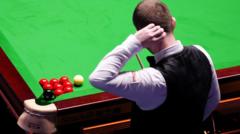
The Crucible Theatre is a claustrophobic pressure cooker. When you sit in those raked seats, you aren't just watching a game; you are breathing the same dry, recycled air as the two gladiators under the lights. You can hear the click of the balls, the rustle of a waistcoat, and, if it’s quiet enough, the frantic heartbeat of a man who is one mistake away from professional heartbreak. Usually, the drama is fast. It is a flurry of breaks, a masterclass of geometry, and the swift mercy of the pocket.
Then came the second session between Mark Allen and Wu Yize. For an alternative view, check out: this related article.
Most people think of professional sports as a display of peak physical or mental prowess. We want the 147 break. We want the effortless flow. But that night in Sheffield, the audience witnessed something far rarer and significantly more grueling. They witnessed a psychological collapse that manifested as a temporal rift. Time didn’t just slow down. It curdled.
The Anatomy of a Stalemate
To understand why a single frame of snooker lasting 80 minutes and 19 seconds is a form of exquisite torture, you have to understand the geometry of despair. Snooker is a game of angles and safety. When two players are "in the balls," it is ballet. When they are locked in a safety battle, it is chess. But when they are both terrified of losing, it becomes a staring contest where neither person is allowed to blink. Further analysis on this matter has been published by The Athletic.
Mark Allen is a titan of the game. He has the grit of a man who has climbed the mountain and knows the cost of the oxygen up there. Wu Yize is the young lion, full of the fearless talent that defines the new generation of Chinese players. On paper, this should have been a clash of styles. Instead, it became a shared hallucination.
The balls migrated toward the cushions like they were seeking shelter from the players. The reds clustered in awkward, unplayable knots. The pink and black—the high-value targets that usually dictate the rhythm of a frame—became trapped behind a fortress of baulk colors.
Consider the mental state of a man 40 minutes into a single game. In any other sport, the whistle would have blown. In snooker, you are trapped until the math says you can leave.
The referee, a figure of stoic patience, began to look like a man presiding over a slow-motion car crash. Every shot took longer. Every look at the table involved more agonizing over millimeters. The crowd, initially hushed in respect, began to shift. You could hear the coughs. The whispers. The slow realization that they weren't watching a tactical masterclass, but a mutual paralysis.
The Weight of the Table
Mark Allen later called it an "embarrassment." He wasn't talking about the score. He was talking about the loss of identity. When a professional athlete of his caliber cannot find a way to finish a frame, it feels like a betrayal of the craft.
The invisible stakes in the Crucible are higher than the prize money. It is about the "ghosts." Every great player who has ever picked up a cue has felt the weight of those who came before them. When you are stuck in a frame that refuses to end, you feel those ghosts judging you. You feel the television cameras—the millions of eyes watching from living rooms across the globe—as a physical weight on your shoulders.
Wu Yize, despite his youth, showed a different kind of toughness. It wasn't the toughness of making big pots; it was the toughness of not shattering under the boredom. Because that is the secret of the longest frame in Crucible history: it wasn't just hard. It was boring. It was a tedious, grueling, repetitive nightmare of nudging a ball three inches to the left, only for your opponent to nudge it three inches back to the right.
At the 60-minute mark, the air in the arena changed. The tension snapped and was replaced by a surreal kind of humor. When a player finally made a simple pot, the applause wasn't for the skill. It was a collective sigh of relief. We were all hostages to that green cloth.
The Breaking Point
In snooker, $Velocity = Distance / Time$ is a meaningless equation. The only math that matters is the remaining points on the table versus the lead. As the clock ticked past the previous record, the frame stopped being about sport and started being about endurance.
Imagine standing under television lights that generate a subtle, insistent heat. Your lower back begins to ache from the constant bending. Your eyes start to play tricks on you, making the distance between the cue ball and the object ball feel like a mile of treacherous terrain. You know that if you try a risky shot to end the misery and you miss, you hand the frame to your rival. So you play safe. Again. And again.
But the real problem lies elsewhere. It’s in the "Internal Monologue."
Why am I doing this? Why won't he just miss? If I play the thin safety, will I leave the red on?
The longer it goes, the more those thoughts turn into a cacophony. The quiet of the Crucible becomes deafening. You start to overthink the grip on your cue. You wonder if the chalk is clicking differently. You become a stranger to your own mechanics.
The Aftermath of the Longest Hour
When the frame finally ended—80 minutes and 19 seconds after the first break—there was no celebration. There was only a grim sort of acknowledgement. They had broken a record, but it was the kind of record nobody wants to hold. It was the marathon that nobody signed up for.
Allen eventually clawed his way through the match, but the scar of that frame remained. It served as a reminder that snooker is as much a psychological horror as it is a game of skill. It is a sport where your own mind can become your most formidable opponent, locking you in a room with no exits and forcing you to solve a puzzle that has no right answer.
Critics called it a slog. Pundits called it a disaster for the schedule. But for those who truly love the game, it was a fascinating study in the limits of human concentration. It showed what happens when two elite minds refuse to give an inch, even when the world is begging them to just move on.
We look for greatness in the flashy shots and the trophy lifts. We rarely look for it in the grit of a man who stays focused for eighty minutes on a single, stubborn task that seems designed to break his spirit.
As the players finally walked out of the arena into the cool Sheffield night, they left behind a table that had seen more drama in one frame than some tournaments see in a week. The record books will show the numbers. The fans will remember the wait. But only Allen and Wu truly know what it felt like to be the only two people awake in a world where time had simply given up.
The lights in the Crucible eventually go out, but the memory of that silence—that heavy, agonizing, eighty-minute silence—lingers long after the balls are tucked back into their boxes.