The winter air in St. Petersburg does not just bite; it bruises. In January, the Baltic wind sweeps across the Gulf of Finland, carrying a damp, heavy cold that settles deep into the stone architecture of Russia’s imperial capital. For the workers at the Petersburg Oil Terminal, the graveyard shift is a test of endurance. They move like ghosts through clouds of frozen breath, enveloped by the low, rhythmic thrum of heavy machinery and the pungent, chemical scent of crude oil. It is a predictable, numbing routine.
Until the sky shatters.
It started with a sound. Not the familiar roar of a jet engine or the sharp crack of a failing pipe, but a strange, lawnmower-like buzz cutting through the freezing dark. Men looked up, squinting into the blackness. Then came the flash. A brilliant, violent burst of orange tore through the night, instantly followed by a concussive boom that rattled the bulletproof glass of nearby high-rises. In seconds, a massive storage tank became a towering inferno, casting a surreal, midday glow over the snow-covered industrial landscape.
Ukraine had just brought the war to Vladimir Putin’s backyard.
For nearly two years, the standard narrative of the conflict was defined by muddy trenches in the Donbas, artillery duels in Kharkiv, and missile strikes rain down on Kyiv. To the average citizen in St. Petersburg or Moscow, the violence was something that happened "out there," a distant reality confined to television screens and heavily censored state media reports. This strike changed everything. By sending explosive-laden drones more than 1,250 kilometers across international borders to strike a critical energy hub, Kyiv did not just ignite a fuel tank. They scorched the illusion of safety that the Kremlin had meticulously cultivated for its domestic population.
Consider the geography of this strike. To reach the Petersburg Oil Terminal, the Ukrainian drones had to bypass some of the most sophisticated, multi-layered air defense networks on the planet. They flew over Belarus, crossed deep into Russian airspace, and evaded the S-400 missile batteries designed to protect the motherland. This was not a lucky shot. It was a calculated demonstration of technological asymmetry.
While Russia relies on massive, multimillion-dollar cruise missiles to strike Ukrainian infrastructure, Ukraine is fighting back with a decentralized army of cheap, long-range kamikaze drones. Many of these lethal craft are assembled in hidden workshops, utilizing off-the-shelf components, carbon-fiber frames, and advanced GPS guidance systems. They fly low, hugging the terrain to avoid radar detection, moving so slowly that traditional air defense systems often mistake them for large birds or civilian aircraft. It is David utilizing digital stones against a Goliath trapped in twentieth-century military doctrines.
The timing of the attack carries a psychological weight far heavier than the physical destruction of the oil terminal. The drones struck just hours before Vladimir Putin was scheduled to visit the region. The Russian president was preparing for a highly publicized trip to St. Petersburg to commemorate the 80th anniversary of the lifting of the Nazi siege of Leningrad—a sacred milestone in modern Russian state mythology.
Imagine the scene inside the Kremlin’s security apparatus in the wake of the explosion. The frantic phone calls. The furious demands for answers. The sudden, terrifying realization that the sky above the president's hometown was entirely compromised. The message from Kyiv was clear, unvarnished, and terrifyingly direct: We can touch you anywhere. No one is safe.
To understand why this specific target matters, one must look at the economic lifeblood of the Russian regime. The Petersburg Oil Terminal is not just a collection of rusty tanks; it is Russia’s largest Baltic transshipment hub for refined oil products. It is the gateway through which billions of petrodrawers flow into the Kremlin’s war chest. Every barrel of oil loaded onto a tanker here helps fund the artillery shells raining down on Ukrainian villages.
By striking this specific artery, Ukraine is executing a high-stakes economic strangulation strategy. They are proving that Russia’s sprawling energy infrastructure—thousands of miles of pipelines, vulnerable refineries, and massive port facilities—is simply too vast to protect. If a handful of cheap drones can shut down a major Baltic port, the financial foundation of the Russian war effort begins to look incredibly fragile.
But beyond the geopolitics, the economics, and the military strategy, there is a profound human shift occurring in the shadow of these burning fuel tanks.
For the civilian population of St. Petersburg, the war has ceased to be a distant headline. It has arrived at their doorsteps. The orange glow reflected in the windows of their apartments is a stark, undeniable reminder that actions have consequences. The psychological buffer zone has evaporated. People who once watched the conflict with detached indifference are now looking at the winter sky with a lingering sense of dread, wondering if the next low buzz they hear will be the sound of the front line arriving at their roof.
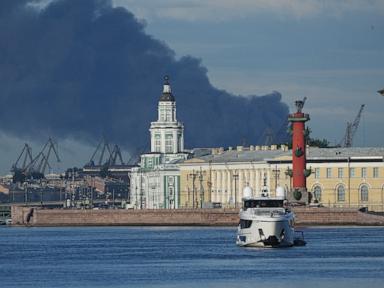
As the sun rose over St. Petersburg the morning after the strike, thick plumes of black smoke still choked the horizon, blotting out the pale winter light. Fire crews worked frantically to douse the remaining embers of the twisted, blackened steel tank. The city tried to return to its normal rhythm, but the air felt different. Heavy. Fractured.
A single, charred drone wing lay embedded in the frozen mud nearby, its small, commercial propeller silent, a stark monument to a new era of warfare that has brought the Kremlin's war home to roost.