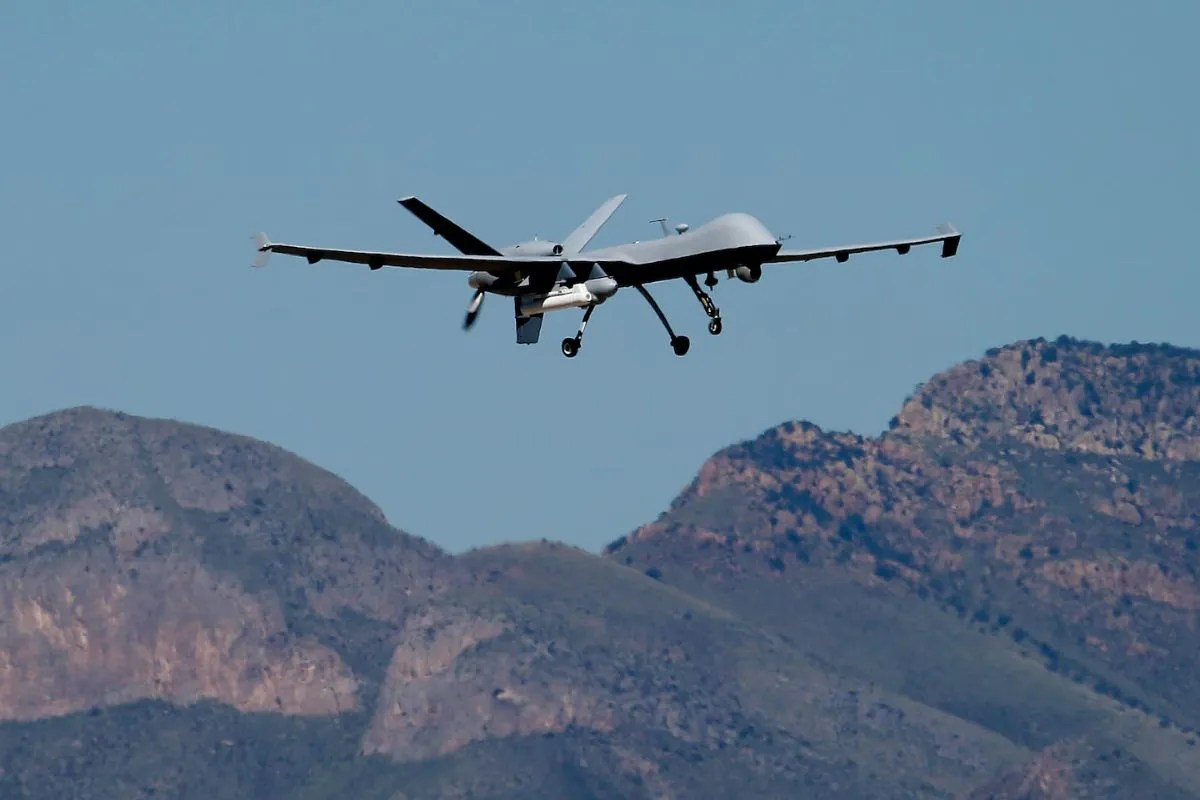
Somewhere in a darkened, temperature-controlled room in the United States, a pilot adjusted their headset. They weren’t sitting in a cockpit. There was no smell of jet fuel, no rattling of a fuselage, no physical sensation of breaking the sound barrier. There was only the hum of high-powered servers and the soft glow of multiple monitors. Thousands of miles away, over the shimmering, volatile waters of the Persian Gulf, a Northrop Grumman MQ-4C Triton—the crown jewel of American aerial surveillance—sliced through the humid night air.
Then, the screens went dark.
The loss of a single aircraft is usually a footnote in military history. But when that aircraft costs $240 million and carries the weight of a superpower's reputation, the ripples travel far beyond the splash zone. In less than a fortnight, the American military apparatus has watched nearly 9,000 crore rupees—a figure so vast it feels abstract—vanish into the depths of the ocean or the dust of the desert. This isn't just a budget line item. It is a tectonic shift in the way modern wars are fought, won, and lost.
Consider the Triton. It is not a mere drone; it is a flying intelligence agency. With a wingspan wider than a Boeing 737, it is designed to stay aloft for 24 hours, peering into the shadows of distant coastlines from 60,000 feet. It sees everything. And yet, for all its sophisticated sensors and its staggering price tag, it proved to be as fragile as a glass bird when caught in the crosshairs of geopolitical friction.
The Ghost in the Machine
We often talk about war in terms of maps and arrows, but the reality is measured in the sweat of the people who maintain these machines and the anxiety of the leaders who command them. When a Triton goes down, it isn't just metal hitting water. It is years of research and development, the labor of thousands of engineers, and a massive chunk of a nation’s strategic advantage sinking into the silt.
Imagine the silence in the Situation Room. The maps remain, but the "eye in the sky" is gone.
The Persian Gulf has always been a theater of nerves. It is a narrow, crowded corridor where a single mistake can trigger a global energy crisis. For the Trump administration, the stakes were personal and political. Each drone lost is a signal to the world that high-tech dominance is not synonymous with invincibility. It reveals a uncomfortable truth: a million-dollar missile can take down a quarter-billion-dollar asset. The math of modern warfare is becoming increasingly lopsided.
When we look at the numbers—8,900 crore rupees in 15 days—we are looking at the price of a small city’s infrastructure. We are looking at hospitals, schools, and roads. But in the cold logic of defense, that money is "operating costs." The real cost is the loss of the invisible net that these drones weave. Without them, the military is flying blind in one of the most dangerous neighborhoods on Earth.
The Hunter and the Prey
There is a specific kind of irony in the way these events unfold. The Triton was built to be untouchable. It flies so high that it is invisible to the naked eye, and its electronics are designed to jam the very systems that would seek to destroy it. But the history of technology is a history of the underdog finding a rock for the giant’s forehead.
In the Gulf, the air is thick with more than just heat. It is thick with electronic signals. Every time a drone of this caliber is lost, the opposing side learns something. They scavenge the wreckage. They study the encryption. They look for the soft spots in the "unbreakable" armor. The $240 million isn't just gone; it has potentially been turned into a textbook for the adversary.
We see this pattern throughout history. From the longbow at Agincourt to the improvised explosive devices in the mountains of Afghanistan, the cheaper, more desperate side always finds a way to bleed the giant. The loss of these drones marks a moment where the giant realizes its skin is thinner than it thought.
The drones are supposed to keep us safe by removing the human pilot from danger. In that sense, they are a success. No American families received a folded flag this week. No pilot is being held in a foreign cell. But by removing the human cost, we have increased the economic and strategic risk. We have made war a game of expensive chess pieces, where the board is the entire planet and the rules are being rewritten in real-time.
The Weight of the Invisible
To understand why this matters to someone who will never see a Triton or visit the Strait of Hormuz, you have to look at the fragility of our connected world. The drones aren't just there to watch for tanks. They watch the oil tankers that fuel our cars and the cargo ships that carry our electronics. When the surveillance net fails, the uncertainty rises. When uncertainty rises, prices at the pump go up. The stock market trembles. The invisible stakes become very visible, very quickly.
There is a psychological toll, too. For decades, the narrative was one of total technological superiority. The loss of nearly 9,000 crore rupees of hardware in such a short window shatters that narrative. It forces a reassessment of what "security" actually looks like. Is it a $240 million drone, or is it the diplomatic capability to ensure the drone never has to fly in the first place?
The tension in the Gulf is a living, breathing thing. It isn't a static news story. It is a sequence of pulses—a drone takes off, a radar locks on, a button is pressed, a splash occurs. Each pulse moves us closer to or further from a conflict that no one can truly afford.
The engineers who built the Triton probably thought of it as a masterpiece of logic and physics. They used $a^2 + b^2 = c^2$ to calculate its lift and used complex algorithms to manage its fuel. But physics doesn't care about politics. Gravity doesn't care about the price tag. Once the engines fail or the missile connects, the masterpiece becomes a pile of expensive scrap metal at the bottom of the sea.
The Echoes in the Deep
As the sun rises over the Gulf, the water looks peaceful. The salt and the currents are already beginning to corrode the wreckage of the Triton. In Washington, the debates will continue. There will be talk of retaliation, of budget increases, and of new, even more expensive technologies to replace what was lost.
But the lesson remains.
We are entering an era where the most advanced tools of power are also the most vulnerable. The 8,900 crore rupees are gone, drifting somewhere in the dark. They serve as a reminder that in the high-stakes game of global influence, the most expensive seat at the table is often the one that is the easiest to kick out.
The pilot who saw their screen go dark that night didn't lose their life, but they lost a piece of the future they were told was invincible. The real story isn't the explosion or the crash. It is the realization that no amount of money can buy absolute control over a world that is inherently chaotic. The sky didn't just fall; it was brought down by the weight of its own ambition.
The ocean is very good at keeping secrets. It will swallow the Triton, the sensors, and the millions of dollars without a sound. But on the surface, the waves are getting higher, and the cost of staying afloat is becoming more than any nation bargained for.