The coffee in the porcelain cup was still warm, but the room had already grown cold with the specific kind of dread that requires no introduction.
Outside the glass windows of King Khalid International Airport, the desert night stretched out like an infinite sheet of black velvet. Inside, passengers sat on cushioned benches, scrolling through phones, nursing delayed flights, complaining about luggage limits, entirely unaware that the geometry of the upper atmosphere had just shifted.
Then came the sound.
It was not a roar. Roars belong to engines. This was a tearing—the sound of atmospheric fabric ripping apart at supersonic speeds, followed instantly by a concussive thud that rattled the terminal's reinforced glass and made every drop of liquid in every cup tremble in unison.
Silence followed. A heavy, suffocating pause where human breath seemed suspended in amber. Then, the fire alarms began to weep.
To understand what happened over Riyadh on that Tuesday, you have to look beyond the cold statistics of intercepted projectiles and military briefings. You have to understand what it feels like to live underneath a sky that has turned into a chessboard. Just twenty-four hours after a deadly Houthi strike sent shockwaves through the region's fragile peace equations, lightning struck the same ground twice. Or rather, it tried to.
Consider the physics of intercept. A ballistic
The Sky Above Riyadh and the Silence That Follows
news
3
The coffee in the terminal is always a little too bitter, served in paper cups that sweat against the cold AC. Outside, the tarmac of King Khalid International Airport shimmered under the white glare of the Arabian sun. For a traveler waiting for a delayed connection, it is a place of mundane anxieties—lost luggage, dead phone batteries, the quiet dread of a middle seat.
Then came the sound.
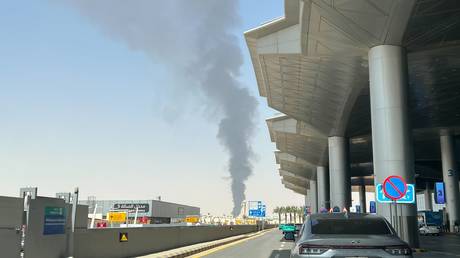
It was not a roar so much as a tear in the fabric of the morning, a sudden, heavy pressure that rattled the reinforced glass of the observation windows. Far above the runway, invisible against the blinding blue, a Patriot missile intercepted the night's second threat in as many days. A white blossom of smoke bloomed high in the stratosphere. Inside the terminal, passengers froze mid-stride, their gaze pulled upward, sharing that universal, fleeting realization that the ordinary world is separated from chaos by a very thin margin.
This was not an isolated flash of theater. It was the second consecutive day the skies above Riyadh had become a theater of war, echoing a Houthi strike that pierced the capital's perimeter just twenty-four hours prior.
To look at a map, Riyadh sits far from the jagged front lines of Yemen's protracted conflict. It is a metropolis of glass towers, sprawling highways, and quiet ambition—a city building its future on vision statements and mega-projects. Yet geography has a way of shrinking when technology advances. When modified ballistic missiles and long-range drones cross hundreds of kilometers of empty desert to target the heart of a G20 economy, the illusion of distance vanishes.
Consider what happens inside the air defense battery control rooms miles away from the terminal.
Operators sit in dim, hum-filled shelters, surrounded by flickering amber displays. They do not have the luxury of looking out the window. Their reality is reduced to vector lines, velocity calculations, and time-to-impact countdowns. A warning blips on a screen. Seconds tick down. A decision must be made that will either preserve the morning commute of thousands or rewrite the headlines of the global press. When the interceptor launches, the physical shockwave hits the control vehicle long before the sound reaches the city below. It is a visceral reminder that modern security is a high-stakes, invisible architecture, maintained by people whose names the public will never know.
The aftermath of such strikes follows a swift, practiced choreography. Within minutes, emergency services mobilize. Traffic is diverted. Social media flickers with shaky smartphone videos of smoke trails, followed quickly by official statements from the Arab Coalition detailing intercepted threats and falling debris.
Debris is a sanitized word for a terrifying reality. When a missile is destroyed at thirty thousand feet, its metal carcass does not simply vanish. It becomes shrapnel, raining down across residential districts and industrial zones. The danger is not merely the intent of the attacker, but the uncontrolled physics of the intercept. A shattered booster casing crashing through a roof or landing on an empty stretch of highway leaves behind a crater of anxiety that takes much longer to repair than asphalt.
For the international business community watching from London, New York, or Singapore, these consecutive strikes trigger a familiar calculus. Risk analysts recalculate insurance premiums for regional shipping and aviation. Investors pause to re-read regional security briefs. The economic diversification story—the grand narrative of transformation that defines modern Saudi Arabia—suddenly has to account for the persistent shadow of regional instability.
Yet, on the ground, the resilience of everyday life is striking.
An hour after the intercept above Riyadh, the airport terminal resumed its hum. Security lines reformed. Boarding passes were scanned. The barista wiped down the counter, and the next flight to Dubai pushed back from the gate. People adapt because they must. To live under the arc of modern conflict is to master the art of compartmentalization, tucking away the memory of a supersonic shockwave to focus on the next meeting, the next class, the next flight home.
The sky eventually cleared of smoke, leaving only the thin white trails of commercial jets heading east and west. But the silence that followed the interception was different from the silence that came before it. It was heavy with the knowledge that the horizon is vast, and the distance between peace and crisis is measured only in seconds.