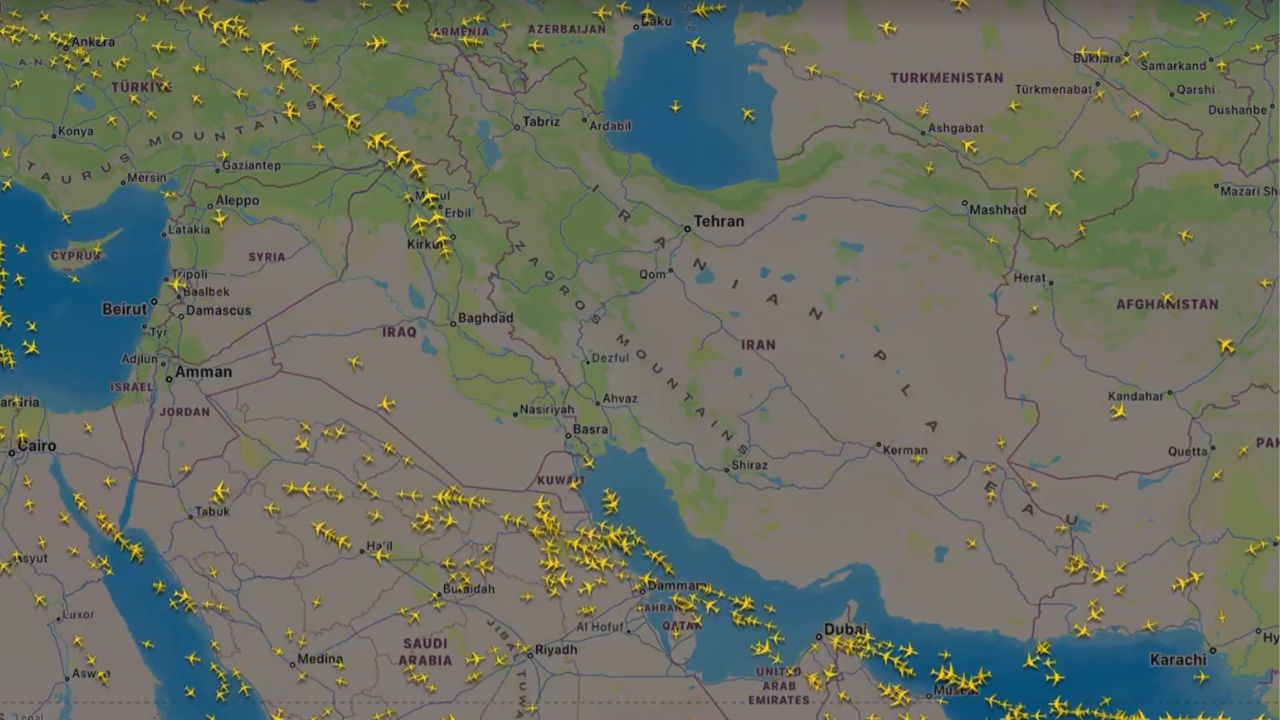
The blue glow of a smartphone screen is a harsh sun at three in the morning. For Elias, a software consultant sitting in a plastic chair at Frankfurt Airport, that glow carried the weight of a vanishing world. He wasn’t looking at a spreadsheet or a social media feed. He was watching a digital map of the Middle East, where small yellow icons representing passenger jets were performing a synchronized, frantic dance of avoidance.
One by one, the lines representing flight paths—the invisible threads that stitch our global civilization together—snapped.
A notification pinged. Lufthansa. Cancelled. Then another. Emirates. Delayed indefinitely. Then the screen went dark as the battery died, leaving Elias in the sudden, cavernous silence of a terminal that had just become a cul-de-sac.
When we read the headlines about airlines suspending service to Tehran, Tel Aviv, or Beirut following military strikes, we tend to view them through the lens of geopolitics. We talk about "regional stability," "strategic deterrence," and "insurance premiums." But for the person sitting on a suitcase in a transit lounge, geopolitics is a secondary concern. The primary reality is the sudden, jarring realization that the world is much larger, and much more fragmented, than the brochures led us to believe.
The Fragility of the Great Circle
Modern aviation is built on the illusion of the Great Circle. We assume that the shortest distance between two points is a straight line, and that this line is a public right-of-way. We have grown accustomed to the idea that a silver tube can hurtle through the stratosphere at 500 miles per hour, indifferent to the ancient animosities and fresh scars of the earth miles below.
But the sky has borders. They are invisible until the moment they become iron walls.
Following the recent exchange of strikes between Israel and Iran, the "Notices to Air Missions" (NOTAMs) began to flicker across dispatch screens like a fever chart. Airspace that was once a routine highway—the corridors over Iraq, the high-altitude transit zones of the Persian Gulf—became "hot." For an airline, "hot" means more than just physical danger. It means a cascading failure of logic, logistics, and liquidity.
Consider the cockpit of a long-haul flight from London to Singapore. When the news of a strike breaks, the pilots aren't just looking for explosions. They are calculating fuel. If the Iranian or Iraqi airspace closes, a flight must divert. It might have to swing south over Saudi Arabia or north over the edge of the Caspian Sea.
Every extra minute in the air burns hundreds of pounds of kerosene. Every diversion risks "timing out" a crew, meaning the pilots hit their legal limit of wakefulness and must land the plane in a city where the airline may have no ground staff, no hotels, and no easy way to get three hundred cranky passengers back into the sky.
The Invisible Toll on the Tarmac
Behind the corporate press releases from Air France-KLM or United Airlines lies a frantic, human scramble. There is a dispatcher in a windowless room in Chicago or Dubai who hasn't slept in twenty hours. They are playing a high-stakes game of 3D chess, trying to find a path for a Boeing 777 that avoids a missile's trajectory while staying within the narrow constraints of international law and fuel reserves.
Then there are the people.
Hypothetically, let’s look at Sarah. Sarah is a medical researcher who has saved for three years to bring her parents from Amman to New York for her wedding. In the dry language of a Reuters report, her flight is "suspended due to regional tensions." In Sarah's reality, her father is stuck in a terminal where the food is running out and the uncertainty is curdling into a quiet, desperate panic.
She isn't thinking about the tactical efficacy of a drone strike. She is thinking about the empty seat at the front of the chapel.
This is the hidden cost of a "suspended" route. It is the severance of human connection. We live in an era where we can see a person's face on a screen in real-time from across the globe, but if the planes stop flying, that person might as well be on the moon. The strikes didn't just hit military targets; they hit the connective tissue of the human family.
The Economics of Anxiety
When a major carrier like Lufthansa or Delta pulls out of a region, it isn't a snap decision. It is a cold, calculated move based on the soaring cost of risk. Insurance companies, the silent giants who dictate where the world’s commerce can actually go, begin to hike "war risk" premiums to astronomical levels.
For some airlines, the cost of insuring a single flight into a tense zone becomes higher than the revenue generated by the tickets.
But there is a deeper economic shadow. When the Middle East—a literal bridge between the East and the West—becomes a "no-fly" zone, the global supply chain winces. High-value electronics, time-sensitive pharmaceuticals, and specialized machinery all travel in the bellies of those same passenger planes. When the flights stop, the "just-in-time" economy grinds its gears.
The delay of a flight from Tehran isn't just a travel inconvenience. It might be the reason a factory in Germany stops its assembly line or a hospital in Mumbai runs out of a specific cardiac stent. We are all passengers on these flights, whether we have a ticket or not.
The Geometry of Fear
There is a specific kind of silence that descends on an airport when a region goes dark. It is different from the usual bustle of departures. It is heavy. It is the sound of people realizing that the "global village" is a fragile construct maintained by a very thin layer of trust and a very thick layer of kerosene.
The strike-and-counterstrike cycle between nations is often described as a chess match. If it is chess, then the airlines are the pawns, sacrificed early to protect the more powerful pieces. But these pawns carry souls. They carry dreams. They carry the simple, profound human desire to go somewhere else and then come home again.
The pilots often feel it most. They are the ones who have to look out the window and see the flashes on the horizon. They are the ones who have to tell a cabin full of sleeping people that the world has changed since they took off, and that they won't be landing where they expected. It is a heavy burden to hold the lives of hundreds in a space that has suddenly become a target.
The maps are redrawing themselves. Not with ink, but with fire and jet fuel.
As Elias sat in Frankfurt, eventually finding a corner of the terminal where a lonely outlet still provided power, he didn't check the news for military updates. He checked the status of a single tail number. He looked for a sign that a pilot, somewhere over the darkened desert, had found a way through the closing doors.
He waited for the yellow icon to move.
The tragedy of the modern world is that we have mastered the art of flying, but we are still struggling with the ancient art of standing on the same ground. We have built wings that can carry us over any mountain, yet we find ourselves grounded by a border drawn in the air.
Elias finally saw his flight status change from "Cancelled" to "Rescheduled via Cairo." It would take ten extra hours. It would cost a month's salary in new fees. He would miss the first day of his sister's graduation. But as he stood up, joints cracking, he realized he was one of the lucky ones. He still had a path, however jagged.
Somewhere, miles above the clouds, a pilot was banking a massive silver bird away from the darkness, searching for the narrow, flickering light of a safe harbor.